

If you’ve ever looked at Japanese text and felt completely lost, you’re not alone. Japanese looks intimidating at first — all those symbols, all those scripts. But here’s something that might surprise you: most Japanese beginners can start reading real Japanese within just a few weeks.
The secret? Hiragana.
It’s the first script every Japanese learner masters, and honestly, once it clicks, everything else starts making sense. This guide will walk you through exactly what hiragana is, why it exists, how it works, and how to write every character correctly from stroke one.
What is Hiragana, Exactly?
Hiragana (平仮名) is one of three writing systems used in the Japanese language. It’s a phonetic alphabet — meaning each character represents a sound, not a meaning. Think of it like the ABCs of Japanese, except instead of letters making individual sounds like “b” or “k,” hiragana characters represent full syllable sounds like “ka,” “mi,” or “su.”
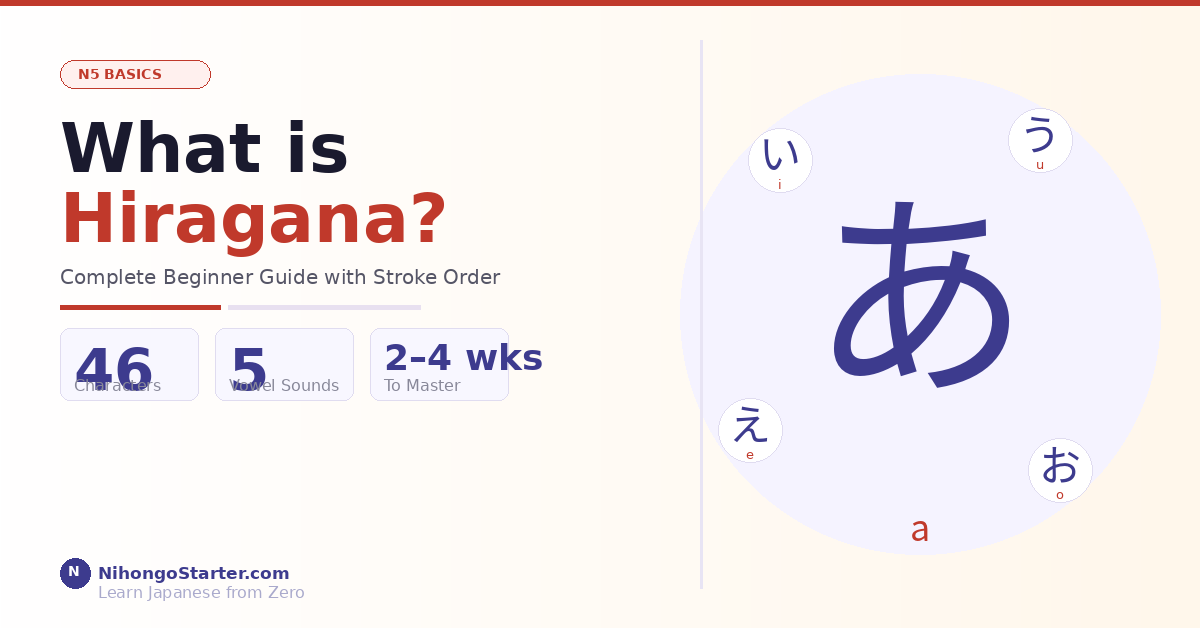
There are 46 basic hiragana characters in total. Every single sound in the Japanese language can be written using these 46 characters. That’s actually pretty manageable when you think about it — English has 26 letters and they make wildly inconsistent sounds. Hiragana is refreshingly logical by comparison.
Japanese children learn hiragana first, before kanji or katakana. That alone tells you how fundamental it is to the language.
The Three Japanese Writing Systems — Quick Overview
Before going deeper, it helps to understand where hiragana fits in the bigger picture:
- Hiragana — 46 characters, used for native Japanese words, grammar, and verb endings
- Katakana — 46 characters, used mainly for foreign loanwords (like “coffee” → コーヒー)
- Kanji — thousands of Chinese-origin characters with meaning and sound
Real Japanese text mixes all three. A single sentence might use all of them together. But hiragana is the glue that holds everything together — it appears in virtually every sentence.
Why Hiragana is the First Thing You Should Learn
A lot of beginners make the mistake of studying Japanese using romaji — that’s Japanese written in Roman letters, like “konnichiwa” instead of こんにちは. It feels easier at first, but it actually slows you down massively.
Here’s why learning hiragana first is the smarter move:
Learning hiragana rewires your brain to think in Japanese sounds rather than English approximations. The romaji version of Japanese sounds is never perfectly accurate anyway — it’s always a rough translation. Once you read hiragana directly, you hear the language correctly in your head.
Most Japanese learning resources — textbooks, apps, dictionaries — assume you know hiragana. If you skip it, you’ll hit a wall fast. According to the Japan Foundation, hiragana proficiency is the baseline expectation even at the very beginning of structured Japanese study.
The good news? Most learners master all 46 hiragana characters in two to four weeks with consistent practice. It’s one of the best investments of study time you’ll make.
The Complete Hiragana Chart — All 46 Characters
Hiragana is organized into a grid called the gojūon (五十音), which literally means “fifty sounds” — though the modern version has 46. The chart is organized by vowel sounds across the top and consonant groups down the side.
The Five Vowels — Learn These First
These are the foundation of everything:
| Character | Romaji | Sound |
|---|---|---|
| あ | a | Like “ah” in “father” |
| い | i | Like “ee” in “feet” |
| う | u | Like “oo” but shorter |
| え | e | Like “e” in “pet” |
| お | o | Like “o” in “open” |
Every other hiragana character is built around these five vowel sounds. “Ka” is k + a. “Mi” is m + i. Once you nail the vowels, the pattern clicks immediately.
The Main Hiragana Groups
K-row: か (ka) き (ki) く (ku) け (ke) こ (ko)
S-row: さ (sa) し (shi) す (su) せ (se) そ (so)
T-row: た (ta) ち (chi) つ (tsu) て (te) と (to)
N-row: な (na) に (ni) ぬ (nu) ね (ne) の (no)
H-row: は (ha) ひ (hi) ふ (fu) へ (he) ほ (ho)
M-row: ま (ma) み (mi) む (mu) め (me) も (mo)
Y-row: や (ya) ゆ (yu) よ (yo)
R-row: ら (ra) り (ri) る (ru) れ (re) ろ (ro)
W-row: わ (wa) を (wo)
Standalone: ん (n)
How to Write Hiragana — Stroke Order Basics
This is the part most online guides skip, and it matters more than people realize.
Stroke order isn’t just a tradition. It’s the reason handwritten hiragana looks natural and flows correctly. When you write characters in the wrong stroke order, they look stiff, unbalanced, and sometimes unreadable to native speakers. More importantly, correct stroke order builds muscle memory — making you faster and more accurate over time.
The Four Universal Stroke Order Rules
Before you practice individual characters, memorize these four rules. They apply to almost every hiragana character:
1. Top to bottom. When a character has strokes at different heights, always write the higher strokes first.
2. Left to right. When strokes are side by side, start from the left side and move right.
3. Horizontal before vertical. When a horizontal and vertical stroke cross, write the horizontal one first — with some exceptions in the H-row.
4. Finishing strokes last. Enclosing strokes or final sweeping lines almost always come at the end.
Stroke Order for the 5 Vowels
あ (a) — 3 strokes Start with a short horizontal line across the top. Then a curved line sweeping down and to the right. Finally, a loop that crosses the second stroke and curls left.
い (i) — 2 strokes A short diagonal stroke curving down-left. Then a longer curved stroke starting higher and sweeping down to a soft point. Simple and clean.
う (u) — 2 strokes A small horizontal tick at the top. Then a rounded U-shape dropping down from just below that tick.
え (e) — 4 strokes Horizontal line first. Then a vertical line crossing it. A curved arm going right. Finally a sweeping stroke through the middle going left.
お (o) — 3 strokes Horizontal line first. Then a vertical line crossing it downward. Finally a curved looping stroke that wraps around to the right.
Practice Tip That Actually Works
Don’t try to memorize all 46 at once. Group them into sets of five, practice writing each group ten times by hand on grid paper, then test yourself by covering the chart and writing from memory. Spaced repetition apps like Anki are excellent for drilling hiragana — the free deck “Japanese Core” includes all hiragana with audio.
Common Hiragana Mistakes Beginners Make
In my experience helping people start Japanese, these are the mistakes that slow progress the most:
Relying on romaji too long. The longer you use romaji as a crutch, the harder it becomes to switch. Set yourself a deadline — two weeks maximum — then go cold turkey on romaji.
Confusing similar-looking characters. The pairs さ/ち, わ/れ, and ぬ/め trip up almost every beginner. The fix is deliberate side-by-side comparison practice, not just general drilling.
Skipping stroke order. Writing characters in random stroke order feels fine at first, but it creates bad habits that become very hard to unlearn later. Get it right from day one.
Not using audio. Hiragana is a phonetic system — sound is everything. Always practice with audio so your eyes and ears learn together. NHK World’s free Japanese lessons include hiragana audio for every character.
FAQ
How long does it take to learn hiragana?
Most beginners learn all 46 hiragana characters in two to four weeks with daily practice of 15–20 minutes. Some dedicated learners do it in a week. The key is consistent daily review rather than long occasional study sessions.
Is hiragana the same as the Japanese alphabet?
Not exactly — hiragana is a syllabary, not an alphabet. Each character represents a full syllable sound (like “ka” or “mi”) rather than a single consonant or vowel sound like English letters. But for practical purposes, thinking of it as the Japanese phonetic alphabet is a helpful starting point.
Do I need to learn to write hiragana by hand, or is typing enough?
Both matter, but for different reasons. Typing is faster and more practical for everyday communication. Handwriting builds deeper memory and helps you recognize characters more reliably. If you’re studying for the JLPT N5 exam specifically, you won’t need to handwrite — but learning stroke order still builds stronger recognition skills.
What comes after hiragana?
After hiragana, most learners move straight to katakana — the second phonetic script, which has 46 matching sounds but different character shapes. After that, you start building your N5 kanji vocabulary (100 characters) and grammar patterns. Hiragana and katakana together are called kana.
Can I read Japanese with just hiragana?
Technically yes — anything written in kanji can be written in hiragana instead. Children’s books and beginner learning materials do exactly this. But real-world Japanese uses kanji heavily, so hiragana alone will only take you so far. Think of it as the essential foundation, not the whole building.
Conclusion
Hiragana is where every Japanese learning journey begins — and for good reason. It’s logical, learnable, and unlocks the door to everything else in the language. Once you can read those 46 characters smoothly, Japanese stops looking like random symbols and starts looking like a code you’re actually cracking.
Start with the five vowels. Learn in groups of five. Use audio every time. Practice stroke order from the beginning, not as an afterthought.
Your next step: print out a hiragana chart, pick up a pencil, and write your first five characters today. Not tomorrow. Today. The learners who make the fastest progress are always the ones who start before they feel ready.
Japanese is waiting — and hiragana is your key in.