

How to introduce yourself in Japanese — that’s the very first real-world skill every beginner needs. Before grammar rules. Before vocabulary lists. Before anything else.
Because the moment you meet a Japanese person, a classmate, or a teacher — that moment arrives fast. And if you’re not ready, it’s uncomfortable in a way that sticks with you.
I remember my first jikoshoukai (自己紹介) clearly. Early 2025, just weeks into studying Japanese, sitting in a room at ISL Dhaka with other learners. The teacher asked everyone to introduce themselves in Japanese. I froze. I had vocabulary. I had hiragana. But I had no idea how to string it into something that sounded right.
What I needed — and what nobody gave me — was a simple, honest template I could fill in with my own information and actually use. That’s exactly what this guide is. By the time you finish reading, you’ll have a complete jikoshoukai you can say out loud today. Not someday. Today.
Table of Contents
What Is Jikoshoukai (自己紹介)?
Jikoshoukai (じこしょうかい) means “self-introduction” in Japanese. Written in kanji: 自己紹介.
Breaking it down:
- 自 (じ / ji) — self
- 己 (こ / ko) — oneself
- 紹介 (しょうかい / shoukai) — introduction
In Japanese culture, self-introduction is not casual small talk. It’s a structured, respectful ritual that sets the tone for every interaction that follows. Whether you’re meeting classmates, joining a new company, or greeting someone at a language exchange — your jikoshoukai is your first impression. And first impressions matter deeply in Japan.
The good news for N5 beginners? There’s a standard format. Japanese self-introductions follow a predictable order every single time — which means you don’t need to improvise. You just need to know the structure and fill it in with your own details.
The 6-Part Jikoshoukai Structure Every N5 Beginner Needs
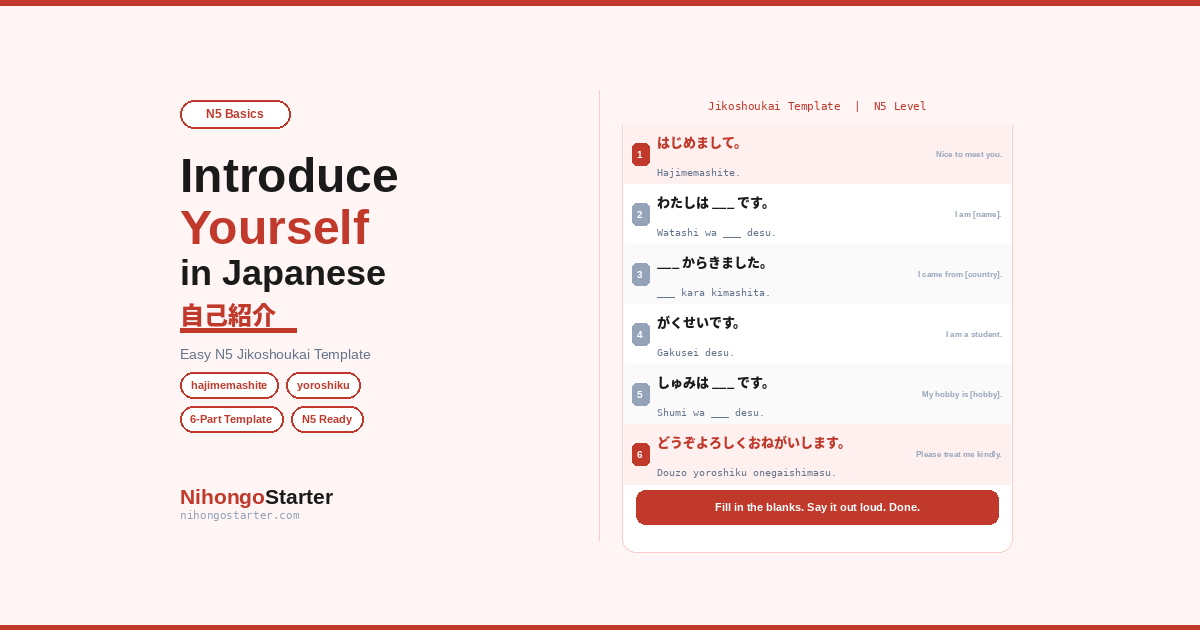
Every jikoshoukai — casual or formal — follows roughly this order:
- Greeting — はじめまして (Hajimemashite)
- Name — わたしは ___ です (Watashi wa ___ desu)
- Origin — ___ からきました (___ kara kimashita)
- Occupation or Role — がくせいです (Gakusei desu)
- Hobby or Interest — しゅみは ___ です (Shumi wa ___ desu)
- Closing — どうぞよろしくおねがいします (Douzo yoroshiku onegaishimasu)
Six parts. Every authentic Japanese self-introduction you’ll ever hear follows this skeleton. The words change. The structure doesn’t.
Part 1 — The Opening Greeting
はじめまして。
Hajimemashite.
(Nice to meet you. / How do you do.)
This is the only correct opening for a first-time introduction in Japanese. It specifically means “this is the first time we are meeting” — so you only ever say it once to the same person.
It’s the Japanese equivalent of “How do you do” — formal, respectful, and universally expected. Never skip it. Never replace it with こんにちは (Konnichiwa) in a first introduction. はじめまして is the correct choice every time.
Part 2 — Your Name
わたしは [なまえ] です。
Watashi wa [namae] desu.
(I am [name].)
Fill in your name where [なまえ] appears. If your name is foreign, write it in katakana — this is standard practice, not a simplification. Foreign names always appear in katakana in Japanese.
| Name | Katakana | Romaji |
|---|---|---|
| Sarah | サラ | Sara |
| Michael | マイケル | Maikeru |
| Sharif | シャリフ | Sharifu |
| Emma | エマ | Ema |
| David | デイビッド | Deibiddo |
A natural alternative that many learners prefer:
わたしの なまえは [なまえ] です。
Watashi no namae wa [namae] desu.
(My name is [name].)
Both are correct at N5 level. The first is slightly more natural in casual speech. The second is clearer for absolute beginners building their first sentences.
Part 3 — Where You’re From
[くに] からきました。
[Kuni] kara kimashita.
(I came from [country].)
The particle から (kara) means “from.” きました (kimashita) is the past tense of “to come.” Together — “came from.” Countries are written in katakana.
| Country | Katakana | Romaji |
|---|---|---|
| Bangladesh | バングラデシュ | Banguradeshu |
| America | アメリカ | Amerika |
| England | イギリス | Igirisu |
| Australia | オーストラリア | Oosutoraria |
| India | インド | Indo |
| Canada | カナダ | Kanada |
| Germany | ドイツ | Doitsu |
| France | フランス | Furansu |
You can also state your nationality directly by adding じん (jin — person) after the country name:
バングラデシュじんです。 Banguradeshu-jin desu. (I am Bangladeshi.)
Clean, simple, and completely natural at N5 level.
Part 4 — Your Occupation or Role
This tells people what you do. Keep it to one clean sentence at N5 level.
| Japanese | Romaji | English |
|---|---|---|
| がくせいです。 | Gakusei desu. | I am a student. |
| だいがくせいです。 | Daigakusei desu. | I am a university student. |
| かいしゃいんです。 | Kaishain desu. | I am a company employee. |
| せんせいです。 | Sensei desu. | I am a teacher. |
| にほんごを べんきょうしています。 | Nihongo wo benkyou shite imasu. | I am studying Japanese. |
That last phrase is perfect for anyone whose primary role right now is learning Japanese. It’s honest, relatable — and Japanese people genuinely appreciate hearing it.
Part 5 — Your Hobby or Interest
This is what makes your jikoshoukai feel human. A name and a country is data. A hobby is a conversation opener.
しゅみは [hobby] です。
Shumi wa [hobby] desu.
(My hobby is [hobby].)
Or alternatively:
[hobby] がすきです。
[Hobby] ga suki desu.
(I like [hobby].)
| Hobby | Japanese | Romaji |
|---|---|---|
| Anime | アニメ | Anime |
| Music | おんがく | Ongaku |
| Reading | どくしょ | Dokusho |
| Cooking | りょうり | Ryouri |
| Travel | りょこう | Ryokou |
| Movies | えいが | Eiga |
| Sports | スポーツ | Supootsu |
| Games | ゲーム | Geemu |
Add とても (totemo — very/really) before すき for extra warmth:
アニメが とてもすきです。 Anime ga totemo suki desu. (I really like anime.)
One of the most useful N5 adverbs you’ll ever use — and it instantly makes your introduction feel warmer and more genuine.
Part 6 — The Closing Phrase
どうぞよろしくおねがいします。
Douzo yoroshiku onegaishimasu.
(Please treat me kindly. / I look forward to knowing you.)
This phrase has no perfect English translation — because nothing in English carries the same cultural weight. It’s humble, warm, and signals that you’re placing yourself in the other person’s care. It closes every jikoshoukai, every time, without exception.
Never skip this. Ending your self-introduction without よろしくおねがいします is like hanging up the phone mid-conversation — the other person is left waiting for something that never comes.
Formality levels for reference:
| Version | Japanese | Use When |
|---|---|---|
| Very casual | よろしく | Close friends only |
| Standard polite | よろしくおねがいします | Most everyday situations |
| Full formal | どうぞよろしくおねがいします | First meetings — always use this at N5 |
At N5 level — always use the full どうぞよろしくおねがいします. You can relax it later as your Japanese improves.
The Complete Jikoshoukai Template — Fill It In Now
Your ready-to-use template. Replace every blank with your own information.
はじめまして。 Hajimemashite. Nice to meet you.
わたしは [あなたのなまえ] です。 Watashi wa [your name] desu. I am [your name].
[あなたのくに] からきました。 [Your country] kara kimashita. I came from [your country].
[がくせい / にほんごをべんきょうしています] 。 [Gakusei / Nihongo wo benkyou shite imasu.] I am a [student / studying Japanese].
しゅみは [hobby] です。 Shumi wa [hobby] desu. My hobby is [hobby].
どうぞよろしくおねがいします。 Douzo yoroshiku onegaishimasu. Please treat me kindly.
Real Example — Completed Template
はじめまして。 Hajimemashite. Nice to meet you.
わたしは シャリフです。 Watashi wa Sharifu desu. I am Sharif.
バングラデシュから きました。 Banguradeshu kara kimashita. I came from Bangladesh.
にほんごを べんきょうしています。 Nihongo wo benkyou shite imasu. I am studying Japanese.
しゅみは アニメです。 Shumi wa anime desu. My hobby is anime.
どうぞよろしくおねがいします。 Douzo yoroshiku onegaishimasu. Please treat me kindly.
Six sentences. Thirty seconds. Complete, natural, culturally correct.
Casual vs Formal Jikoshoukai — Know the Difference
The template above works for most situations a beginner will face. But even at N5 level, you should know that Japanese has two registers — casual and formal.
| Element | Casual / N5 Level | Formal / Business |
|---|---|---|
| Greeting | はじめまして | はじめまして (same) |
| Name | ___ です | ___ ともうします |
| Origin | ___ からきました | ___ からまいりました |
| Closing | よろしく | どうぞよろしくおねがいします |
The humble forms — ともうします (to moushimasu) and からまいりました (kara mairimashita) — appear in business and interview settings. You don’t need to master them yet. But knowing they exist means you won’t be caught off guard when you hear them.
3 Cultural Rules That Make Your Jikoshoukai Authentic
Knowing the words is step one. Understanding the culture behind them is what separates a jikoshoukai that feels genuine from one that sounds like a textbook recitation.
Rule 1 — Bow After Your Final Phrase After delivering your final どうぞよろしくおねがいします, bow. A slight forward nod works for casual settings. A proper 15–30 degree bow for formal ones. The bow happens after your final word — not during it. Finish the phrase completely, then bow.
Rule 2 — Speak Slowly and Clearly Japanese people will appreciate your effort regardless of your level. But they appreciate it more when they can actually understand you. Speak at 70% of your normal speed. Pause between sentences. Pronunciation matters more than speed at this stage.
Rule 3 — Stay Humble A jikoshoukai is not the place to list achievements. Keep it simple, factual, and warm. One hobby. One occupation. One origin. According to The Japan Foundation, humility and warmth in first introductions are among the most valued social qualities in Japanese communication culture. Let the conversation that follows reveal more about you naturally.
Practice Method — Say It Out Loud 3 Times
Reading a jikoshoukai template is not the same as being able to say it smoothly in a real conversation.
The single best thing you can do right now: read your completed template out loud — three times in a row.
- First time: slowly, checking each phrase
- Second time: at normal speaking pace
- Third time: without looking at the page
If you stumble on the third read — that’s exactly where your practice needs to focus. Circle the phrase that tripped you up. Say it ten times alone. Then rebuild the full introduction from the top.
This is the exact method I used when preparing for my PJC Bridge N5 exam in June 2025 — drilling individual phrases until they felt automatic, then rebuilding the full introduction from scratch. It’s not glamorous. But it’s what works.
For pronunciation reference, NHK World’s free Japanese lessons include audio for every basic jikoshoukai phrase. Use it to check your pronunciation of はじめまして and どうぞよろしくおねがいします especially — both are commonly mispronounced by beginners.
FAQ
How do you say “how to introduce yourself in Japanese”?
Self-introduction in Japanese is called jikoshoukai (自己紹介 — じこしょうかい). The standard opening phrase is はじめまして (Hajimemashite — Nice to meet you), followed by your name using わたしは ___ です (Watashi wa ___ desu — I am ___). Every jikoshoukai closes with どうぞよろしくおねがいします (Douzo yoroshiku onegaishimasu — Please treat me kindly). These three phrases form the minimum skeleton of any Japanese self-introduction.
What does jikoshoukai mean in Japanese?
Jikoshoukai (自己紹介) means “self-introduction.” The word breaks down into 自 (ji — self), 己 (ko — oneself), and 紹介 (shoukai — introduction). It refers to the structured, culturally specific way Japanese speakers introduce themselves when meeting someone for the first time — following a standard order of greeting, name, origin, occupation, hobby, and closing phrase.
How long should a jikoshoukai be for N5 level?
At N5 level, a jikoshoukai should be five to seven sentences and take approximately 30–45 seconds to deliver. Short and clear always beats long and uncertain. Cover your greeting, name, origin, one occupation phrase, one hobby, and the closing — then stop. Quality of pronunciation and natural delivery matters far more than length at this stage.
Is it rude to forget よろしくおねがいします at the end?
In casual settings among fellow beginners, forgetting it once isn’t catastrophic. In any real Japanese social situation — language class, meeting Japanese speakers, formal introductions — omitting よろしくおねがいします is noticeably incomplete. Japanese listeners genuinely expect it at the end of every introduction. Always include it.
How do I write my foreign name in Japanese for a jikoshoukai?
Foreign names are written in katakana — this is standard and correct, not a simplification. Match each syllable of your name to its closest katakana equivalent. Sarah becomes サラ (Sa-ra), Michael becomes マイケル (Ma-i-ke-ru). When delivering your jikoshoukai verbally, simply say your name clearly and slowly — Japanese speakers are experienced at hearing foreign names and will appreciate the effort.
Your Jikoshoukai Is Ready — Now Say It Out Loud
Learning how to introduce yourself in Japanese doesn’t require months of study. It requires one good template, a few minutes of practice, and the confidence to open your mouth.
You have the template. You have the vocabulary. You have the cultural context that most guides skip entirely. The only thing left is to say it — even if it feels awkward, even if your pronunciation isn’t perfect yet, even if you need to peek at your notes the first few times.
Every Japanese speaker you’ll ever meet started exactly where you are right now. The difference between beginners who progress and those who stall is one thing: one group speaks. The other waits until they feel ready.
You’re already ready. Fill in the template. Say it out loud three times. Go introduce yourself.
Once your jikoshoukai is solid, the next step is understanding the grammar that powers every sentence inside it — read our guide on Japanese sentence structure for beginners to see exactly how SOV word order and particles make your introduction work.
どうぞよろしくおねがいします。