
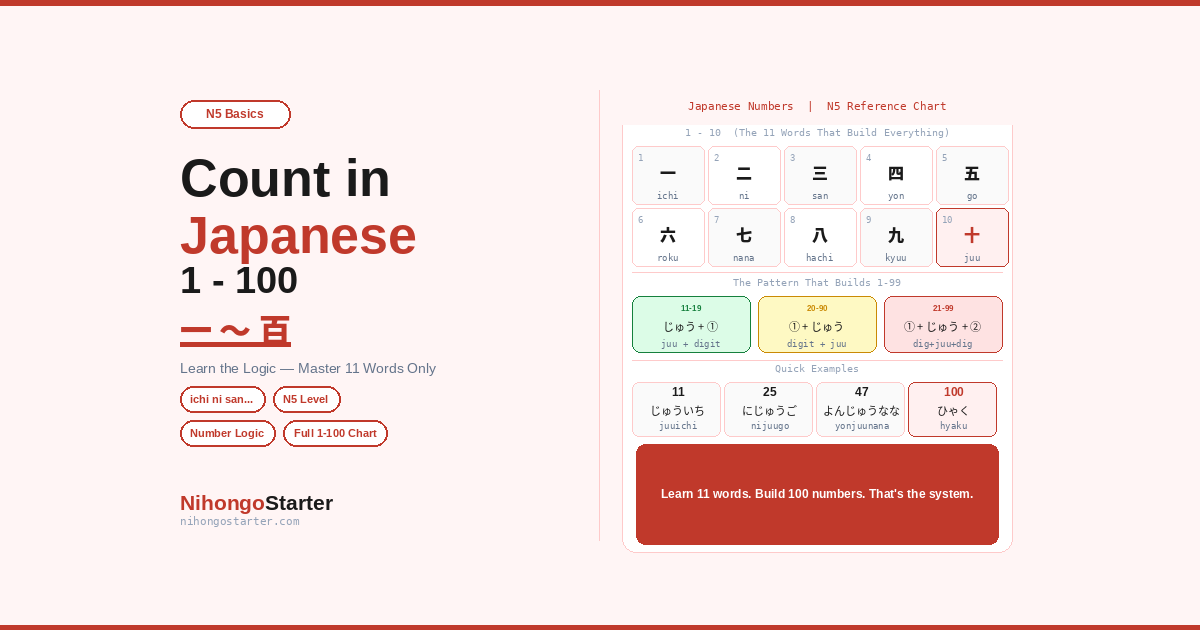

How to count in Japanese 1-100 is one of those things that looks intimidating from the outside — and then clicks in about ten minutes once someone shows you the logic.
That’s the key word. Logic.
When I was preparing for my N5 exam in 2025, Japanese numbers were one of the first things I tackled. I expected a hundred words to memorize. What I found instead was a beautifully simple mathematical pattern — one where knowing just eleven words lets you build every number from 1 all the way to 99. And then one more word takes you to 100.
That’s it. Eleven words. Infinite combinations.
This guide teaches you exactly that system — with a full reference chart, pronunciation tips, the tricky exceptions that trip up every beginner, and real-world examples so you can use numbers immediately.
Table of Contents
Why Japanese Numbers Are Actually Easier Than English
Before we dive in — let me reframe something that most guides get backwards.
English numbers are actually more complicated than Japanese. Think about it:
- Eleven. Twelve. Thirteen. Fourteen — wait, why isn’t it “oneteen, twoteen”?
- Twenty, thirty, forty — why does “four” become “for” in “forty”?
- Irregular. Unpredictable. You just have to memorize each one.
Japanese has none of that chaos. The system is pure, clean mathematics.
Once you learn 1 through 10, you don’t memorize 11, 12, or 13. You build them. Eleven is literally “ten-one.” Twenty is “two-ten.” Thirty-seven is “three-ten-seven.” The pattern never breaks. Not once, all the way to 100.
This isn’t me being optimistic. This is just how Japanese numbers work. And once that logic clicks — you’ll wonder why English does it the complicated way.
Step 1 — Master the Foundation: Numbers 1 to 10
These are the only numbers you truly need to memorize. Everything from 11 to 99 is built from this list.
| Number | Kanji | Hiragana | Romaji | Pronunciation Guide |
|---|---|---|---|---|
| 1 | 一 | いち | ichi | ee-chee |
| 2 | 二 | に | ni | nee |
| 3 | 三 | さん | san | sahn |
| 4 | 四 | し / よん | shi / yon | shee / yohn |
| 5 | 五 | ご | go | goh |
| 6 | 六 | ろく | roku | roh-koo |
| 7 | 七 | しち / なな | shichi / nana | shee-chee / nah-nah |
| 8 | 八 | はち | hachi | hah-chee |
| 9 | 九 | きゅう / く | kyuu / ku | kyoo / koo |
| 10 | 十 | じゅう | juu | joo |
The Two-Reading Rule — 4, 7, and 9
You’ll notice that 4, 7, and 9 each have two readings. This confuses nearly every beginner. Here’s the simple rule:
4 — yon vs shi Use yon in almost all everyday situations. Shi sounds like 死 (death) in Japanese — which makes it feel unlucky in many contexts. When counting, use yon. You’ll hear shi in some specific compound words.
7 — nana vs shichi Use nana as your default. It’s clearer, more common in everyday speech, and avoids confusion with hachi (8) which shichi can sound similar to when spoken quickly.
9 — kyuu vs ku Use kyuu as your default for general counting. Ku sounds like 苦 (suffering), so yon and kyuu are the safer, more modern choices. You’ll hear ku in specific contexts like time-telling (くじ — 9 o’clock).
The easy memory rule: yon, nana, kyuu — these three are your safe defaults for everyday counting.
Step 2 — Numbers 11 to 19: The “Ten-Plus” Pattern
Here’s where the magic starts. Watch what happens:
| Number | Kanji | Hiragana | Romaji | The Logic |
|---|---|---|---|---|
| 11 | 十一 | じゅういち | juuichi | 10 + 1 |
| 12 | 十二 | じゅうに | juuni | 10 + 2 |
| 13 | 十三 | じゅうさん | juusan | 10 + 3 |
| 14 | 十四 | じゅうよん | juuyon | 10 + 4 |
| 15 | 十五 | じゅうご | juugo | 10 + 5 |
| 16 | 十六 | じゅうろく | juuroku | 10 + 6 |
| 17 | 十七 | じゅうなな | juunana | 10 + 7 |
| 18 | 十八 | じゅうはち | juuhachi | 10 + 8 |
| 19 | 十九 | じゅうきゅう | juukyuu | 10 + 9 |
Every single one follows the same formula: じゅう (10) + the single digit.
You’re not memorizing 11, 12, 13. You’re calculating them. That’s a fundamentally different — and much faster — way to learn.
Say them out loud: juuichi, juuni, juusan, juushi, juugo… Feel the rhythm? It’s consistent every time.
Step 3 — The Tens: 20, 30, 40… to 90
Now flip the formula. Instead of 10 + digit, you do digit × 10:
| Number | Kanji | Hiragana | Romaji | The Logic |
|---|---|---|---|---|
| 20 | 二十 | にじゅう | nijuu | 2 × 10 |
| 30 | 三十 | さんじゅう | sanjuu | 3 × 10 |
| 40 | 四十 | よんじゅう | yonjuu | 4 × 10 |
| 50 | 五十 | ごじゅう | gojuu | 5 × 10 |
| 60 | 六十 | ろくじゅう | rokujuu | 6 × 10 |
| 70 | 七十 | ななじゅう | nanajuu | 7 × 10 |
| 80 | 八十 | はちじゅう | hachijuu | 8 × 10 |
| 90 | 九十 | きゅうじゅう | kyuujuu | 9 × 10 |
Still no new words. Still using the same ten you already memorized. Just in a different order.
Compare this to English: twenty, thirty, forty — three completely different words with no obvious connection to two, three, four. Japanese? にじゅう, さんじゅう, よんじゅう. The pattern is transparent every single time.
Step 4 — Any Number from 21 to 99
Now combine both patterns: tens + singles.
| Number | Kanji | Hiragana | Romaji | The Logic |
|---|---|---|---|---|
| 21 | 二十一 | にじゅういち | nijuuichi | 2×10 + 1 |
| 35 | 三十五 | さんじゅうご | sanjuugo | 3×10 + 5 |
| 47 | 四十七 | よんじゅうなな | yonjuunana | 4×10 + 7 |
| 58 | 五十八 | ごじゅうはち | gojuuhachi | 5×10 + 8 |
| 63 | 六十三 | ろくじゅうさん | rokujuusan | 6×10 + 3 |
| 72 | 七十二 | ななじゅうに | nanajuuni | 7×10 + 2 |
| 84 | 八十四 | はちじゅうよん | hachijuuyon | 8×10 + 4 |
| 99 | 九十九 | きゅうじゅうきゅう | kyuujuukyuu | 9×10 + 9 |
Pick any number between 21 and 99. You can build it right now using the pattern. No additional vocabulary needed.
Test yourself: what is 56 in Japanese? Five-ten-six. ごじゅうろく (gojuuroku). What about 83? Eight-ten-three. はちじゅうさん (hachijuusan).
That’s the system working. Once it’s in your head — it never leaves.
Step 5 — The Magic Word: 100
百 (ひゃく / hyaku)
That’s the one new word you need for 100. Just one.
| Number | Kanji | Hiragana | Romaji |
|---|---|---|---|
| 100 | 百 | ひゃく | hyaku |
Notice something important: 100 in Japanese is just ひゃく — not いちひゃく (one-hundred). You don’t say “one” before hyaku when it’s exactly 100. The word stands alone. This is one of the small but important rules that catches beginners — so note it now and you won’t stumble later.
The Complete Japanese Number Chart 1-100
Here is your full reference. Every number from 1 to 100 — built from the same eleven words.
1–10
| 1 いち | 2 に | 3 さん | 4 よん | 5 ご |
|---|---|---|---|---|
| 6 ろく | 7 なな | 8 はち | 9 きゅう | 10 じゅう |
11–20
| 11 じゅういち | 12 じゅうに | 13 じゅうさん | 14 じゅうよん | 15 じゅうご |
|---|---|---|---|---|
| 16 じゅうろく | 17 じゅうなな | 18 じゅうはち | 19 じゅうきゅう | 20 にじゅう |
21–30
| 21 にじゅういち | 22 にじゅうに | 23 にじゅうさん | 24 にじゅうよん | 25 にじゅうご |
|---|---|---|---|---|
| 26 にじゅうろく | 27 にじゅうなな | 28 にじゅうはち | 29 にじゅうきゅう | 30 さんじゅう |
31–50
| 31 さんじゅういち | 32 さんじゅうに | 33 さんじゅうさん | 40 よんじゅう | 41 よんじゅういち |
|---|---|---|---|---|
| 42 よんじゅうに | 45 よんじゅうご | 48 よんじゅうはち | 49 よんじゅうきゅう | 50 ごじゅう |
51–100
| 51 ごじゅういち | 60 ろくじゅう | 61 ろくじゅういち | 70 ななじゅう | 71 ななじゅういち |
|---|---|---|---|---|
| 80 はちじゅう | 81 はちじゅういち | 90 きゅうじゅう | 91 きゅうじゅういち | 100 ひゃく |
Real-World Uses — Where You’ll Need These Numbers Today
Learning numbers in isolation is useful. But knowing exactly where you’ll use them makes them stick faster.
Telling Your Age
なんさいですか。 (Nan-sai desu ka?) — How old are you?
わたしは [number] さいです。 Watashi wa [number]-sai desu. I am [number] years old.
Examples:
- わたしは にじゅうさん さいです。(Watashi wa nijuusan-sai desu.) — I am 23 years old.
- わたしは さんじゅう さいです。(Watashi wa sanjuu-sai desu.) — I am 30 years old.
Talking About Prices
Japanese currency is yen (円 / えん / en). Prices are straightforward — just say the number followed by えん.
- ごじゅうえん (gojuu en) — 50 yen
- ひゃくえん (hyaku en) — 100 yen
- さんびゃくえん (sanbyaku en) — 300 yen
Giving Your Phone Number
Phone numbers in Japanese are read digit by digit, separated by の (no) between groups.
Example: 090-1234-5678 → ゼロきゅうゼロ の いちにさんよん の ごろくななはち
Answering “How Many?”
いくつですか。 (Ikutsu desu ka?) — How many?
[number] つ です。 (Hitotsu, futatsu…) — for small counts using native Japanese numbers.
Or simply: [number] です。 for most N5 situations.
The 3 Mistakes Every Beginner Makes With Japanese Numbers
I made all three of these when I started. Know them now and skip the frustration.
Mistake 1 — Saying “ichi-hyaku” for 100
100 in Japanese is just ひゃく (hyaku) — not いちひゃく (ichi-hyaku). You never put いち (one) in front of hyaku for exactly 100. Same rule applies to 1,000 (せん / sen) — not いちせん. It’s one of the most common beginner errors, and native speakers will gently correct you every time.
Mistake 2 — Always Using Shi and Shichi
Defaulting to し (shi) for 4 and しち (shichi) for 7 is understandable — you see them in textbooks. But in everyday speech, よん (yon) and なな (nana) sound more natural and avoid the unlucky connotations of shi (death) and the ambiguity of shichi. Make yon and nana your automatic defaults from day one.
Mistake 3 — Trying to Memorize Instead of Calculate
This is the biggest one. If you try to memorize じゅういち, じゅうに, じゅうさん as three separate vocabulary items — you’ll struggle. If you understand that all of them are just じゅう + the digit — you’ll never forget them. The moment the mathematical logic clicks, Japanese numbers stop being vocabulary and start being arithmetic. That’s a much easier game.
How to Practice Japanese Numbers Daily
Knowing the system is step one. Making it automatic is step two. Here’s the daily practice method that actually works:
Morning — Count out loud while doing something routine. Count your steps walking to the bathroom. Count objects in the room. Count in Japanese while making coffee. Attach the numbers to a physical activity and they become automatic faster.
Anytime — Read prices in Japanese. Every time you see a price — on a menu, on a shopping app, anywhere — say the number in Japanese under your breath. にじゅうごドル (nijuugo doru — $25). ごじゅうえん (gojuu en — ¥50). Real context beats flashcards every time.
Evening — Reverse drill. Write five random numbers between 1 and 100. Say each one in Japanese without thinking. Circle any that required effort. Practice those five the next morning.
Anki is also excellent for number drilling — create a simple deck with Arabic numerals on the front and Japanese readings on the back. Five minutes a day is all you need.
FAQ
How do you count in Japanese from 1 to 10?
The ten base numbers in Japanese are: いち (1), に (2), さん (3), よん (4), ご (5), ろく (6), なな (7), はち (8), きゅう (9), じゅう (10). These are the Sino-Japanese readings used for standard counting. Once you know these ten words, you can build every number from 11 to 99 using simple addition and multiplication — no additional vocabulary needed.
What is the easiest way to remember Japanese numbers 1-100?
The easiest method is to understand the mathematical logic rather than memorizing individual numbers. Learn 1–10 by heart. Then recognize that 11–19 are simply じゅう (10) plus the single digit — juuichi, juuni, juusan. And 20–90 are the single digit multiplied by じゅう — nijuu, sanjuu, yonjuu. Once you internalize this pattern, you can calculate any number rather than recall it from memory.
Why do some Japanese numbers have two readings?
Numbers 4, 7, and 9 each have two readings because Japanese has both Sino-Japanese (Chinese-derived) and native Japanese number systems. Four can be し (shi) or よん (yon), seven can be しち (shichi) or なな (nana), and nine can be く (ku) or きゅう (kyuu). In everyday counting, よん, なな, and きゅう are preferred because し sounds like 死 (death) and く sounds like 苦 (suffering) — making the alternative readings more comfortable in daily use.
How do you say 100 in Japanese?
One hundred in Japanese is ひゃく (hyaku). Importantly, you do not say いちひゃく (ichi-hyaku) — you simply say ひゃく alone for exactly 100. This is different from how numbers like 200 (にひゃく / nihyaku) or 300 (さんびゃく / sanbyaku) work, where you do put the digit before hyaku. This exception applies only to exactly 100 and is one of the most common beginner mistakes.
Are Japanese numbers used differently for counting objects?
Yes — and this is a topic for when you’re comfortable with basic counting. Japanese uses counter words (助数詞 / josūshi) that change depending on what you’re counting. People use 人 (nin), small animals use 匹 (hiki), flat objects use 枚 (mai), and so on. At N5 level, you’ll encounter the most common counters — but for now, mastering the number system itself is the priority. Counters build naturally on top of the number foundation you’re building today.
Start Counting — Your Japanese Number Foundation Starts Now
How to count in Japanese 1-100 comes down to one insight: it’s not vocabulary — it’s arithmetic.
Learn eleven words. Apply the pattern. Build any number from 1 to 100 on demand.
That’s the whole system. No tricks. No shortcuts needed. The language itself is already the shortcut.
Start with 1 to 10. Say them out loud right now — ichi, ni, san, yon, go, roku, nana, hachi, kyuu, juu. Then build 11. Then 20. Then try 47. Then 93.
The moment you successfully calculate a number you never consciously memorized — that’s when it clicks. And once it clicks, it stays.
Now that you have numbers down, your next step is putting them into real sentences. Head to our guide on Japanese sentence structure for beginners to see exactly how numbers fit into N5 grammar — or revisit how to introduce yourself in Japanese where your age becomes the first number you’ll use out loud.
いち、に、さん — go count something.