

How long to learn JLPT N5 is the question every beginner asks within their first week of studying Japanese.
And most answers they find online are frustratingly vague — “it depends,” “a few months,” “just study every day.” None of that actually helps you plan.
So let me give you real numbers.
I passed the PJC Bridge N5 equivalent exam in June 2025 — just a few months after starting Japanese from absolute zero in Dhaka. The following month, I sat the N4 equivalent and passed that too. What made the difference wasn’t talent. It was having a clear picture of what N5 actually requires, how many hours it realistically takes, and a daily schedule that didn’t burn me out.
That’s exactly what this guide gives you. Real data, three honest timelines, and a practical plan you can start today.
Table of Contents
What Is JLPT N5 — And What Does It Actually Test?
Before talking about study time, let’s be clear about what you’re preparing for.
The JLPT (Japanese Language Proficiency Test) is the world’s most widely recognized Japanese language certification. It’s administered by the Japan Foundation and Japan Educational Exchanges and Services, offered twice a year — in July and December — at test centers across more than 90 countries.
N5 is the entry level. According to the official JLPT guidelines, N5 measures “the ability to understand some basic Japanese” — meaning you can read hiragana and katakana, understand simple sentences, and follow basic everyday conversations.
Here’s exactly what N5 tests:
| Area | Requirement |
|---|---|
| Hiragana | All 46 characters — reading and recognition |
| Katakana | All 46 characters — reading and recognition |
| Kanji | Approximately 100 basic kanji |
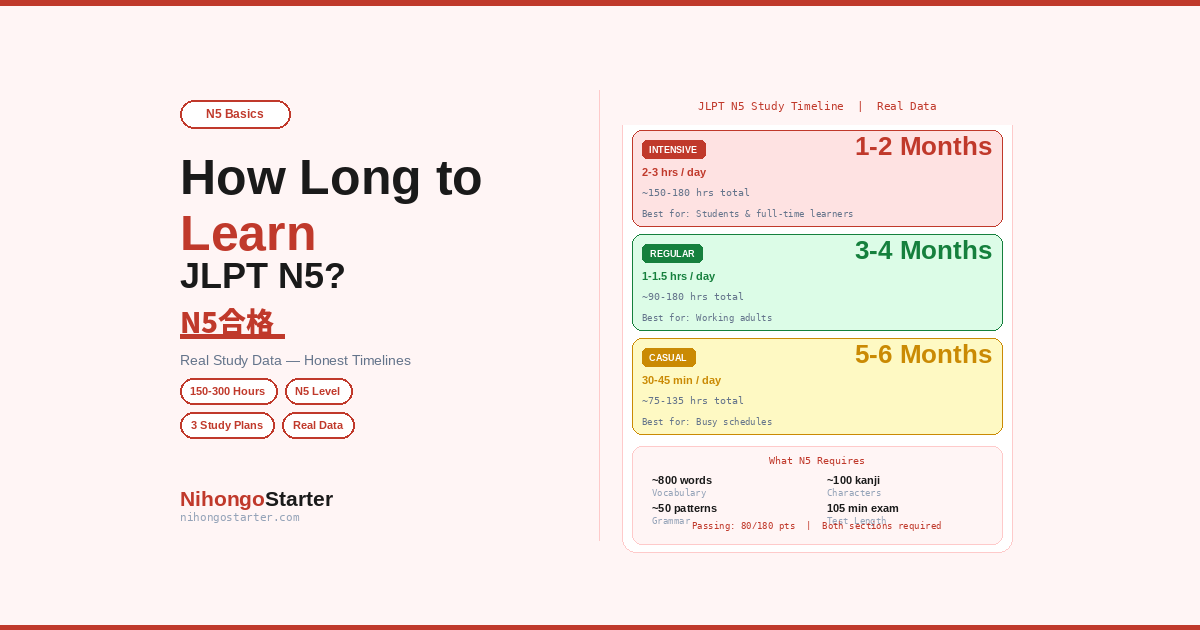
| Vocabulary | Approximately 800 words |
| Grammar | Approximately 50 core N5 grammar patterns |
| Listening | Simple conversations and announcements |
The passing score: 80 out of 180 total points — with a minimum of 19 points required in each scoring section. You need to pass both sections (Language Knowledge/Reading AND Listening) independently. A high total score doesn’t save you if one section falls below the minimum.
The honest truth about N5: It is genuinely beginner-level. You are not expected to hold a conversation or read a newspaper. You need to understand basic Japanese — and with a structured plan, that is completely achievable from zero.
The Real Study Hour Data — What Research Actually Shows
This is the number everyone wants — and the answer varies more than most guides admit. Here’s what the actual data says:
Official JLEC estimate (Japanese Language Education Center): 150–300 hours for learners without prior kanji knowledge. For learners with kanji background (Chinese speakers, for example), the range drops to 100–200 hours.
JapanesePod101 data: Over 70% of first-time N5 test-takers pass with approximately 100 hours of focused preparation — though this assumes some prior exposure to Japanese.
Coto Academy research: 350–500 total hours to pass N5 for complete beginners — a higher estimate that factors in building the full foundation from scratch, not just exam prep.
The realistic consensus for absolute beginners: 150–300 focused study hours to be genuinely N5-ready — not just exam-ready, but actually understanding basic Japanese.
Here’s why the range is wide: the 100-hour estimates often assume the learner already knows hiragana and katakana. If you’re starting from zero — which most NihongoStarter readers are — add 20–40 hours to master both scripts before your N5 content study even begins.
The 3 Honest Timelines — Pick Yours
Stop trying to find one universal answer. Your timeline depends entirely on how much time you can realistically commit per day. Here are the three real scenarios:
⚡ Timeline 1 — Intensive (1–2 Months)
Daily commitment: 2–3 hours per day Total hours: 120–180 hours Who this is for: Students, people between jobs, or anyone who can dedicate serious daily time
This is the fast-track path. Two to three hours of focused daily study — not casual scrolling through Japanese apps, but genuine active study: writing, reading, listening, reviewing. At this pace, most motivated beginners can reach N5-ready in 6–8 weeks.
The risk with this timeline: burnout. Two hours of language study every single day is mentally demanding. Build in at least one lighter day per week, and use spaced repetition tools like Anki to maximize retention efficiency so you’re not grinding through brute-force repetition.
📅 Timeline 2 — Regular (3–4 Months)
Daily commitment: 1–1.5 hours per day Total hours: 90–180 hours Who this is for: Working adults, students with other commitments — anyone who can consistently carve out an hour daily
This is the sweet spot for most learners. One consistent hour per day is manageable enough to sustain for months without burning out — and consistent daily exposure is actually more effective for language retention than sporadic long sessions.
Research from the Journal of Experimental Psychology shows that spaced, distributed practice outperforms massed practice for long-term retention. In plain English: one hour every day beats seven hours on Sunday. Your brain consolidates language during sleep — daily exposure works with that biology.
At this pace, most beginners reach N5-ready in three to four months.
🌿 Timeline 3 — Casual (5–6 Months)
Daily commitment: 30–45 minutes per day Total hours: 75–135 hours Who this is for: Busy people, parents, professionals with limited daily time — anyone who can only grab short study windows
This is longer but still very achievable. Thirty focused minutes daily — no distractions, active engagement — is genuinely enough to reach N5 level in five to six months.
The key word is focused. Thirty minutes of active flashcard drilling, grammar practice, and reading beats two hours of passively watching Japanese YouTube with subtitles. Quality of study time matters at least as much as quantity.
What Exactly to Study — Week by Week
Knowing the timeline is step one. Knowing what to actually study during those hours is step two. Here’s the honest N5 roadmap broken into clear phases:
Phase 1 — Scripts (Weeks 1–3)
Goal: Read hiragana and katakana fluently without hesitation
Start here. Nothing else. Not vocabulary. Not grammar. Scripts first.
Hiragana takes most absolute beginners one to two weeks of daily practice to read without hesitation. Katakana takes slightly longer for many learners because the characters look more similar to each other. Plan three weeks total — two for hiragana, one for katakana.
Without solid script reading, everything else in N5 study becomes dramatically harder. Don’t rush this phase.
Resources for this phase:
- NihongoStarter’s hiragana reading practice guide
- NihongoStarter’s difference between hiragana and katakana
Phase 2 — Core Vocabulary and Kanji (Weeks 4–8)
Goal: Build toward 800 N5 vocabulary words and 100 N5 kanji
This is the longest and most demanding phase. Don’t try to learn all 800 words from a list — that’s memorization, not learning. Instead:
- Learn 15–20 new vocabulary words per day using Anki or a similar spaced repetition system
- Study 2–3 new kanji daily — with their readings and a real vocabulary example, not just the character in isolation
- After 30 days, you’ll have roughly 450–600 words and 60–90 kanji — well over halfway
The N5 kanji include the most fundamental characters you’ll ever encounter: 日, 月, 人, 大, 小, 上, 下, 山, 川, 火, 水, 木, 金, 土. Many of these you already know from the days of the week guide — which is exactly why building vocabulary in connected themes accelerates retention.
Phase 3 — Grammar Patterns (Weeks 6–10, overlapping with Phase 2)
Goal: Understand and use approximately 50 core N5 grammar patterns
Start grammar study around week six — once you have enough vocabulary to make grammar practice meaningful. The N5 grammar patterns include:
- Basic sentence structure (は、が、を、に、で particles)
- Verb conjugation — present, past, negative forms
- です/ます polite forms
- Basic adjective forms (い-adjectives and な-adjectives)
- Simple question formation with か
- Common sentence endings and connectors
The best free resource for N5 grammar is JLPT Sensei’s grammar list — organized by level with clear explanations and example sentences. Genki I covers the same ground in textbook format if you prefer structured learning.
Phase 4 — Listening Practice (Weeks 8–12)
Goal: Understand simple Japanese conversations and announcements under exam conditions
Listening is worth 25% of the N5 exam — and it’s the section most beginners underestimate. The listening section features:
- Simple two-person conversations
- Short announcements
- Questions about pictures and situations
Start listening practice before you feel ready. Exposure to natural speech speeds up your overall comprehension in ways that reading study alone cannot. NHK World’s free Japanese lessons include native audio at an appropriate pace for N5 learners.
Phase 5 — Mock Tests (Final 2–3 Weeks)
Goal: Get comfortable with exam format, timing, and pressure
Take at least two full practice tests under timed conditions. This is non-negotiable. Knowing the material and performing under exam conditions are two different skills.
The official JLPT website has free sample questions. Work through them in full exam conditions — no pausing, no looking things up. Review every wrong answer carefully. Wrong answers are your most valuable study data.
The Honest Factors That Change Your Timeline
The timelines above are averages. These factors will make your journey faster or slower — and knowing them helps you calibrate expectations honestly:
Factors that speed you up:
- You already know Chinese characters (kanji familiarity cuts N5 time dramatically)
- You’ve been watching anime or consuming Japanese media casually
- You’ve studied another East Asian language before
- You have a structured daily study routine
Factors that slow you down:
- You’re starting from complete zero with no Japanese exposure
- Your study sessions are irregular — some days three hours, many days zero
- You’re studying passively (listening while doing other things) rather than actively
- You skip listening practice and focus only on reading and vocabulary
The factor that matters most of all: Consistency. Every piece of research on language learning agrees on this. A learner who studies 45 minutes every single day will outperform a learner who studies three hours on weekends. The daily exposure is what your brain needs to build lasting neural pathways — not occasional intensity.
My Personal N5 Timeline — What Actually Happened
I started Japanese in early 2025 with zero prior knowledge. No anime background. No Chinese characters. No previous Asian language experience. Complete zero.
Here is what my actual timeline looked like:
- Weeks 1–2: Hiragana — drilled daily until automatic recognition
- Weeks 3–4: Katakana — harder than hiragana but clicked by end of week 4
- Weeks 5–8: Core vocabulary and basic kanji — 15 new words daily using Anki
- Weeks 9–12: Grammar patterns — worked through N5 patterns systematically
- Weeks 13–14: Full mock tests, listening focus, weak area review
- Week 15: Sat PJC Bridge N5 equivalent exam at ISL Dhaka — passed with 60/100 (C+ level)
Total active study time: approximately 180–200 hours over roughly 15 weeks. Daily commitment: 1.5 to 2 hours, with one lighter day per week.
The single most valuable thing I did was treat every study session as active — writing, speaking out loud, building real sentences — rather than passively reading through notes. Passive study feels productive but builds much slower retention than active engagement.
The 5 Signs You’re Actually N5-Ready
Study hours are a guide — not a guarantee. Here’s how to know you’re genuinely ready to sit the exam:
- You read hiragana and katakana without hesitation — not slowly sounding out each character, but reading fluidly at a natural pace
- You score consistently above 100/180 on full mock tests — the passing score is 80, but aiming for 100+ gives you a genuine safety margin
- You understand the gist of simple Japanese conversations — you can follow along even when you don’t catch every word
- You can use 30+ N5 grammar patterns in original sentences — not just recognizing them, but producing them
- You pass each section of mock tests independently — both Language Knowledge/Reading AND Listening above the minimum threshold
If you tick all five — register for the exam. Don’t wait for perfect confidence. N5 is designed to be passed by genuine beginners, and exam experience itself is valuable regardless of the result.
FAQ
How long does it take to learn JLPT N5 from scratch?
Most complete beginners need 150–300 hours of focused study to pass JLPT N5. In real time, that translates to roughly 1–2 months with intensive daily study (2–3 hours/day), 3–4 months at a regular pace (1–1.5 hours/day), or 5–6 months at a casual pace (30–45 minutes/day). The biggest variables are your consistency, prior exposure to Japanese or Chinese characters, and whether your study method is active or passive.
Is JLPT N5 hard for absolute beginners?
N5 is genuinely designed for beginners — it’s the easiest of five JLPT levels. That said, starting from zero means you need to master two phonetic scripts (hiragana and katakana), learn approximately 800 vocabulary words, 100 kanji, and 50 grammar patterns. None of these are impossible individually, but covering all of them simultaneously requires consistent daily commitment. Most motivated beginners who study every day find N5 very achievable within a few months.
How many hours a day should I study for JLPT N5?
One to two hours of focused daily study is the sweet spot for most learners targeting N5. Less than 30 minutes per day produces very slow progress. More than three hours per day risks burnout without proportionally better results. Consistency matters more than session length — one steady hour every day will outperform irregular cramming sessions of three or four hours.
Can I pass JLPT N5 in one month?
It’s possible but demanding. To pass N5 in one month from scratch, you’d need to commit three or more hours of active study every single day — covering scripts, vocabulary, grammar, and listening simultaneously. Most people find this pace unsustainable. Six to eight weeks of two-hour daily sessions is a more realistic fast-track timeline that still allows the material to consolidate properly.
What is the best study method for JLPT N5?
The most effective N5 study method combines daily spaced repetition (using Anki or a similar tool) for vocabulary and kanji, active grammar practice with real sentence building, and consistent listening exposure. Learning hiragana and katakana completely before starting N5 content study is essential — trying to learn scripts and exam content simultaneously slows both down. Mock tests in the final weeks under real exam conditions are non-negotiable for building exam performance, not just knowledge.
Start Today — Your Timeline Begins Now
How long to learn JLPT N5 is a question with a real answer: 150–300 hours, spread over 1–6 months depending on your daily commitment.
That’s not vague. That’s a number you can plan around.
Choose the timeline that fits your life. Commit to it daily. Start with hiragana if you haven’t already — everything else in N5 builds from there.
The learners who pass N5 aren’t the ones who waited until they felt ready. They’re the ones who started, stayed consistent, and showed up every day even when progress felt slow.
Your timeline starts the moment you open your study materials today — not someday, today.
Once you’ve nailed the scripts and started building your vocabulary foundation, dive into our guide on Japanese sentence structure for beginners to start building real N5-level sentences — and review how to introduce yourself in Japanese to put your first vocabulary into real speaking practice immediately.
いちにちいっぽ。 (Ichinichi ippo.) — One step every day.