
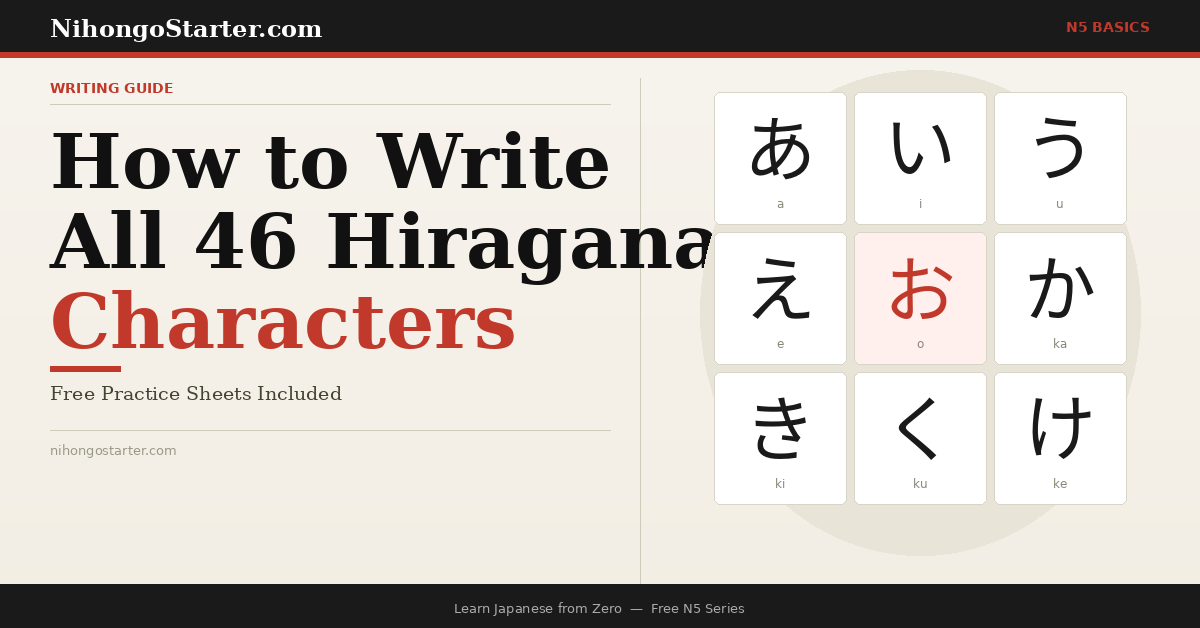

Most people think learning to write Japanese takes years. Honestly? The first script — hiragana — is something you can fully master in two to four weeks. I’ve seen complete beginners go from zero to reading hiragana smoothly in under a month, simply by following the right order and practicing consistently.
The problem is most guides dump all 46 characters on you at once with zero strategy. That’s like handing someone a 1,000-piece puzzle with no picture on the box. No wonder people quit.
This guide is different. We’ll go through every single hiragana character in logical groups, show you the correct stroke order for each, and give you a clear system to practice — including free printable sheets you can use today.
The Four Golden Rules of Hiragana Stroke Order
Before we jump into the characters, let’s settle something most beginners skip entirely — stroke order.
It’s tempting to think “as long as the character looks right, who cares what order I draw the strokes?” But stroke order isn’t just tradition. It’s the reason hiragana looks natural and flows properly when written by hand. Writing characters in the wrong order creates stiff, unbalanced shapes that look immediately off to native readers.
More practically, correct stroke order builds muscle memory. Once your hand knows the pattern, writing becomes automatic — fast and consistent without thinking. Get it right from day one.
These four rules apply to almost every hiragana character. Learn them once and they’ll guide you through the entire chart:
- Top to bottom — higher strokes always come first
- Left to right — when strokes are side by side, start from the left
- Horizontal before vertical — when lines cross, write the horizontal one first
- Sweeping or enclosing strokes last — finishing curves and loops always come at the end
Step-by-Step Hiragana Stroke Guide
Group 1 — The 5 Vowels (Start Here Every Time)
These are the five most important characters in hiragana. Every other character is built around these vowel sounds. Master these before moving on to anything else.
- あ (a) — 3 strokes Stroke 1: short horizontal line across the top. Stroke 2: curved line sweeping down and to the right from near the center. Stroke 3: a loop that crosses the second stroke and curls left. Keep it rounded and open.
- い (i) — 2 strokes Stroke 1: short diagonal stroke curving down-left. Stroke 2: longer curved stroke starting higher, sweeping down to a gentle point. Clean, simple, and fast.
- う (u) — 2 strokes Stroke 1: small tick at the top. Stroke 2: a narrow U-shape dropping straight down below it. Think of a deep cup, not a shallow bowl.
- え (e) — 2 strokes Stroke 1: a short horizontal dash at the top. Stroke 2: one continuous sweeping zig-zag stroke that goes right, curves back left through the center, then sweeps down and finishes with a slight upward flick. Do not break this into multiple strokes — it flows as one movement.
- お (o) — 3 strokes Stroke 1: horizontal line across the top. Stroke 2: vertical line that drops down and curves into a loop at the bottom — this stroke combines the vertical drop AND the loop as one continuous movement. Stroke 3: a small dash on the upper right side of the character. Most beginners forget this third stroke entirely — don’t skip it.
Practice tip: Write each vowel 20 times before moving on. Two short sessions per day beats one long session every time.
Group 2 — The K-Row (か き く け こ)
- か (ka) — 3 strokes Stroke 1: horizontal line. Stroke 2: vertical stroke crossing through it downward. Stroke 3: curved arm sweeping right from near the crossing point.
- き (ki) — 4 strokes Stroke 1: top horizontal line. Stroke 2: second horizontal line below it. Stroke 3: vertical stroke crossing both lines. Stroke 4: curved stroke sweeping right and down from the bottom crossing point.
- く (ku) — 1 stroke One clean angular line — goes slightly right then turns sharply down-left. One of the easiest characters in the entire chart.
- け (ke) — 3 strokes Stroke 1: vertical line on the left. Stroke 2: horizontal line crossing through it. Stroke 3: curved stroke sweeping right and down from the crossing point.
- こ (ko) — 2 strokes Stroke 1: top horizontal line. Stroke 2: bottom horizontal line below it with a slight curve. Don’t space them too far apart.
Group 3 — The S-Row (さ し す せ そ)
- さ (sa) — 3 strokes Stroke 1: horizontal line. Stroke 2: vertical stroke crossing through it. Stroke 3: curved stroke that sweeps right and loops back left — crossing near the TOP of the character. Watch out: beginners confuse さ with ち. The loop on さ crosses near the top. The loop on ち crosses in the middle.
- し (shi) — 1 stroke One smooth stroke — a vertical line curving gently to the right at the bottom like a fishhook. One of the most satisfying characters to write once you get the flow.
- す (su) — 2 strokes Stroke 1: a cross shape — horizontal line over vertical. Stroke 2: a large loop swinging out right, curving under, and ending with a small hook back left.
- せ (se) — 3 strokes Stroke 1: horizontal line. Stroke 2: vertical line crossing downward through it. Stroke 3: short horizontal stroke at the bottom right with a slight upward flick at the end.
- そ (so) — 1 stroke One continuous flowing stroke — curves right, doubles back left, then sweeps down and right in a wide arc. Go slowly the first ten times. Speed comes naturally after the flow is locked in.
Group 4 — The T-Row (た ち つ て と)
- た (ta) — 4 strokes Similar structure to さ but with an added vertical stroke. Stroke 1: horizontal. Stroke 2: vertical crossing it. Stroke 3: short diagonal. Stroke 4: the curved loop crossing near the top right.
- ち (chi) — 2 strokes Often confused with さ. Stroke 1: horizontal line sweeping right with a slight curve. Stroke 2: a large curved loop starting from above and crossing through the middle — rounder and lower than さ.
- つ (tsu) — 1 stroke One left-to-right sweeping curve ending with a sharp downward hook on the right side. Think of a wave crashing right.
- て (te) — 1 stroke One flowing stroke — a horizontal line that curves down and to the right, looping back left at the bottom. Smooth and continuous.
- と (to) — 2 strokes Stroke 1: short vertical line. Stroke 2: a curved stroke that sweeps from the middle of the first stroke, arches right, and hooks back left at the bottom.
Group 5 — The N-Row (な に ぬ ね の)
- な (na) — 4 strokes Stroke 1: horizontal. Stroke 2: vertical crossing it. Stroke 3: left-curving stroke. Stroke 4: a wide looping stroke that crosses and wraps around to the right. One of the more complex characters — give it extra practice.
- に (ni) — 3 strokes Stroke 1: short horizontal line. Stroke 2: another horizontal line below. Stroke 3: vertical line connecting and extending below the second horizontal.
- ぬ (nu) — 2 strokes Often confused with め. Stroke 1: a short curved stroke on the left. Stroke 2: a large looping stroke that sweeps right, curves under, and loops back — more angular than め. Write ぬ and め side by side until your eye spots the difference instantly.
- ね (ne) — 2 strokes Stroke 1: vertical line on the left. Stroke 2: a stroke that crosses through, curves right, and loops back with a sweeping tail. Similar to れ — the key difference is ね has a longer sweeping tail that curls outward.
- の (no) — 1 stroke One circular stroke that starts at the top, sweeps clockwise, and exits with a curling tail to the right. One of the most recognizable characters — beginners always remember の.
Group 6 — H, M, Y, R, W Rows and ん
H-Row highlights:
- は (ha) — 3 strokes — vertical line, horizontal crossing it, curved arm sweeping right and down
- ふ (fu) — 4 strokes — the most complex character in the H-row; four separate strokes building top to bottom; take it slow
- へ (he) — 1 stroke — a simple mountain-shaped arc; identical to the katakana へ
M-Row highlights:
- ま (ma) — 3 strokes — horizontal, vertical crossing it, sweeping loop at the bottom
- み (mi) — 2 strokes — left curved stroke, then a larger hook-and-loop stroke on the right
- も (mo) — 3 strokes — two horizontal lines, then a large downward sweeping stroke with a loop
Y-Row (only 3 characters):
- や (ya) — 3 strokes — one of the larger characters; sweeping strokes building left to right
- ゆ (yu) — 2 strokes — a squared left stroke, then a large U-loop on the right
- よ (yo) — 2 strokes — short horizontal line, then a larger F-shaped stroke below it
R-Row highlights:
- ら (ra) — 2 strokes — horizontal stroke, then a hooked vertical loop below
- れ (re) — 2 strokes — vertical left stroke, then a crossing stroke that loops and sweeps right; similar to ね but the tail sweeps inward not outward
- ろ (ro) — 1 stroke — similar to る but without the closing loop at the bottom
W-Row and standalone:
- わ (wa) — 2 strokes — often confused with れ; the second stroke on わ is a simple downward curve, not a full loop
- を (wo) — 3 strokes — used almost exclusively as a grammar particle; worth memorizing separately
- ん (n) — 1 stroke — curves right, loops slightly upward, then sweeps down-left; deceptively simple but takes a few tries to get the proportions right
Modified Characters — Dakuten and Combinations
Once you know the 46 basic characters, you unlock two more layers instantly:
- Dakuten (゛) — two small dashes on the upper right transform a character into its voiced version. か (ka) becomes が (ga). さ (sa) becomes ざ (za). た (ta) becomes だ (da). You don’t learn new characters — you just add two small marks.
- Handakuten (゜) — a small circle added to H-row characters creates P sounds. は (ha) becomes ぱ (pa). ひ (hi) becomes ぴ (pi).
- Combination characters — small versions of や, ゆ, よ combine with I-row characters to create blended sounds like きゃ (kya), しゅ (shu), ちょ (cho). Write the small character noticeably smaller and slightly lower than the main character.
These aren’t extra characters to memorize from scratch — they’re your existing 46 with tiny additions. Most learners pick these up in a day or two once the main chart is solid.
Your 21-Day Practice Plan
This is the exact schedule I’d give any beginner starting from zero. It’s built around spaced repetition — the most proven memory technique in language learning, backed by research , the creator of the spaced repetition algorithm.
| Days | Focus | Daily Practice |
|---|---|---|
| 1–3 | 5 vowels only | Write each 20 times, 2 sessions |
| 4–7 | K-row + S-row | Review vowels first, then new group |
| 8–12 | T-row + N-row + H-row | Quiz yourself without looking at chart |
| 13–17 | M, Y, R, W rows + ん | Full chart review daily |
| 18–21 | Random mixed drills | Someone calls romaji, you write kana |
For printable practice sheets, Tofugu’s free hiragana PDF is the best available — it includes grid sheets for every character with stroke order guides printed directly on the sheet. JapanesePod101 also offers free downloadable kana worksheets for registered users.
For digital drilling, Anki with the free Japanese Hiragana deck is unbeatable — spend 10 minutes a day on recognition and your reading speed will surprise you by week three.
FAQ
How many times should I practice writing each hiragana character?
Most learners retain characters solidly after writing each one 20–30 times spread across multiple sessions. The key is spacing — writing the same character 30 times in one sitting is far less effective than writing it 10 times across three separate days. Your brain consolidates memory during sleep, not during the study session itself.
Should I learn hiragana in order or by frequency?
The traditional order (vowels → K-row → S-row etc.) works well because each row follows a consistent sound pattern. Some learners prefer starting with the most frequently appearing characters. Either approach works — consistency matters far more than sequence.
What paper should I use for hiragana practice?
Genkouyoushi paper — traditional Japanese grid paper with equal squares — is ideal. Each character gets its own box, which trains correct proportions from the start. You can print free genkouyoushi sheets from Incompetech by searching for square grid paper.
How do I know when I have truly mastered hiragana?
You have mastered hiragana when recognition is instant and automatic — you read a hiragana text at normal speed without sounding out individual characters. For writing, mastery means producing any character cleanly from memory without checking a chart. Most learners reach this point between weeks three and six with consistent daily practice.
Is learning to write hiragana by hand still worth it when I can just type?
Yes — and the science backs this up. Research published in Frontiers in Psychology consistently shows that handwriting activates significantly more areas of the brain than typing, creating stronger and more durable memory traces. Even if you never handwrite Japanese again after learning, the process of writing by hand will make you faster at reading and better at retention. Think of it as a memory investment.
Conclusion
All 46 hiragana characters are fully learnable in three to four weeks with the right system. The difference between learners who master it quickly and those who struggle for months comes down to one thing — correct practice from day one. Right stroke order, logical groupings, spaced repetition, and daily consistency.
Start with the five vowels right now. Write あ twenty times. Then い. Then う. That’s your first session done in under ten minutes.
Every Japanese sentence you’ll ever read starts with these 46 characters. Master them and the entire language opens up in front of you.