
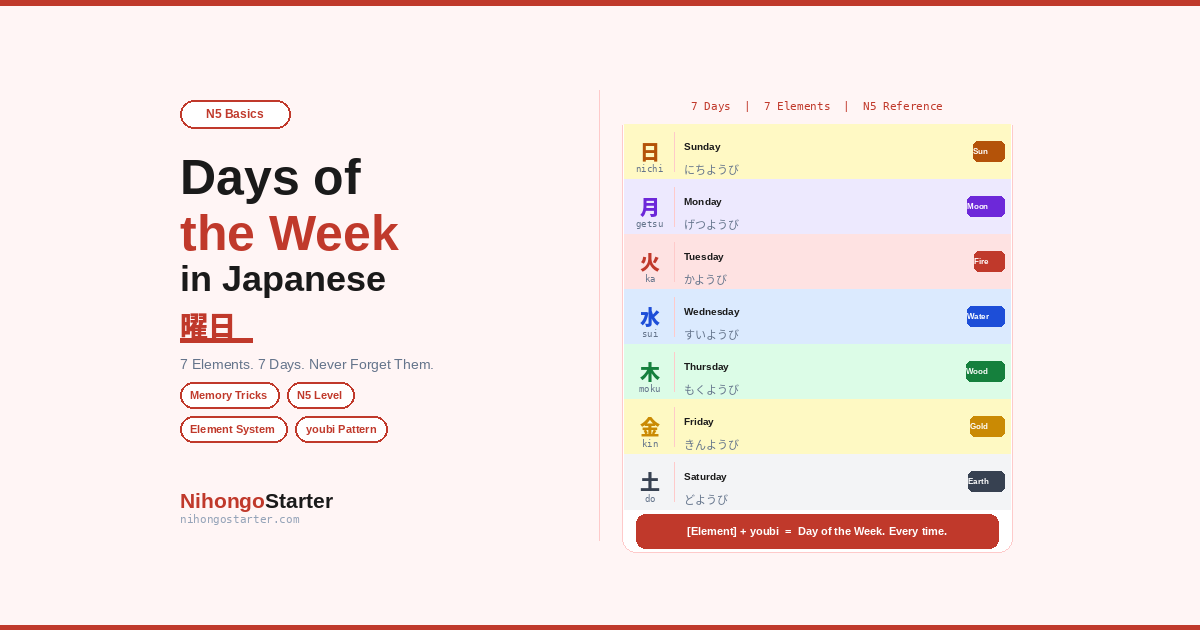

The days of the week in Japanese look intimidating at first glance. Seven long words, each ending in ようび (youbi), with kanji you’ve never seen before.
But here’s the thing most guides don’t tell you upfront — every single Japanese day of the week is built from a natural element. Sun. Moon. Fire. Water. Wood. Gold. Earth.
That’s it. Seven elements. Seven days. One system.
When I was preparing for my N5 exam in 2025, this was the single fact that made the days of the week click for me instantly. Not flashcards. Not rote repetition. Just understanding the logic hiding inside the words — and suddenly all seven days became impossible to forget.
This guide will give you that same insight, plus the memory tricks that lock each day in permanently.
Table of Contents
The One Thing Every Japanese Day Has in Common
Before the memory tricks, let’s understand the structure — because once you see it, everything else becomes obvious.
Every Japanese day of the week follows this exact pattern:
[Element] + 曜日 (ようび / youbi)
曜日 (youbi) simply means “day of the week.” It’s the same suffix on every single day — never changes. So the only thing you actually need to learn for each day is the element that comes first.
That transforms memorizing seven long words into learning seven single kanji — each one representing something from nature you already understand.
Sun. Moon. Fire. Water. Wood. Gold. Earth.
Here’s where it gets even more interesting. These aren’t random choices. They come from an ancient system of five classical elements used across East Asian astronomy and philosophy — combined with the sun and moon. The same system influenced the naming of days in many languages worldwide. Japanese just made it beautifully transparent by writing it directly into the words.
All 7 Days — With Their Elements and Memory Tricks
Let’s go through each day one by one. For every day you’ll get the full word, the kanji breakdown, the element meaning, and a memory trick that makes it stick permanently.
日曜日 (にちようび / Nichiyoubi) — Sunday
Element: 日 (にち / nichi) — Sun
| Kanji | Hiragana | Romaji | Meaning |
|---|---|---|---|
| 日曜日 | にちようび | Nichiyoubi | Sun + Day of the Week |
The kanji 日 literally means “sun” and “day.” This is the easiest day to remember — because Sunday in Japanese is literally Sun-day, exactly like English.
Memory trick: The kanji 日 looks like a window frame with a horizontal bar across the middle — picture yourself looking through that window at a bright Sunday sunrise. Sun. Window. Sunday. Done.
Bonus: 日 is one of the most common kanji you’ll ever see. It appears in 日本 (にほん / Nihon — Japan, literally “origin of the sun”), 今日 (きょう / kyou — today), and 毎日 (まいにち / mainichi — every day). Learning Sunday teaches you one of the most useful kanji in the entire language.
月曜日 (げつようび / Getsuyoubi) — Monday
Element: 月 (げつ / getsu) — Moon
| Kanji | Hiragana | Romaji | Meaning |
|---|---|---|---|
| 月曜日 | げつようび | Getsuyoubi | Moon + Day of the Week |
Monday in Japanese is Moon-day — which is exactly where the English word “Monday” comes from too. Monday = Moon’s Day in Old English. Japanese and English share the same ancient astronomical origin here, just expressed differently.
Memory trick: Picture the sun setting on Sunday evening — and the moon rising to take its place. Sunday → Monday. Sun → Moon. The visual transition makes the order automatic.
Bonus: 月 also means “month” in Japanese — so you’ll see it constantly in dates and calendar expressions. 一月 (いちがつ / ichigatsu — January), 先月 (せんげつ / sengetsu — last month). One kanji, enormous usefulness.
火曜日 (かようび / Kayoubi) — Tuesday
Element: 火 (か / ka) — Fire
| Kanji | Hiragana | Romaji | Meaning |
|---|---|---|---|
| 火曜日 | かようび | Kayoubi | Fire + Day of the Week |
Tuesday’s element is fire — and it connects to Mars, which ancient Japanese astronomers called 火星 (かせい / kasei — “Fire Star”) because of its red color.
Memory trick: The kanji 火 actually looks like a flame if you squint — a central vertical stroke with two strokes spreading outward like fire dancing sideways. Look at it and see a campfire. Tuesday = Fire day = the day things heat up at the start of the work week.
Alternative trick: “KA” sounds like “car” — imagine your car catching fire on a Tuesday morning. Dramatic, but memorable.
水曜日 (すいようび / Suiyoubi) — Wednesday
Element: 水 (すい / sui) — Water
| Kanji | Hiragana | Romaji | Meaning |
|---|---|---|---|
| 水曜日 | すいようび | Suiyoubi | Water + Day of the Week |
Wednesday’s element is water — connecting to Mercury, which was called 水星 (すいせい / suisei — “Water Star”) in ancient Japanese astronomy.
Memory trick: Fire burns on Tuesday → water puts it out on Wednesday. The two days tell a mini story: fire, then water. If you remember Tuesday = fire, Wednesday = water comes naturally as the response.
Alternative trick: “SUI” sounds like “sweaty” — Wednesday is hump day, the middle of the week when you’re working hard and breaking a sweat. Water Wednesday. Sweaty midweek. Either way, water sticks.
木曜日 (もくようび / Mokuyoubi) — Thursday
Element: 木 (もく / moku) — Wood / Tree
| Kanji | Hiragana | Romaji | Meaning |
|---|---|---|---|
| 木曜日 | もくようび | Mokuyoubi | Wood + Day of the Week |
Thursday’s element is wood or tree — connecting to Jupiter, called 木星 (もくせい / mokusei — “Wood Star”). Jupiter was associated with growth, prosperity, and nature in classical East Asian thought.
Memory trick: The kanji 木 literally looks like a tree — a vertical trunk with a horizontal branch and roots spreading at the bottom. Look at it and see a tree. Thursday = Tree day. The kanji draws itself for you.
Alternative trick: “MOKU” sounds like “mock” — imagine a tree mockingly blocking your path on Thursday, one day before the weekend. You’re so close to Friday and a tree is in the way.
金曜日 (きんようび / Kin’youbi) — Friday
Element: 金 (きん / kin) — Gold / Metal
| Kanji | Hiragana | Romaji | Meaning |
|---|---|---|---|
| 金曜日 | きんようび | Kin’youbi | Gold + Day of the Week |
Friday’s element is gold — connecting to Venus, called 金星 (きんせい / kinsei — “Gold Star”). Venus shines with a bright golden glow in the night sky, making the connection feel perfectly natural.
Memory trick: Friday = Gold day. And gold feels like Friday, doesn’t it? The end of the work week, payday for many people, the feeling of something precious finally arriving. 金 (kin) also means “money” in Japanese — 金曜日 is literally the day of gold and money. No wonder everyone loves Friday.
Bonus: 金 appears constantly in Japanese — お金 (おかね / okane — money), 金色 (きんいろ / kin’iro — golden color). Friday teaches you the kanji for money.
土曜日 (どようび / Doyoubi) — Saturday
Element: 土 (ど / do) — Earth / Soil
| Kanji | Hiragana | Romaji | Meaning |
|---|---|---|---|
| 土曜日 | どようび | Doyoubi | Earth + Day of the Week |
Saturday’s element is earth or soil — connecting to Saturn, called 土星 (どせい / dosei — “Earth Star”). The kanji 土 represents the ground, soil, and all things earthly.
Memory trick: Saturday = Earth day = the day you’re grounded. No work. You’re home. Feet on the earth. Relaxed. The kanji 土 looks like a cross with a flat base — picture a gravestone (dark, but unforgettable) or a plus sign planted in the ground.
Alternative trick: “DO” sounds like “dough” — on Saturday you finally have time to bake bread, which comes from earth (grain, soil). Saturday is dough day. Earth day. Same thing.
The Complete Reference Table
| Day | Kanji | Hiragana | Romaji | Element | Planet |
|---|---|---|---|---|---|
| Sunday | 日曜日 | にちようび | Nichiyoubi | Sun 日 | Sun |
| Monday | 月曜日 | げつようび | Getsuyoubi | Moon 月 | Moon |
| Tuesday | 火曜日 | かようび | Kayoubi | Fire 火 | Mars |
| Wednesday | 水曜日 | すいようび | Suiyoubi | Water 水 | Mercury |
| Thursday | 木曜日 | もくようび | Mokuyoubi | Wood 木 | Jupiter |
| Friday | 金曜日 | きんようび | Kin’youbi | Gold 金 | Venus |
| Saturday | 土曜日 | どようび | Doyoubi | Earth 土 | Saturn |
Here’s the unique insight that most guides miss entirely: the five weekday elements — fire, water, wood, gold, earth — are the five classical elements of East Asian philosophy (五行 / gogyou). This ancient system of thought influenced science, medicine, architecture, and culture across Japan, China, and Korea for thousands of years. The days of the week didn’t get random elements assigned to them. They got the five cosmic building blocks of the universe — with sun and moon added as the two celestial anchors.
When you learn the Japanese days of the week, you’re not just learning vocabulary. You’re touching a system of thought that shaped an entire civilization.
The Story Method — All 7 Days in One Unforgettable Narrative
Memory research consistently shows that information attached to a story is retained far longer than isolated facts. Here’s a narrative that chains all seven days together — once you read it, you’ll find the sequence sticks automatically.
On Sunday, the Sun is shining brightly. As the sun sets, the Moon rises — it’s Monday. The moon catches Fire on Tuesday — a burning red Mars in the sky. Wednesday arrives with Water — rain falls and puts the fire out. From the wet earth, a Tree grows tall by Thursday. By Friday, the tree is decorated with Gold — payday has arrived. Saturday comes and everyone returns to the Earth — grounded, rested, home.
Sun → Moon → Fire → Water → Wood → Gold → Earth.
Read that story twice. Then close your eyes and try to recite all seven elements in order. Most people can do it on the first try. That’s the power of narrative memory over isolated repetition.
Using Days of the Week in Real Japanese Sentences
Knowing the days in isolation is step one. Using them in sentences is step two — and it’s easier than you think.
Asking What Day It Is
きょうは なんようびですか。 Kyou wa nan’youbi desu ka. What day of the week is it today?
きょうは [day] です。 Kyou wa [day] desu. Today is [day].
Talking About Schedules
[day] に [activity] があります。 [Day] ni [activity] ga arimasu. I have [activity] on [day].
もくようびに にほんごの クラスが あります。 Mokuyoubi ni nihongo no kurasu ga arimasu. I have Japanese class on Thursday.
Asking About Plans
[day] は ひまですか。 [Day] wa hima desu ka. Are you free on [day]?
きんようびは ひまです。 Kin’youbi wa hima desu. I am free on Friday.
Useful Time Words That Pair With Days
| Japanese | Hiragana | Romaji | Meaning |
|---|---|---|---|
| 今日 | きょう | kyou | today |
| 明日 | あした | ashita | tomorrow |
| 昨日 | きのう | kinou | yesterday |
| 来週 | らいしゅう | raishuu | next week |
| 先週 | せんしゅう | senshuu | last week |
| 毎週 | まいしゅう | maishuu | every week |
| 週末 | しゅうまつ | shuumatsu | weekend |
The 3-Day Practice Method
Reading this guide once will get you 70% of the way there. Doing this three-day practice routine gets you the rest.
Day 1 — Elements Only Write the seven elements on paper: Sun, Moon, Fire, Water, Wood, Gold, Earth. Under each one, write the corresponding kanji. Don’t worry about the full word yet. Just bond with the kanji and their meanings for one day.
Day 2 — Full Words Write the complete word for each day — kanji, hiragana, and romaji. Say each one out loud. Then cover your notes and try to write all seven from memory. Check and repeat for anything that stumbled.
Day 3 — Sentences Use each day in a real sentence. “きんようびに えいがを みます。” (I’ll watch a movie on Friday.) Attaching days to real activities is what moves them from short-term recall to long-term automatic memory.
Three days. That’s genuinely all it takes with this system.
FAQ
What is ようび (youbi) in Japanese?
ようび (曜日 / youbi) means “day of the week” in Japanese. It’s the suffix attached to every Japanese weekday — the element kanji comes first, then ようび. So 月曜日 (getsuyoubi) is literally “moon + day of the week” = Monday. Because youbi appears identically on every single day, you don’t need to memorize it as part of each individual word — just know that it always means “day of the week” and focus your memory on the seven element kanji that precede it.
What are the days of the week in Japanese in order?
In order from Sunday to Saturday: 日曜日 (nichiyoubi — Sunday), 月曜日 (getsuyoubi — Monday), 火曜日 (kayoubi — Tuesday), 水曜日 (suiyoubi — Wednesday), 木曜日 (mokuyoubi — Thursday), 金曜日 (kin’youbi — Friday), 土曜日 (doyoubi — Saturday). Japan follows the same seven-day week as most of the world, starting with Sunday (日曜日) as the first day of the week on Japanese calendars.
Why is Friday called 金曜日 (Gold Day) in Japanese?
金曜日 (kin’youbi) means “Gold Day” because it corresponds to the planet Venus, which was called 金星 (kinsei — Gold Star) in ancient Japanese and Chinese astronomy. Venus shines with a bright, golden-white glow in the sky, earning its association with gold and metal. The same connection exists in other languages — the English word “Friday” comes from “Frigg’s Day,” the Norse goddess associated with Venus. Different languages, same planet, different cultural expression.
Is it hard to remember the days of the week in Japanese?
With the element system explained in this guide, most beginners find the Japanese days of the week easier to remember than expected — and easier than many other N5 vocabulary sets. The reason is that each day has a meaningful, visual kanji with a clear English equivalent (sun, moon, fire, water, wood, gold, earth). Meaningful vocabulary is always easier to retain than arbitrary strings of sounds. Once you understand that every day is just [element] + ようび, seven individual words become one simple pattern with seven visual anchors.
How do you abbreviate the days of the week in Japanese?
Japanese days of the week are commonly abbreviated to just the element kanji — the same way English shortens “Monday” to “Mon.” So 日 (nichi) for Sunday, 月 (getsu) for Monday, 火 (ka) for Tuesday, 水 (sui) for Wednesday, 木 (moku) for Thursday, 金 (kin) for Friday, 土 (do) for Saturday. You’ll see these single-kanji abbreviations on calendars, schedules, and timetables throughout Japan. Learning the abbreviations now makes reading real Japanese calendars immediately possible.
Seven Elements. Seven Days. Zero Excuses to Forget.
The days of the week in Japanese aren’t seven random words to memorize. They’re a window into one of the oldest and most elegant systems of natural philosophy in human history — fire, water, wood, gold, earth, sun, moon — encoded directly into the language you’re learning.
Once you see the elements, you can’t unsee them. And once you can’t unsee them, you can’t forget the days.
Say them out loud right now — nichiyoubi, getsuyoubi, kayoubi, suiyoubi, mokuyoubi, kin’youbi, doyoubi. Picture the element for each one as you say it. Do it twice. Check how many you remember on the third pass.
That’s your practice session done for today.
Now that you know the days, you can start using them in real sentences straight away. Head back to our guide on Japanese sentence structure for beginners to see exactly how days slot into N5 grammar — or review how to count in Japanese to pair dates with numbers for full calendar fluency.
日、月、火、水、木、金、土 — seven kanji. One system. Yours forever.