

You’ve learned the 46 hiragana characters. You know the stroke order. You can write あ through ん without looking at a chart.
And then you look at a real Japanese sentence — and your brain goes completely blank.
Sound familiar? That’s not failure. That’s the exact gap between memorizing hiragana and actually reading hiragana. And closing that gap is exactly what this guide is for.
Here you’ll get real hiragana reading exercises you can do right now — single characters, simple words, short phrases, and beginner sentences — plus a clear practice method that builds genuine reading speed, not just recognition.
Table of Contents
Why Reading Practice Feels Hard at First (And Why That’s Normal)
Here’s something most beginner guides never explain: there’s a big difference between recognizing a character and reading it fluently.
Recognition means you see あ and eventually — after a pause — you remember it says “a.” Reading fluency means you see あいうえお and your brain processes all five sounds instantly, the same way you read “a-e-i-o-u” in English without thinking.
That automatic processing doesn’t come from writing practice alone. It comes from reading — a lot of it, from day one.
I’ve seen so many beginners spend weeks drilling stroke order and then panic the first time they try to read a real word. The fix isn’t to go back and memorize harder. The fix is to start reading immediately — even when it feels slow and uncomfortable. That discomfort is your brain building the neural pathways it needs.
Step 1 — Single Character Drills (Your Warm-Up)
Before jumping into words, spend five minutes on raw character recognition. This is your warm-up, not your main practice.
Look at each character below. Say the sound out loud — don’t just think it. Hearing your own voice saying the sound is what locks hiragana into long-term memory.
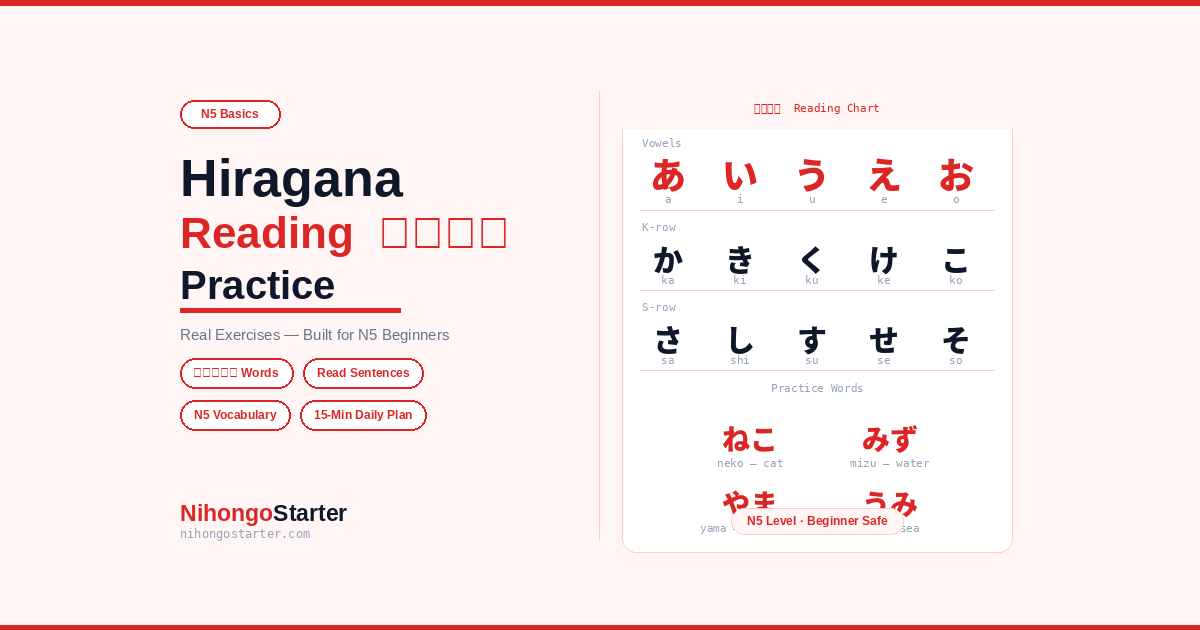
Vowel Row — Start Here Every Session
| Character | Sound | Tip |
|---|---|---|
| あ | a | Like “ah” — open your mouth wide |
| い | i | Like “ee” — smile when you say it |
| う | u | Like “oo” but short — don’t round your lips too much |
| え | e | Like “e” in “pet” |
| お | o | Like “oh” — round and clear |
Mixed Character Drill — Read Across Without Pausing
か き く け こ さ し す せ そ た ち つ て と
Try to read each row in one smooth flow. The moment you hesitate on a character, circle it. Those hesitation characters are exactly where your practice needs to focus next.
Step 2 — Real Hiragana Word Reading Practice
This is where reading practice actually starts to feel like Japanese. Real words — not random syllables — are what your brain needs to build pattern recognition.
Work through these word groups out loud. Romaji is included for checking, but cover it while you read. Peeking immediately defeats the whole exercise.
Everyday Objects (Nouns) — Level 1
These are simple, high-frequency words that appear everywhere in beginner Japanese.
| Hiragana | Romaji | Meaning |
|---|---|---|
| ねこ | neko | cat |
| いぬ | inu | dog |
| みず | mizu | water |
| きく | kiku | to listen / chrysanthemum |
| くるま | kuruma | car |
| てがみ | tegami | letter |
| やま | yama | mountain |
| うみ | umi | sea |
| そら | sora | sky |
| はな | hana | flower / nose |
Read each word three times out loud before moving to the next. First time slowly, second time at normal pace, third time without looking at the romaji at all.
Action Words (Verbs) — Level 2
| Hiragana | Romaji | Meaning |
|---|---|---|
| たべる | taberu | to eat |
| のむ | nomu | to drink |
| みる | miru | to see / watch |
| いく | iku | to go |
| くる | kuru | to come |
| する | suru | to do |
| かく | kaku | to write |
| よむ | yomu | to read |
| きく | kiku | to listen / ask |
| ねる | neru | to sleep |
Notice something? Several of these words you’ll see every single day in Japanese — よむ (to read), かく (to write), たべる (to eat). Practicing hiragana with real vocabulary means you’re building your N5 word bank at the exact same time.
Words With Tricky Characters — Level 3
These words contain the character pairs that trip beginners up most often. Practice these deliberately.
| Hiragana | Romaji | Tricky Part |
|---|---|---|
| さくら | sakura | さ vs ち — loop position |
| ちかく | chikaku | ち vs さ — loop position |
| ぬいぐるみ | nuigurumi | ぬ vs め — shape comparison |
| ねむい | nemui | ね vs れ — tail direction |
| わたし | watashi | わ vs れ — second stroke |
| すごい | sugoi | す — the looping second stroke |
If any of these slow you down, that’s your target. Write the confusing pair side by side ten times, read them alternately, then go back to the word list and read it again.
Step 3 — Beginner Sentence Reading Exercises
This is the moment most hiragana guides skip completely — and it’s the most important step.
Reading isolated words is useful. But Japanese sentences have flow — characters connect into meaning, particles glue words together, rhythm starts to emerge. You need sentence-level reading practice to build that feeling.
Start with these short sentences. Read them aloud. Don’t worry about understanding grammar deeply yet — just focus on reading the characters smoothly.
Exercise Set A — Short Sentences (5–8 Characters)
1. わたしは ねこです。 Watashi wa neko desu. (I am a cat.) ← Yes, a silly sentence. Silly sentences are easier to remember.
2. みずを のみます。 Mizu wo nomimasu. (I drink water.)
3. やまが みえます。 Yama ga miemasu. (I can see the mountain.)
4. いぬは いえに います。 Inu wa ie ni imasu. (The dog is in the house.)
5. きょうは いい てんきです。 Kyou wa ii tenki desu. (Today is good weather.)
Exercise Set B — Slightly Longer Sentences
6. まいにち にほんごを べんきょうします。 Mainichi nihongo wo benkyou shimasu. (I study Japanese every day.)
7. あさ ごはんを たべて、がっこうに いきます。 Asa gohan wo tabete, gakkou ni ikimasu. (I eat breakfast and go to school.)
8. このほんは むずかしくないです。 Kono hon wa muzukashikunai desu. (This book is not difficult.)
Read each sentence three times. First at whatever pace feels comfortable. Second time, faster. Third time — try to read it as naturally as you’d read an English sentence. That third read is what builds fluency.
How to Practice Hiragana Reading Daily (The System That Actually Works)
Most people practice hiragana randomly and wonder why progress is slow. Here’s the system I’d give any beginner starting from zero — simple, consistent, and genuinely effective.
The 15-Minute Daily Method
Minutes 1–3: Character warm-up Pick one hiragana row from the chart. Read each character out loud three times. Focus on your hesitation characters from the day before.
Minutes 4–9: Word reading Work through a list of 10–15 hiragana words (use the Level 1 and 2 lists above). Cover the romaji. Read aloud. Check. Mark anything that slowed you down.
Minutes 10–13: Sentence reading Read two or three sentences from Exercise Set A or B. Read each one three times. Your goal is smooth, natural reading — not perfect speed.
Minutes 14–15: Spaced repetition review Open Anki or your flashcard app of choice and review any flagged characters or words. Five cards, no more. Just reinforce what you struggled with that day.
That’s it. Fifteen minutes daily beats two hours on a Sunday every single time. Your brain consolidates memory during sleep — spread-out practice works with that biology, not against it.
When to Know You’re Ready to Move On
Here’s the honest benchmark: you’re ready to move past hiragana reading drills when you can read any of the Level 2 word lists above without hesitating on a single character.
Not perfectly — just without hesitation. Speed comes later. Recognition comes first.
Once you hit that point, your next move is starting katakana practice while continuing to read hiragana through real beginner Japanese texts.
The Best Free Resources for Hiragana Reading Practice
You don’t need to spend money to practice. These are genuinely good free resources — not filler links.
NHK World Easy Japanese — NHK’s free beginner course includes hiragana audio for every lesson. Hearing native pronunciation while you read is one of the most effective things you can do at this stage.
Tadoku Free Reading Books — Free graded reading books starting at Level 0, written entirely in hiragana. Short, simple picture-book style stories — perfect for the stage right after you finish drilling individual words.
Anki — Free SRS Flashcard App — Download the free Japanese Core deck. Use it for ten minutes a day. Spaced repetition is the most research-backed memory technique available, and Anki is the gold standard tool for it.
FAQ
How long does it take to read hiragana fluently?
Most beginners reach smooth, hesitation-free hiragana reading in four to six weeks with daily practice. “Fluent” reading — where you process characters automatically without sounding them out — usually takes two to three months of consistent reading practice beyond the initial memorization phase. The key variable is daily reading exposure, not study session length.
Should I use romaji while practicing hiragana reading?
Use romaji only as a check — never as a crutch. The method in this guide is the right approach: cover the romaji, attempt the reading, then uncover to verify. If you read romaji alongside hiragana, your brain will always default to the romaji and hiragana recognition will never become automatic. Set yourself a strict rule: romaji is for checking only.
What words should I read first when practicing hiragana?
Start with concrete nouns — things you can picture clearly, like ねこ (cat), みず (water), やま (mountain). Concrete words stick faster because your brain links the sound to an image, not just an abstract meaning. After nouns, move to basic verbs like たべる (eat) and のむ (drink). Avoid abstract vocabulary at this stage.
Is reading hiragana words enough, or do I need sentences?
Words alone are not enough. Japanese sentences have particles, verb endings, and a rhythm that only appears in connected text. The sooner you start reading whole sentences — even very simple ones like the exercises in this guide — the faster your brain adapts to real Japanese reading patterns. Aim to add sentence reading within your first two weeks of hiragana practice.
How do I know if I’m reading hiragana correctly?
The most reliable check is audio comparison. Read a word aloud, then check your pronunciation against a native audio source. NHK World’s free lessons have audio for every character and many beginner words. If your reading matches the native audio, you’re on track. If it doesn’t — that’s valuable information about exactly which characters need more attention.
Conclusion
Memorizing hiragana is step one. Reading it — really reading it, smoothly and automatically — is step two. And that step only happens through practice with real words, real sentences, and consistent daily exposure.
Start today. Take the Level 1 word list in this guide, cover the romaji column, and read every word out loud. Do it again tomorrow. Add sentences the day after that. Fifteen minutes a day, every day, is all it takes.
The learners who read Japanese fluently aren’t the ones who studied harder. They’re the ones who started reading earlier — even when it was slow, even when it was uncomfortable, even when they weren’t sure they were doing it right.
You already know the characters. Now go read something.