

Most beginners hit this wall within their first week of Japanese.
They’ve learned hiragana. They know some vocabulary. They try to build their first sentence — and it comes out completely wrong. Not a little wrong. Backwards wrong.
That was me in early 2025, sitting in Dhaka with my notebook, trying to say “I eat sushi” in Japanese and producing something that made no grammatical sense. The problem wasn’t my vocabulary. It was that I was thinking in English — and Japanese grammar works on a completely different logic.
Here’s what changed everything for me: once I understood why Japanese sentences are structured the way they are, the grammar stopped feeling random. It started feeling logical. Almost elegant, actually.
That’s exactly what this guide will do for you.
Table of Contents
What SOV Means — And Why It Changes Everything
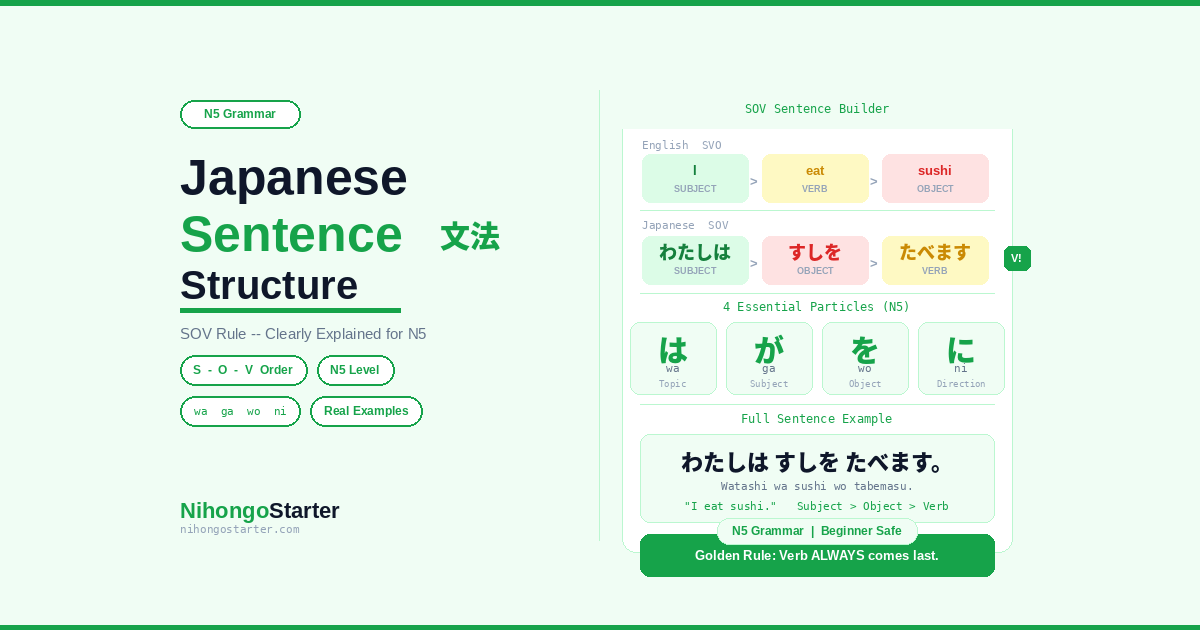
In English, sentences follow this order:
Subject → Verb → Object
“I eat sushi.”
- I = Subject (who does the action)
- eat = Verb (the action)
- sushi = Object (what the action is done to)
Japanese flips the verb to the end:
Subject → Object → Verb
“I sushi eat.”
In Japanese: 私は すしを たべます。 (Watashi wa sushi wo tabemasu.)
That’s the SOV rule. Subject first, object in the middle, verb always at the end. Always.
Sound familiar? Actually — this word order is more common globally than English SVO. Japanese, Korean, Turkish, and many other languages all put the verb last. English is actually the unusual one here.
The moment I reframed it that way during my N5 preparation, Japanese stopped feeling backwards. It started feeling like its own perfectly logical system.
The One Rule You Must Never Break
Before anything else — burn this into your brain:
The verb always comes last. No exceptions.
In English, you can move things around and still be understood. “Sushi I eat” sounds odd, but the meaning is clear. Japanese doesn’t work that way. The verb must sit at the end of every sentence, every time — whether it’s a simple two-word phrase or a long, complex statement.
This is the golden rule of Japanese sentence structure. Everything else has flexibility. The verb position does not.
What Are Particles — And Why They’re Actually Brilliant
Here’s the part that trips up almost every English speaker.
In English, word order tells you who does what. “The dog bit the man” and “The man bit the dog” are completely different sentences — purely because of the order.
Japanese doesn’t rely on word order the same way. Instead, it uses particles — small markers attached directly to words that tell you the grammatical role of each word.
Think of particles as name tags. Every word in a Japanese sentence wears a name tag that says exactly what job it’s doing.
Because of particles, Japanese word order is actually more flexible than English — you can move elements around for emphasis. The verb just has to stay at the end.
Here are the four particles every N5 beginner must know:
| Particle | Reading | Job | Example |
|---|---|---|---|
| は | wa | Topic marker — “as for…” | わたしは (As for me…) |
| が | ga | Subject marker — specific focus | ねこが (The cat specifically…) |
| を | wo | Object marker — receives the action | すしを (sushi — the thing being eaten) |
| に | ni | Direction / time / location | がっこうに (to school / at school) |
These four particles appear in virtually every N5 sentence. Learn them deeply — not just what they are, but what they feel like in a real sentence.
Building Your First Japanese Sentences — Step by Step
Let’s build sentences from scratch, one layer at a time. This is the method I used when preparing for my PJC Bridge exam — start simple, add one element at a time, and always keep the verb at the end.
Level 1 — The Simplest Possible Sentence
In Japanese, a sentence can be just one word — the verb.
たべます。 Tabemasu. (I eat. / He eats. / She eats.)
That’s a complete, grammatically correct Japanese sentence. No subject needed. Context handles who’s doing the action. English requires “I eat” — Japanese is happy with just “eat.”
Level 2 — Adding a Topic (は)
Now let’s add who we’re talking about:
わたしは たべます。
Watashi wa tabemasu.
(I eat.)
Breaking it down:
- わたしは — “As for me” (は marks the topic)
- たべます — “eat” (verb at the end ✅)
Level 3 — Adding an Object (を)
Now add what’s being eaten:
わたしは すしを たべます。
Watashi wa sushi wo tabemasu.
(I eat sushi.)
Breaking it down:
- わたしは — “As for me” (topic marker は)
- すしを — “sushi” (object marker を — this is what’s being eaten)
- たべます — “eat” (verb still at the end ✅)
There it is. A complete Subject-Object-Verb sentence. This exact structure is the foundation of almost everything you’ll say and read in Japanese at N5 level.
Level 4 — Adding Time and Place
Japanese sentences typically follow this expanded order:
Topic → Time → Place → Object → Verb
わたしは まいにち がっこうで にほんごを べんきょうします。
Watashi wa mainichi gakkou de nihongo wo benkyou shimasu.
(I study Japanese at school every day.)
Breaking it down:
- わたしは — “As for me” (topic)
- まいにち — “every day” (time)
- がっこうで — “at school” (place — で marks location of action)
- にほんごを — “Japanese” (object)
- べんきょうします — “study” (verb — still at the end ✅)
Every element added — the verb never moved. That’s Japanese grammar working exactly as designed.
The です (Desu) Sentence — Describing What Something Is
Not every Japanese sentence uses an action verb. Many use です (desu) — the polite equivalent of “is/am/are.” This is one of the most common N5 patterns and one of the first you’ll learn.
Pattern: [Topic] は [Noun/Adjective] です。
Real examples:
わたしは がくせいです。
Watashi wa gakusei desu.
(I am a student.)
これは ほんです。
Kore wa hon desu.
(This is a book.)
とうきょうは おおきいです。
Tōkyō wa ōkii desu.
(Tokyo is big.)
Notice the pattern: topic marked with は, then the description or noun, then です at the end. Clean, logical, consistent. Once this clicks, you’ll use it dozens of times a day.
Japanese vs English Sentence Structure — Side by Side
This direct comparison helped me more than any grammar explanation when I was preparing for my N5. See the logic for yourself:
| English (SVO) | Japanese (SOV) | Notes |
|---|---|---|
| I drink coffee. | わたしは コーヒーを のみます。 | Verb moves to end |
| She reads a book. | かのじょは ほんを よみます。 | Same SOV pattern |
| He goes to school. | かれは がっこうに いきます。 | に marks direction |
| We eat breakfast. | わたしたちは あさごはんを たべます。 | を marks the object |
| Is this a pen? | これは ペンですか。 | か turns statement into question |
That last row is worth noting. In Japanese, turning a statement into a question is beautifully simple — just add か to the end. No subject-verb inversion needed the way English does it (“This is a pen” → “Is this a pen?”). Japanese: add か. Done.
The Three Most Common Beginner Mistakes
I made all three of these when I started. Learn from them now so you don’t have to.
Mistake 1 — Putting the Verb in the Middle
It’s a deeply ingrained English habit. You’ll catch yourself saying:
❌ わたしは たべます すしを。 (Putting the verb before the object)
✅ わたしは すしを たべます。 (Object before verb — always)
Every time you build a sentence, check the end. Is the verb there? Good.
Mistake 2 — Always Saying わたしは
In English, you must always state the subject: “I eat,” “I study,” “I go.” Dropping “I” sounds ungrammatical.
In Japanese, once the context is clear, the subject is routinely dropped. Saying わたしは (I) at the start of every sentence sounds unnatural — like a robot speaking.
In casual conversation, “たべます” alone is completely natural for “I eat.” Let context do the work.
Mistake 3 — Ignoring Particles
Particles are not optional decoration. They are the structure of the sentence. Using the wrong particle — or dropping one — changes the meaning completely, or makes the sentence incomprehensible.
Every noun in a Japanese sentence needs its particle. Don’t skip them while practicing, even when it feels slow. Getting particles right early is what separates learners who sound natural from those who perpetually sound like beginners.
FAQ
Is Japanese sentence structure really that different from English?
Yes — fundamentally different at the structural level. English puts the verb in the middle of the sentence between subject and object. Japanese always puts the verb at the end. Beyond that, Japanese uses particles instead of word order to show grammatical relationships, which actually gives it more flexibility than English in some ways. Once the SOV pattern clicks, most beginners find Japanese grammar surprisingly consistent and logical.
Why does the verb always go at the end in Japanese?
This is simply how SOV languages are structured — and Japanese is a consistent SOV language. Linguists believe verb-final languages developed this way because it allows speakers to add contextual information (time, place, manner) before stating the action, which creates a natural flow of known-to-new information. For learners, the practical benefit is clear: if you hear the verb at the end, you always know when a thought is complete.
What is the most important particle for beginners?
For absolute beginners, は (wa) is the first particle to internalize — it marks your topic and appears in almost every sentence. After that, を (wo) is critical because it marks the object of every action verb. Together, は and を give you the skeleton of Subject-Object-Verb sentences immediately. According to The Japan Foundation, these particles are foundational to all N5-level communication.
Do I need to say “watashi wa” (I) in every sentence?
No — and native speakers rarely do. Japanese regularly drops the subject when it’s clear from context. If you and a friend are talking about what you ate for lunch, saying たべました (tabemashita — “ate”) is completely natural and understood. The subject is implied. Beginners tend to over-use わたしは out of habit from English — it’s one of the first things to relax as your Japanese improves.
How long does it take to get comfortable with Japanese sentence structure?
Most consistent learners feel comfortable with basic SOV sentence building within two to four weeks of daily practice. Full internalization — where you think in Japanese word order rather than translating from English — usually takes two to three months of regular reading and writing practice. The key is building real sentences every day, not just studying grammar rules passively. When I was preparing for my N5 exam in 2025, writing ten new sentences daily using the day’s vocabulary was the single most effective practice method I used.
Start Building — Your Japanese Foundation Starts Here
Japanese sentence structure isn’t complicated. It’s just different.
Subject first. Object in the middle. Verb at the end. Particles marking every role. That’s it. That’s the entire foundation of N5 Japanese grammar — and once it clicks, everything else in the language starts making sense on top of it.
The learners who struggle with Japanese grammar are usually the ones fighting it — trying to make it work like English. The ones who progress fast are the ones who accept the new logic and practice it daily.
Start with the Level 1 sentences in this guide. Build to Level 2. Then Level 3. Write ten sentences a day. Keep the verb at the end. Let the particles do their job.
Now that you understand the structure, the next step is learning the two scripts you’ll use to read and write it — start with our guide on the difference between hiragana and katakana if you haven’t already, or go deeper into reading practice with our hiragana reading guide.
Japanese grammar is logical. It just needed someone to prove it.