
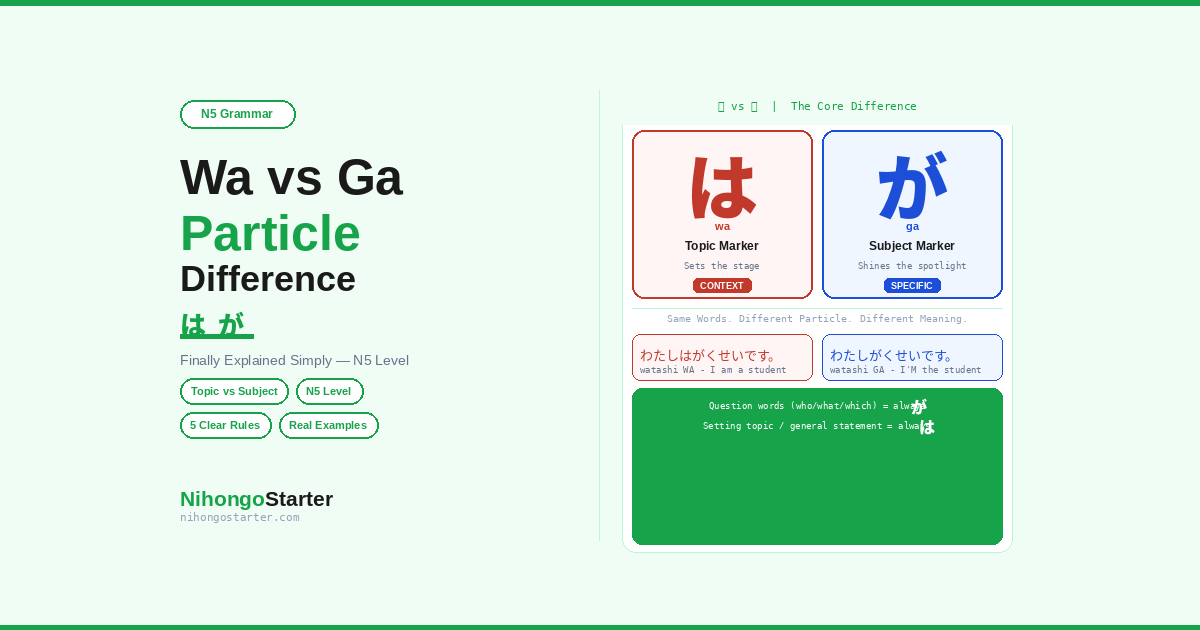

The wa vs ga particle difference is the single most searched grammar question in Japanese learning — and it’s been confusing beginners for decades.
Not because Japanese is broken. Not because the rule is impossible to understand. But because most explanations start with the wrong question.
They say: “は marks the topic. が marks the subject.” Then they stop — as if that sentence explains anything. A beginner reads it, nods blankly, and goes right back to guessing.
When I was preparing for my N5 exam in 2025, this exact confusion almost derailed me. I read explanation after explanation and kept hitting the same wall. Then one day, a single visual analogy made everything click. Within ten minutes of understanding that analogy, I could feel which particle was right — not just guess.
That’s what this guide does. By the end, you won’t just know the rule. You’ll feel it.
Table of Contents
Why This Confuses Everyone — Including Native Speakers
Before we fix the confusion, let’s be honest about why it exists.
は (wa) and が (ga) often appear in the same position in a sentence — right after a noun. And in many sentences, both are technically grammatically correct. They just mean slightly different things.
That’s the trap. When two words can both be “right” but mean different things, beginners freeze. They can’t tell the difference because nobody has shown them clearly what each particle is actually doing.
Here’s the truth that most guides skip: は and が are not competing for the same job. They have completely different jobs. The confusion comes from the fact that their jobs sometimes overlap in the same sentence.
Once you understand what each one actually does — they stop fighting each other in your head.
The Visual Analogy That Makes Everything Click
Forget “topic” and “subject” for a moment. Those are grammatical terms that don’t mean much until you understand them in context.
Instead, picture this:
は (wa) is a stage curtain. When an actor walks in front of a stage curtain, it says: “This is what we’re talking about. This is the context. Everything that follows is about this.” The curtain sets the scene.
が (ga) is a spotlight. When a spotlight hits one actor on a crowded stage, it says: “THIS one. This specific person. Not the others — THIS one.” The spotlight picks out one thing and puts all attention on it.
That’s the core difference.
は sets the stage — it establishes context and topic. が shines a light — it identifies something specific or introduces something new.
Read those two lines again. Then look at every example in this guide through that lens. The curtain. The spotlight. It works every time.
は (Wa) — The Topic Marker Explained
は (wa) tells your listener: “Here is what we’re talking about.”
When you use は, you’re setting up the context of your sentence. You’re saying: “Let’s put this thing front and center — and now I’ll say something about it.”
The key feeling of は: The thing marked with は is already known or already in the conversation. It’s not new information. It’s the established frame.
Basic は Examples
わたしは がくせいです。
Watashi wa gakusei desu.
I am a student.
Breaking it down:
- わたしは — “As for me…” (the topic is set: we’re talking about me)
- がくせいです — “…am a student” (the new information comes after は)
とうきょうは おおきいです。
Tōkyō wa ōkii desu.
Tokyo is big.
- とうきょうは — “As for Tokyo…” (topic established)
- おおきいです — “…is big” (what we’re saying about it)
は Also Signals Contrast
This is the part most beginner guides miss entirely — and it’s crucial.
When you use は, there’s often a hidden contrast lurking underneath the sentence. は quietly implies: “…but other things might be different.”
わたしはコーヒーをのみます。 Watashi wa kōhī wo nomimasu. I drink coffee. (neutral statement — no contrast)
わたしはコーヒーはのみます。 Watashi wa kōhī wa nomimasu. I DO drink coffee. (implied: but maybe not other things — tea perhaps?)
See the second は? When は appears mid-sentence on something that isn’t the topic, it creates contrast. It says: “this thing yes — but other things, maybe not.”
This is why native Japanese speakers sometimes use は in unexpected places — they’re creating subtle contrast and emphasis that isn’t always visible in translation.
が (Ga) — The Subject Marker Explained
が (ga) tells your listener: “This specific thing is doing the action — pay attention to which thing it is.”
When you use が, you’re either introducing something completely new into the conversation, or you’re specifically identifying one thing out of several possibilities.
The key feeling of が: The thing marked with が is either brand new information, or it’s being specifically singled out — spotlighted — from among other options.
Basic が Examples
だれが きますか。
Dare ga kimasu ka.
Who is coming?
- だれが — “Who specifically?” (が points to the unknown — we need to identify something)
Answer: たなかさんが きます。
Tanaka-san ga kimasu.
Tanaka-san is coming.
- たなかさんが — “Tanaka-san specifically” (が identifies the answer — it spotlights one person from all possibilities)
Notice: the question uses が, and the answer uses が. That’s not a coincidence. When you’re asking or answering “who/what/which” — が is almost always the right particle. You’re identifying something specific.
が Introduces New Information
そとで ねこが います。
Soto de neko ga imasu.
There is a cat outside.
The cat is brand new information. You’re not talking about a cat that’s already been mentioned — you’re introducing it for the first time. が marks this newness.
Once the cat is established in the conversation, it can become the topic. Then you’d switch to は:
そのねこは しろいです。
Sono neko wa shiroi desu.
That cat is white.
Now “that cat” is known — we’ve already established it. So は takes over. This は → が → は flow is one of the most natural patterns in Japanese conversation.
Side-by-Side Comparison — Same Sentence, Different Meaning
This is where the difference becomes undeniable. Same words. Same structure. Different particle. Completely different meaning.
Pair 1
わたしは がくせいです。 Watashi wa gakusei desu. I am a student. (Topic: “as for me” — this is what I’m saying about myself)
わたしが がくせいです。 Watashi ga gakusei desu. I am the student / It’s ME who is the student. (Spotlight: of all the people here, I’m the one who is a student — not someone else, me)
Pair 2
ねこは さかなを たべます。 Neko wa sakana wo tabemasu. Cats eat fish. (General statement about cats as a topic)
ねこが さかなを たべます。 Neko ga sakana wo tabemasu. The cat is eating fish. (Identifying this specific cat as the one doing the eating — right now, this particular cat)
Pair 3
あなたは だれですか。 Anata wa dare desu ka. Who are you? (Topic is “you” — I’m asking what I can say about you)
だれが きましたか。 Dare ga kimashita ka. Who came? (Identifying — who specifically? が must be used because the subject is unknown)
Do you feel the difference? は is calm, broad, contextual. が is pointed, specific, identifying.
The 5 Rules That Cover 90% of N5 Usage
You don’t need to master every nuance of は and が to pass N5 or communicate naturally. These five rules cover almost everything you’ll encounter at beginner level.
Rule 1 — Question Words Always Use が
When a question word (だれ who, なに what, どれ which, どこ where) is the subject of the sentence — always use が. Never は.
You can’t mark an unknown thing as a topic. は requires the topic to be known. Question words are by definition unknown — so が is the only option.
- だれが きますか。(Dare ga kimasu ka.) — Who is coming?
- なにが すきですか。(Nani ga suki desu ka.) — What do you like?
- どれが あなたのですか。(Dore ga anata no desu ka.) — Which one is yours?
Rule 2 — Answers to “Who/What” Questions Use が
When your sentence directly answers a “who” or “what” question — use が. You’re spotlighting the answer.
- Q: だれが きますか。(Who is coming?)
- A: たなかさんが きます。(Tanaka-san is coming.)
Rule 3 — Introducing New Information Uses が
The very first time something enters the conversation — use が. Once it’s established and known, switch to は.
- First mention: あそこに ねこが います。(There’s a cat over there.) — new information
- After established: その ねこは くろいです。(That cat is black.) — now it’s known
Rule 4 — General Statements and Known Topics Use は
When you’re making a general statement about something, or talking about something both speaker and listener already know — use は.
- にほんごは むずかしいです。(Japanese is difficult.) — general statement
- やまださんは せんせいです。(Yamada-san is a teacher.) — talking about a known person
Rule 5 — Likes, Dislikes, and Abilities Use が for the Object
This is a specific N5 pattern that trips up almost every beginner:
[Topic] は [thing] が すきです / きらいです / じょうずです
- わたしは にほんごが すきです。(I like Japanese.)
- かれは すいえいが じょうずです。(He is good at swimming.)
The structure is always: topic marked with は, then the thing you like/dislike/are good at marked with が. This pattern is fixed — don’t try to swap them.
The Famous Elephant Sentence — Decoded
One sentence appears in virtually every は vs が explanation — and for good reason. It perfectly shows both particles working together in one sentence.
ぞうは はなが ながいです。
Zō wa hana ga nagai desu.
As for elephants, their noses are long.
Breaking it down:
- ぞうは — “As for elephants…” (topic set with は — we’re talking about elephants)
- はなが — “their noses specifically…” (が identifies the specific thing being described)
- ながいです — “…are long”
The sentence uses both particles at once — は for the topic (elephants), が for the specific subject within that topic (the nose). This は → が construction is one of the most common patterns in Japanese.
Other examples of the same structure:
このえいがは おんがくが すばらしいです。 Kono eiga wa ongaku ga subarashii desu. As for this movie, the music is wonderful.
にほんは ふじさんが ゆうめいです。 Nihon wa Fujisan ga yūmei desu. As for Japan, Mount Fuji is famous.
The Quick Decision Guide — Which Particle Do I Use?
When you’re writing or speaking and you freeze — run through this checklist:
Use が when:
- The word before it is a question word (だれ, なに, どれ)
- You’re introducing something for the first time
- You’re answering “who/what” and spotlighting the answer
- You’re using すき, きらい, じょうず, へた (likes/dislikes/ability patterns)
- You’re describing something you just noticed or observed right now
Use は when:
- You’re setting a topic that’s already known
- You’re making a general statement about something
- You want to imply contrast with other things
- The thing you’re marking has already been mentioned
When both feel right: If both は and が seem grammatically possible — ask yourself: “Am I setting context, or am I spotlighting something specific?” Context → は. Spotlight → が.
Real N5-Level Practice Sentences
Read each sentence. Identify which particle is used and why. Cover the explanation and try to figure it out first.
1. わたしは まいにち にほんごを べんきょうします。 Watashi wa mainichi nihongo wo benkyou shimasu. (I study Japanese every day.) → は because “I” is the established topic — we’re setting context about me.
2. あ、あめが ふってきた! A, ame ga futte kita! (Oh, it started raining!) → が because rain is brand new information — you just noticed it, you’re introducing it.
3. だれが このてがみを かきましたか。 Dare ga kono tegami wo kakimashita ka. (Who wrote this letter?) → が because だれ (who) is a question word — always が.
4. わたしは ねこが すきです。 Watashi wa neko ga suki desu. (I like cats.) → は for the topic (me), が for the thing liked (cats) — the fixed likes/dislikes pattern.
5. たなかさんが きました。 Tanaka-san ga kimashita. (Tanaka-san came!) → が because Tanaka-san’s arrival is new, specific information — spotlighted.
FAQ
What is the simplest way to understand wa vs ga in Japanese?
The simplest way: は (wa) sets the topic — it says “here’s what we’re talking about.” が (ga) identifies the subject — it says “this specific thing is doing the action.” Think of は as a curtain that sets the stage, and が as a spotlight that picks out one specific actor. When you’re establishing context or making a general statement, use は. When you’re introducing something new or answering “who/what,” use が.
Can は and が be used in the same sentence?
Yes — and this is extremely common in Japanese. The pattern [topic]は [subject]が [verb/adjective] appears constantly. The classic example is ぞうは はなが ながいです (As for elephants, their noses are long) — は sets the topic (elephants) and が identifies the specific subject within that topic (the nose). Understanding this dual-particle pattern is essential for reading and producing natural N5-level Japanese.
Why do Japanese likes and dislikes use が instead of を?
Japanese conceptualizes emotions differently from English. Instead of “I like cats” (where “cats” is the object of liking), Japanese says わたしは ねこが すきです — literally “As for me, cats are likeable.” Cats are the subject of being likeable, not the object of an action. This is why が rather than を appears with すき (like), きらい (dislike), じょうず (good at), and へた (bad at). The thing being liked or disliked is always marked with が in these fixed patterns.
Is it ever okay to use は where が would also work?
Yes — in many sentences, both particles are grammatically acceptable but produce different nuances. わたしは がくせいです (I am a student — neutral topic statement) vs わたしが がくせいです (I am the student — emphasizing it’s specifically me, not someone else). Neither is wrong — they just communicate different things. As a beginner, focus on the clear rules first (question words, new information, likes/dislikes) and trust that the nuances will develop naturally through exposure.
Do native Japanese speakers always know which particle to use?
Interestingly, native Japanese speakers often struggle to explain their particle choices — they feel correct instinctively without being able to articulate why. According to research cited by Tofugu, は vs が has been the subject of academic debate among linguists for over fifty years. This is worth knowing as a learner: even at advanced levels, some は vs が choices involve subtle nuance rather than clear rules. At N5 level, the five rules in this guide cover everything you need.
The Curtain and the Spotlight — Never Forget Them
The wa vs ga particle difference isn’t a riddle. It’s two tools doing two different jobs.
は is your curtain — it sets the stage, establishes context, marks what’s already known. が is your spotlight — it picks out something specific, introduces the new, identifies the answer.
Use that image every time you hesitate. Ask yourself: “Am I setting the curtain, or am I turning on the spotlight?” The answer will almost always tell you which particle to reach for.
Study the five rules. Practice the sentence pairs. Read the elephant sentence until it feels obvious. And remember — even native speakers don’t always agree on every nuance. At N5 level, your goal isn’t perfection. It’s developing a feel for these two particles that grows stronger with every sentence you read and write.
Now that particles are starting to click, take your understanding further with our complete guide on Japanese sentence structure for beginners — where は, が, and を all work together in real N5 sentences. And if you want to see these particles in immediate practical use, revisit our jikoshoukai guide — every sentence in a Japanese self-introduction uses these exact particles.
は か が か — now you know the difference.