
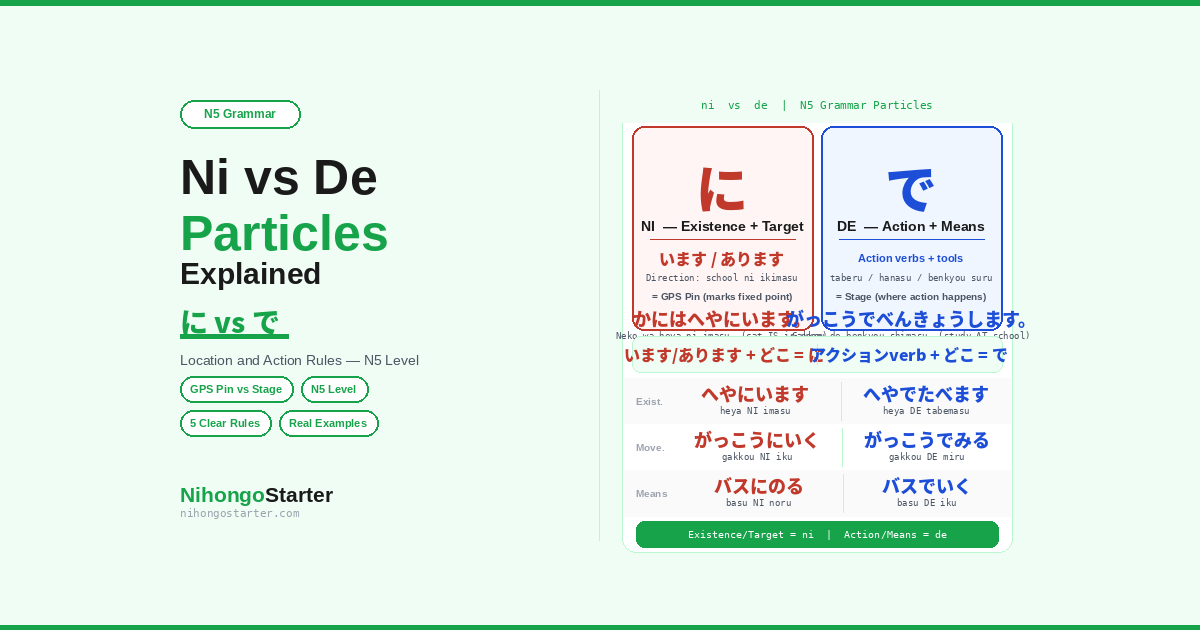

Japanese particles に (ni) and で (de) confuse beginners more than almost any other N5 grammar point.
Both translate as “at” or “in” in English. Both appear after location words. And yet using the wrong one produces sentences that sound completely wrong to any Japanese speaker.
When I was drilling N5 grammar ahead of my PJC Bridge exam in June 2025, this was the particle pair that cost me the most practice time. I kept second-guessing myself mid-sentence — freezing between がっこうに and がっこうで, unsure which one fit. Then I found the formula that resolved it permanently.
Table of Contents
The core rule: に marks existence and targets. で marks actions.
That single distinction — existence vs action — makes the right choice automatic 95% of the time. This guide builds that instinct from scratch.
The One Formula That Solves Everything
直接回答 (Direct Answer):
に = WHERE something IS or WHERE something GOES で = WHERE something HAPPENS
Think of it this way:
- に is a GPS pin. It marks a fixed point — where something exists, where something is headed, where something arrives.
- で is a stage. It marks the backdrop — the location where an action takes place.
A GPS pin is static. A stage is active.
That mental image — pin vs stage — is the fastest way to feel the difference before the grammar explanation fully lands.
Particle に (Ni) — Existence, Direction, and Target
Direct Answer: に marks three things at N5 level — where something exists, where something is going, and who receives something.
Use 1: Location of Existence (Where Something IS)
Use に when the verb describes existence — specifically います (imasu) and あります (arimasu).
Formula: [Place] + に + います / あります
| Japanese | Romaji | English |
|---|---|---|
| ねこは へやに います。 | Neko wa heya ni imasu. | The cat is in the room. |
| ほんは つくえの うえに あります。 | Hon wa tsukue no ue ni arimasu. | The book is on the desk. |
| せんせいは がっこうに います。 | Sensei wa gakkou ni imasu. | The teacher is at school. |
Key signal: If your verb is います or あります — に is almost always correct. These are existence verbs. に marks where the existence happens.
Use 2: Direction and Destination (Where Something GOES)
Use に when a movement verb shows where something is headed or where it arrives.
Formula: [Destination] + に + movement verb (いきます/きます/かえります)
| Japanese | Romaji | English |
|---|---|---|
| がっこうに いきます。 | Gakkou ni ikimasu. | I go to school. |
| うちに かえります。 | Uchi ni kaerimasu. | I return home. |
| にほんに きました。 | Nihon ni kimashita. | I came to Japan. |
Key signal: If your verb is いく, くる, or かえる — the destination takes に.
Use 3: Time — Specific Points on the Calendar
Use に with specific, calendar-based time expressions.
| Japanese | Romaji | English |
|---|---|---|
| しちじに おきます。 | Shichiji ni okimasu. | I wake up at 7 o’clock. |
| げつようびに べんきょうします。 | Getsuyoubi ni benkyou shimasu. | I study on Monday. |
| さんがつに にほんに いきます。 | Sangatsu ni Nihon ni ikimasu. | I go to Japan in March. |
Critical note: Do NOT use に with relative time words — きょう (today), あした (tomorrow), きのう (yesterday), らいしゅう (next week). These never take に.
Use 4: Indirect Object — Who Receives Something
に marks the person receiving an action — the equivalent of “to” in English giving/receiving sentences.
| Japanese | Romaji | English |
|---|---|---|
| ともだちに プレゼントを あげました。 | Tomodachi ni purezento wo agemashita. | I gave a present to my friend. |
| こどもに えいごを おしえます。 | Kodomo ni eigo wo oshiemasu. | I teach English to the children. |
Particle で (De) — Action, Means, and Scope
Direct Answer: で marks two things at N5 level — where an action takes place, and how an action is performed (the means or tool used).
Use 1: Location of Action (Where Something HAPPENS)
Use で when the verb describes an action — eating, studying, playing, reading, working, shopping, and almost every other active verb.
Formula: [Place] + で + action verb
| Japanese | Romaji | English |
|---|---|---|
| がっこうで べんきょうします。 | Gakkou de benkyou shimasu. | I study at school. |
| レストランで ごはんを たべます。 | Resutoran de gohan wo tabemasu. | I eat at the restaurant. |
| こうえんで あそびます。 | Kouen de asobimasu. | I play at the park. |
| としょかんで ほんを よみます。 | Toshokan de hon wo yomimasu. | I read a book at the library. |
Key signal: Almost every verb that isn’t います or あります is an action verb. If the verb describes something happening — で marks where it happens.
Use 2: Means and Method (HOW Something is Done)
で also marks the tool, method, or means used to perform an action. This is で’s second major job — and it’s equally important at N5 level.
Formula: [Tool/Method] + で + action
| Japanese | Romaji | English |
|---|---|---|
| バスで いきます。 | Basu de ikimasu. | I go by bus. |
| にほんごで はなします。 | Nihongo de hanashimasu. | I speak in Japanese. |
| はしで たべます。 | Hashi de tabemasu. | I eat with chopsticks. |
| でんしゃで がっこうに いきます。 | Densha de gakkou ni ikimasu. | I go to school by train. |
Note that last example: でんしゃで (by train = means) + がっこうに (to school = destination). Both particles appear in the same sentence — each doing its separate job. This is extremely common in natural Japanese.
Side-by-Side: Same Place, Different Particle, Different Meaning
This is where the distinction becomes undeniable. Same location word — completely different particle — completely different meaning.
| Japanese | Romaji | Meaning | Why |
|---|---|---|---|
| がっこうに います。 | Gakkou ni imasu. | I am at school. (existence) | います = existence verb → に |
| がっこうで べんきょうします。 | Gakkou de benkyou shimasu. | I study at school. (action) | べんきょうする = action verb → で |
| こうえんに います。 | Kouen ni imasu. | I am at the park. | います → に |
| こうえんで はしります。 | Kouen de hashirimasu. | I run at the park. | はしる = action → で |
| うちに います。 | Uchi ni imasu. | I am at home. | います → に |
| うちで たべます。 | Uchi de tabemasu. | I eat at home. | たべる = action → で |
The location word is identical. The verb changes everything.
My personal insight from N5 exam preparation: When I reviewed my practice test errors in the weeks before my June 2025 exam at ISL Dhaka, every single に vs で mistake I had made traced back to one thing — I was looking at the location word instead of looking at the verb. The moment I trained myself to check the verb first, my particle accuracy jumped immediately. Check the verb. The location particle follows the verb’s nature — not the location word.
The Verb-First Decision Framework
Every time you hesitate between に and で — look at the verb first. Not the location. The verb.
Ask yourself one question:
“Is this verb describing existence/arrival, or is it describing an action?”
What does the verb describe?
│
├── Existence (います/あります)     → に
├── Destination/Arrival (いく/くる/かえる) → に
├── Receiving (あげる/もらう/おしえる) → に
│
└── Action (almost everything else)   → で
    └── Means/Tool (bus, Japanese, chopsticks) → で
Run every sentence through this check. Within two weeks of consistent practice, it becomes automatic.
The 4 Tricky Cases — Where Beginners Get Stuck
Most に vs で confusion comes from a handful of specific situations. Here are the four that appeared in my N5 practice tests most frequently:
Tricky Case 1 — すんでいます (To Live Somewhere)
すんでいます uses に — not で — even though it seems like an ongoing action.
✅ とうきょうに すんでいます。 (Tōkyō ni sundeimasu.) — I live in Tokyo. ❌ とうきょうで すんでいます。 — Wrong.
Why? すむ describes a state of existence — where someone resides. Existence states use に. This is the same logic as います and あります.
Tricky Case 2 — The Same Place, Two Particles in One Sentence
Japanese sentences frequently contain both に and で in the same sentence. This isn’t a mistake — it’s two particles doing two different jobs simultaneously.
でんしゃで とうきょうに いきます。 Densha de Tōkyō ni ikimasu. I go to Tokyo by train.
- でんしゃで = by train (means → で)
- とうきょうに = to Tokyo (destination → に)
When you see both particles in one sentence — don’t panic. Each one is simply doing its own job.
Tricky Case 3 — あいます (To Meet Someone)
あいます (to meet) uses に for the person being met — even though “meeting” feels like an action.
✅ ともだちに あいます。 (Tomodachi ni aimasu.) — I meet a friend.
Why? The person you meet is the target of the meeting — not the location where it happens. に marks targets as well as locations of existence.
Tricky Case 4 — Transportation Verbs
Verbs like のります (to board/ride) use に — not で — for the vehicle.
✅ バスに のります。 (Basu ni norimasu.) — I get on the bus. ✅ でんしゃで いきます。 (Densha de ikimasu.) — I go by train.
The distinction: に marks what you board (the target of the boarding action). で marks the means of travel. Both can appear with transportation — but they mean different things.
N5-Level Practice Sentences — Test Yourself
Read each sentence. Before looking at the explanation — identify which particle is used and ask yourself why.
1. としょかんで ほんを かります。 Toshokan de hon wo karimasu. (I borrow a book at the library.) → で because かりる (to borrow) is an action verb.
2. えきに ともだちが います。 Eki ni tomodachi ga imasu. (My friend is at the station.) → に because います = existence verb.
3. にほんごで てがみを かきます。 Nihongo de tegami wo kakimasu. (I write a letter in Japanese.) → で because にほんご is the means (tool = Japanese language).
4. くじに ねます。 Kuji ni nemasu. (I sleep at 9 o’clock.) → に because 9 o’clock is a specific time point.
5. こうえんで ともだちに あいました。 Kouen de tomodachi ni aimashita. (I met my friend at the park.) → Two particles: こうえんで (action location — meeting happens at the park → で) + ともだちに (target — the person being met → に).
Complete N5 Reference Table
| Particle | Job | Verb Type | Example |
|---|---|---|---|
| に | Existence location | います/あります | うちに います |
| に | Destination | いく/くる/かえる | がっこうに いく |
| に | Specific time | — | しちじに おきる |
| に | Indirect object/target | あげる/おしえる/あう | ともだちに あげる |
| で | Action location | almost all other verbs | がっこうで べんきょうする |
| で | Means/tool/method | — | バスで いく / はしで たべる |
FAQ
What is the difference between に (ni) and で (de) in Japanese?
に (ni) marks existence and targets — it answers “where does something exist?” and “where is something going?” で (de) marks actions — it answers “where does something happen?” and “how is something done?” The fastest decision rule: check your verb first. Existence verbs (います/あります) take に. Action verbs take で. Movement verbs going to a destination take に. The means of transport or tool used takes で.
When do I use に vs で for location in Japanese?
Use に when the location holds something — specifically when your verb is います (for people/animals) or あります (for objects). Use で when the location hosts an action — when your verb describes eating, studying, playing, reading, working, or almost any other active verb. The same physical place can take either particle depending on what the sentence is saying about it: がっこうに います (I am at school — existence → に) vs がっこうで べんきょうします (I study at school — action → で).
Can に and で both appear in the same Japanese sentence?
Yes — and this is extremely common in natural Japanese. A sentence like でんしゃで がっこうに いきます (I go to school by train) contains both particles working simultaneously: で marks the means (by train) and に marks the destination (to school). When you see both particles in one sentence, each one is simply performing its own separate job. This is not contradictory — it’s Japanese grammar working exactly as designed.
Why does すんでいます (to live) use に instead of で?
すむ (to live/reside) describes a state of existence — where someone permanently or semi-permanently is. Because it expresses existence rather than active doing, it follows the same logic as います and あります, and takes に. This is one of the most common beginner mistakes. According to Tofugu’s research on Japanese particles, several verbs that appear action-like actually describe states of existence and therefore take に — すむ (live), とまる (stay), and similar residence verbs are the most important examples at N5 level.
Does に ever mark means of transport like で does?
Yes — but for a different purpose. で marks the means of travel (how you travel): バスで いきます (I go by bus). に marks the vehicle you board (what you get onto): バスに のります (I board the bus). When に appears with transportation, it marks the vehicle as the target of the boarding action — not the means of travel. This distinction trips up many N5 learners. Remember: のります (to board/ride) always takes に for the vehicle. いきます with a vehicle always takes で.
Two Particles. One Question. Zero Confusion.
The Japanese particles に vs で distinction comes down to one question asked of every verb in your sentence.
Existence or target? → に. Action or means? → で.
Practice that question with every sentence you encounter for the next two weeks. Read a sentence, find the location word, ignore it for a moment, look at the verb, classify it — existence or action? — and let the particle follow automatically.
That verb-first habit is what separates learners who guess from learners who know.
Now that に and で are clear, head to our guide on Japanese sentence structure for beginners to see all four core particles — は, が, を, and に/で — working together in complete N5 sentences. And if the wa vs ga distinction is still fuzzy, revisit our wa vs ga particle guide — together, these three guides cover every major N5 particle you’ll encounter in the exam.
に か で か — check the verb. The answer is already there.