
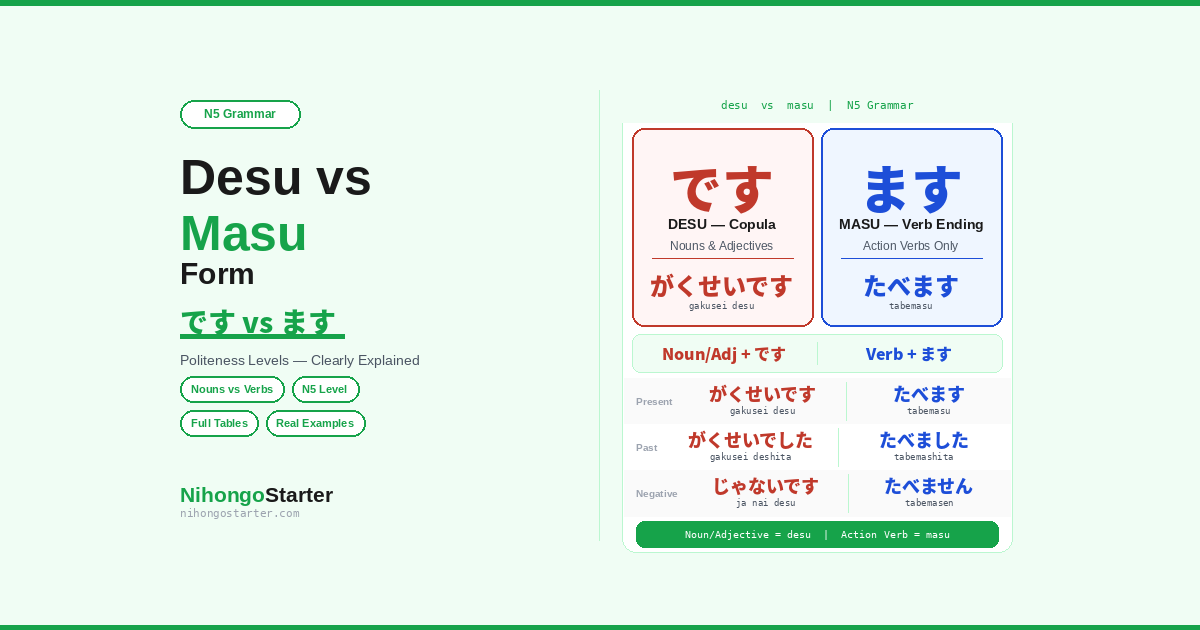

Desu and masu form Japanese — two of the very first grammar endings you’ll encounter. And two of the most consistently confused.
Every beginner hits the same wall. Both endings make speech polite. Both show up at the end of sentences. And yet using them incorrectly — or mixing them up — immediately sounds unnatural to any Japanese speaker.
When I first started learning Japanese in early 2025, I made this mistake constantly. I’d attach です to verbs and まず to nouns without thinking about why. The result was sentences that were grammatically broken in a way I couldn’t diagnose, because nobody had explained the actual logic.
Here’s what I wish someone had told me on day one: です and ます don’t just make sentences polite — they work on completely different types of words. Once you understand which word type each one belongs to, the confusion disappears permanently.
That’s exactly what this guide explains. The logic, the rules, the full conjugation tables, and the mistakes to avoid — all in one place.
Table of Contents
The Core Logic — One Rule That Explains Everything
Before tables and conjugations — here is the single most important thing to understand about です and ます.
です (desu) goes after nouns and adjectives. ます (masu) goes after verbs.
That’s the foundation. That’s the whole distinction.
です is a copula — it acts like “is/am/are” in English, linking a subject to a noun or adjective. ます is a verb ending — it attaches to the stem of an action verb to make that action polite.
Think of it this way:
です is a name tag. It says: “This thing IS that thing.” It describes or identifies. ます is a uniform. It says: “This action is performed politely.” It makes actions formal.
You wouldn’t put a name tag on an action. You wouldn’t dress up a description in a uniform. Different tools. Different jobs.
The moment this distinction becomes instinctive — choosing the right ending becomes automatic.
What Is です (Desu) — The Polite Copula
です (desu) is Japanese’s polite copula. In linguistics, a copula is a linking word — it connects the subject of a sentence to what you’re saying about it.
In English, “is,” “am,” and “are” are copulas. In Japanese, です does the same job — but it stays the same regardless of who the subject is. No “I am / you are / she is” variation. Just です, every time.
Pronunciation note: The う (u) at the end of です is devoiced — it’s almost silent in natural speech. Say it as “dess” not “deh-su.” You’ll hear this clearly from any native speaker.
What Goes Before です
1. Nouns
The most fundamental use of です. Place it after any noun to make a polite statement.
| Japanese | Romaji | English |
|---|---|---|
| がくせいです。 | Gakusei desu. | I am a student. |
| せんせいです。 | Sensei desu. | He is a teacher. |
| にほんじんです。 | Nihonjin desu. | I am Japanese. |
| これはほんです。 | Kore wa hon desu. | This is a book. |
2. な-Adjectives
な-adjectives (also called na-adjectives) describe nouns and take です directly after them in predicate position.
| Japanese | Romaji | English |
|---|---|---|
| しずかです。 | Shizuka desu. | It is quiet. |
| しんせつです。 | Shinsetsu desu. | She is kind. |
| べんりです。 | Benri desu. | It is convenient. |
| すきです。 | Suki desu. | I like it. / It is liked. |
3. い-Adjectives
い-adjectives already conjugate on their own — です is added purely as a politeness marker, not as a grammatical necessity.
| Japanese | Romaji | English |
|---|---|---|
| おいしいです。 | Oishii desu. | It is delicious. |
| むずかしいです。 | Muzukashii desu. | It is difficult. |
| たのしいです。 | Tanoshii desu. | It is fun. |
| あついです。 | Atsui desu. | It is hot. |
The Full です Conjugation Table
This is everything you need to know about です forms at N5 level:
| Form | Japanese | Romaji | Meaning |
|---|---|---|---|
| Present (positive) | です | desu | is / am / are |
| Present (negative) | じゃないです / ではありません | ja nai desu / dewa arimasen | is not / am not |
| Past (positive) | でした | deshita | was / were |
| Past (negative) | じゃなかったです / ではありませんでした | ja nakatta desu / dewa arimasen deshita | was not / were not |
| Question | ですか | desu ka | Is it…? / Are you…? |
Real Examples Across All Forms
Present: わたしは がくせいです。 Watashi wa gakusei desu. (I am a student.)
Negative: わたしは がくせいじゃないです。 Watashi wa gakusei ja nai desu. (I am not a student.)
Past: きのうは もくようびでした。 Kinou wa mokuyoubi deshita. (Yesterday was Thursday.)
Past negative: きのうは もくようびじゃなかったです。 Kinou wa mokuyoubi ja nakatta desu. (Yesterday was not Thursday.)
Question: あなたは にほんじんですか。 Anata wa nihonjin desu ka. (Are you Japanese?)
What Is ます (Masu) — The Polite Verb Ending
ます (masu) is not a standalone word. It’s an ending that attaches to the stem of a verb to make that action polite.
While です handles nouns and adjectives — ます handles everything that involves doing, going, eating, speaking, reading, writing, or any other action. If there’s a verb in your sentence, its polite form ends in ます.
How to Form the ます Stem
The process depends on which verb group you’re working with. If you’ve read our te form guide, the verb groups are already familiar.
Group 2 (Ru-verbs): Drop る, add ます
- たべる → たべます (taberu → tabemasu — to eat)
- みる → みます (miru → mimasu — to see/watch)
- おきる → おきます (okiru → okimasu — to wake up)
Group 1 (U-verbs): Change the final う-sound to an い-sound, add ます
- のむ → のみます (nomu → nomimasu — to drink)
- かく → かきます (kaku → kakimasu — to write)
- はなす → はなします (hanasu → hanashimasu — to speak)
- いく → いきます (iku → ikimasu — to go)
- よむ → よみます (yomu → yomimasu — to read)
Group 3 (Irregular):
- する → します (suru → shimasu — to do)
- くる → きます (kuru → kimasu — to come)
The Full ます Conjugation Table
Every ます form you need at N5 level:
| Form | Ending | Example | Meaning |
|---|---|---|---|
| Present / Future (positive) | ます | たべます | eat / will eat |
| Present / Future (negative) | ません | たべません | do not eat |
| Past (positive) | ました | たべました | ate |
| Past (negative) | ませんでした | たべませんでした | did not eat |
| Question | ますか | たべますか | Do you eat? |
| Request (please do) | てください | たべてください | Please eat |
Real Examples Across All Forms
Present: まいにち にほんごを べんきょうします。 Mainichi nihongo wo benkyou shimasu. (I study Japanese every day.)
Negative: コーヒーを のみません。 Kōhī wo nomimasen. (I don’t drink coffee.)
Past: きのう えいがを みました。 Kinou eiga wo mimashita. (I watched a movie yesterday.)
Past negative: きのう ごはんを たべませんでした。 Kinou gohan wo tabemasendeshita. (I didn’t eat yesterday.)
Question: にほんごを はなしますか。 Nihongo wo hanashimasu ka. (Do you speak Japanese?)
Side-by-Side — Choosing the Right Ending
This is where most beginners need practice. Same situation — different word type — completely different ending.
| Situation | Word Type | Correct Ending | Example |
|---|---|---|---|
| Saying what you are | Noun (がくせい) | です | がくせいです |
| Saying what you do | Verb (べんきょうする) | ます | べんきょうします |
| Describing something | い-adj (おいしい) | です | おいしいです |
| Describing a state | な-adj (しずか) | です | しずかです |
| Talking about going | Verb (いく) | ます | いきます |
| Talking about liking | な-adj (すき) | です | すきです |
Notice すき (like/fond of). This trips up many beginners. すき feels like an action — but in Japanese it’s a な-adjective, not a verb. It takes です, not ます.
The Japanese Politeness Levels — Where です・ます Fits
Understanding where です and ます sit in the broader politeness system helps you know when to use them — and when not to.
Japanese has three main speech levels:
Level 1 — Casual / Plain Form (だ / dictionary verbs) Used with: close friends, family, people younger than you, informal writing
- わたしは がくせいだ。(I’m a student.)
- まいにち べんきょうする。(I study every day.)
Level 2 — Polite Form (です / ます) — THIS is what you’re learning Used with: everyone else — teachers, strangers, colleagues, shopkeepers, most daily interactions
- わたしは がくせいです。(I am a student.)
- まいにち べんきょうします。(I study every day.)
Level 3 — Honorific / Humble Form (keigo) Used with: customers, superiors, very formal situations
- こちらでございます。(It is this way — ultra-polite)
As an N5 beginner, Level 2 (です・ます) is your default for everything. Use it with anyone you don’t know well, any teacher, any service interaction, any formal situation. You can’t go wrong with polite form — it’s always appropriate.
According to The Japan Foundation, teineigo (丁寧語 — polite language, the formal name for the です・ます register) is the baseline form taught to all beginning Japanese learners precisely because it’s safe, universally applicable, and widely expected in social interactions.
Both in the Same Sentence — How です and ます Work Together
Here’s something most beginner guides skip: です and ます frequently appear in the same sentence. Not in conflict — working together.
わたしは がくせいで、まいにち にほんごを べんきょうします。
Watashi wa gakusei de, mainichi nihongo wo benkyou shimasu.
(I am a student, and I study Japanese every day.)
Breaking it down:
- わたしは がくせいで — “I am a student and…” (で is the conjunctive form of です — connecting two clauses)
- まいにち にほんごを べんきょうします — “I study Japanese every day” (verb → ます)
The で links the noun clause to the verb clause. First half uses the copula (noun → です → で), second half uses the verb ending (verb → ます). Both politeness levels match — that’s the key.
Another example:
このまちは しずかで、とても すきです。
Kono machi wa shizuka de, totemo suki desu.
(This town is quiet and I really like it.)
The 4 Most Common Beginner Mistakes
These are the errors I made — and that I see most N5 learners make.
Mistake 1 — Using です After a Verb
The most common error in existence. Attaching です to a verb that already has ます.
❌ たべますです。(Tabemasu desu.) — Wrong. です after ます is redundant and broken. ✅ たべます。(Tabemasu.) — Correct. The verb already ends politely.
The ます form is already complete. It needs nothing added after it.
Mistake 2 — Using ます After a Noun
The reverse error. Trying to make a noun “more polite” by adding ます.
❌ がくせいます。(Gakusei masu.) — Completely wrong. Nouns never take ます. ✅ がくせいです。(Gakusei desu.) — Correct.
Mistake 3 — Treating すき as a Verb
すき (suki — to like) feels like an action — but it’s a な-adjective in Japanese grammar. It always takes です.
❌ ねこがすきます。(Neko ga sukimasu.) — Wrong. ✅ ねこがすきです。(Neko ga suki desu.) — Correct.
The same applies to: きらい (dislike), じょうず (good at), へた (bad at), ゆうめい (famous), しんせつ (kind). All な-adjectives. All take です.
Mistake 4 — Mixing Casual and Polite Forms
Using dictionary form verbs mid-sentence but ending with です is inconsistent and sounds awkward.
❌ まいにち べんきょうするです。(Mixing casual verb with polite です) ✅ まいにち べんきょうします。(All polite — consistent)
Consistency matters. If you’re speaking in です・ます style, every verb in the sentence should use ます form.
Quick Reference — The Decision Guide
When you’re building a sentence and you freeze — ask this:
“What type of word am I ending with?”
→ Noun (person, thing, place, name) = です → な-adjective (しずか, すき, べんり, しんせつ) = です → い-adjective (おいしい, むずかしい, たのしい) = です → Action verb (たべる, のむ, いく, する) = ます
One question. One answer. Right ending every time.
FAQ
What is the difference between desu and masu in Japanese?
です (desu) is a copula — it attaches to nouns and adjectives to make polite statements like “I am a student” or “it is delicious.” ます (masu) is a verb ending — it attaches to the stem of action verbs to make polite statements like “I eat” or “I study.” Both endings make speech polite, but they work on completely different word types. Using です after a verb is a common beginner mistake; using ます after a noun is equally wrong.
When should I use desu vs masu?
Use です when your sentence ends with a noun or adjective — for example, describing what something is or what something is like. Use ます when your sentence ends with an action verb — for example, describing what someone does, goes, eats, drinks, or reads. The simplest test: if there’s an action happening, the verb needs ます. If something is being described or identified, the ending needs です.
Can desu and masu appear in the same sentence?
Yes — and this is extremely common in natural Japanese. Sentences that contain both a noun/adjective clause and an action verb clause will use both endings. The conjunctive form of です is で (de), which connects clauses: わたしは がくせいで、まいにち べんきょうします means “I am a student and I study every day” — the first clause uses で (from です) and the second uses します (ます form). Understanding this pattern is essential for building more complex N5 sentences.
What is the casual equivalent of desu and masu?
The casual equivalent of です is だ (da). The casual equivalent of ます forms is the plain dictionary form of the verb. So がくせいです (polite) becomes がくせいだ (casual), and べんきょうします (polite) becomes べんきょうする (casual). As an N5 beginner, you should stick to です・ます forms in almost all situations — they’re always appropriate and never rude, while casual forms can sound impolite if used with the wrong person.
Is it bad to use desu and masu with everyone?
No — it’s the safest, most universally appropriate register in Japanese. According to Tae Kim’s Guide to Japanese Grammar, using polite です・ます form is always appropriate and never offensive. It’s only when you move to casual forms that social miscalculations can occur. As a beginner, using polite form with everyone — including close friends — might sound slightly stiff, but it will never cause offense. Switching to casual forms is something that happens naturally over time as relationships develop.
One Test. Two Endings. Zero Confusion.
The desu and masu form difference in Japanese isn’t complicated once you see the logic clearly.
Ask yourself what type of word ends your sentence. Noun or adjective — reach for です. Action verb — reach for ます. That one test handles 95% of every sentence you’ll build at N5 level.
Learn the conjugation tables in this guide. Practice the mistake pairs until wrong usage looks obviously broken. Build real sentences — describe yourself, your hobbies, your daily routine — using both endings until the choice becomes instinctive.
The です・ます register is the foundation of all your Japanese interactions. Every teacher, shopkeeper, classmate, and new acquaintance you’ll ever speak to deserves — and expects — the politeness that these two endings carry.
Now that です and ます are clear, the next step is seeing them work inside complete N5 sentences. Head to our guide on Japanese sentence structure for beginners to see how the SOV framework and particles combine with these endings — and revisit our wa vs ga particle guide to make sure every sentence leading up to your です or ます ending uses the right particles throughout.
です。ます。二つで一つ。(Desu. Masu. Futatsu de hitotsu.) — Two things that make one polite language.