
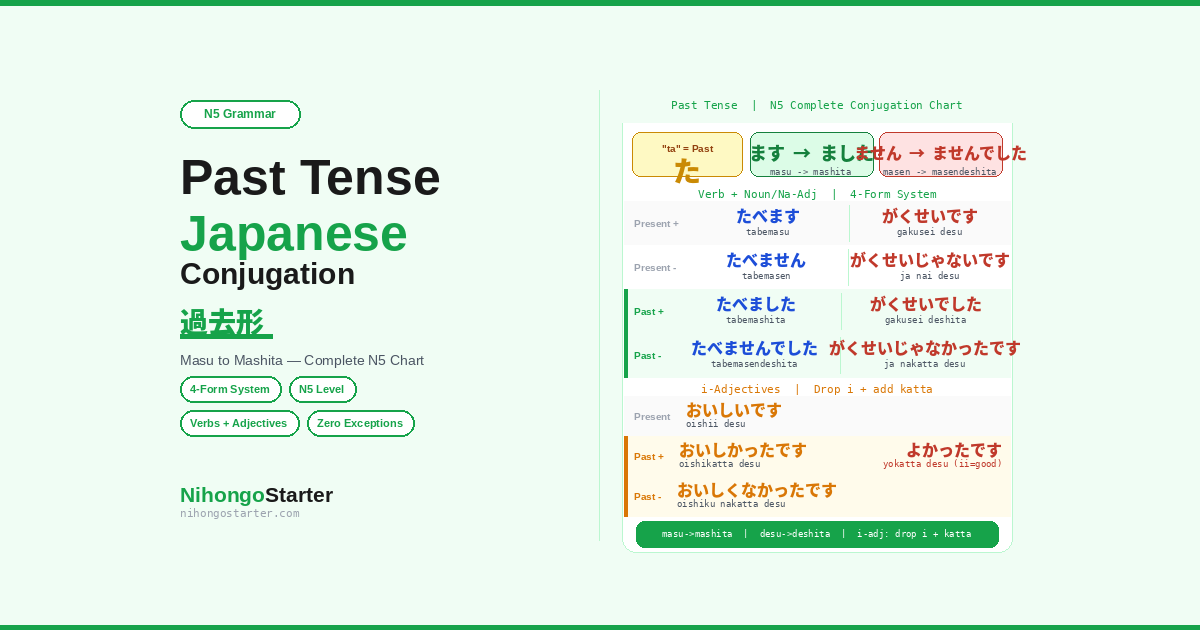

Japanese past tense conjugation at N5 level follows one simple rule — swap the ending.
- ます (masu) → ました (mashita) — polite past positive
- ません (masen) → ませんでした (masen deshita) — polite past negative
- です (desu) → でした (deshita) — noun/adjective past positive
That’s the foundation. Everything else in this guide builds from those three swaps.
When I sat my PJC Bridge N5 exam at ISL Dhaka in June 2025, past tense conjugation was the grammar point I felt most confident about going in — and the reason was simple. Unlike English, where go becomes went and eat becomes ate with zero logical pattern, Japanese polite past tense is completely regular. Every single verb follows the same rules. No exceptions at the ます/ました level.
This guide gives you the complete four-form system, the adjective past tense rules most guides skip, real example sentences, and a practice chart you can use immediately.
Table of Contents
Why Japanese Past Tense Is Easier Than English
Japanese polite past tense has zero irregular verbs. English has over 200 irregular past tense forms. Japanese has none at the ます level.
In English, the verb determines its own past tense form:
- go → went (completely different word)
- eat → ate (vowel change)
- make → made (drop the final e)
- put → put (no change at all)
There is no pattern. You memorize each one individually.
In Japanese polite form, the verb ending determines the past tense — and the rule never breaks:
Every verb: drop ます, add ました. Without exception.
たべます → たべました. のみます → のみました. べんきょうします → べんきょうしました.
The verb stem never changes. Only the ending changes. And the ending always changes the same way. This is one of the genuinely beginner-friendly features of Japanese grammar — and one I wish someone had emphasized to me on day one.
The Complete Four-Form System
Every Japanese verb at N5 level has four polite forms. Master these four and you can express any action in any tense.
This is the unified mental model that most beginner guides miss. They teach ます and ました separately, weeks apart, without showing how they fit into a single complete system.
Here it is as one table:
| Form | Ending | Meaning | Example (たべる) |
|---|---|---|---|
| Present / Future Positive | ます | do / will do | たべます (tabemasu) |
| Present / Future Negative | ません | don’t / won’t | たべません (tabemasen) |
| Past Positive | ました | did | たべました (tabemashita) |
| Past Negative | ませんでした | didn’t | たべませんでした (tabemasendeshita) |
The pattern in plain English:
- Present → ます / ません
- Past → ました / ませんでした
The single transformation rule:
- ます → ました (add した)
- ません → ませんでした (add でした)
Seeing all four forms together — rather than learning them weeks apart — is what makes the system click. The present and past forms mirror each other perfectly.
Verb Past Tense — ました and ませんでした
How to Form ました (Mashita) — Past Positive
Take any ます form verb. Replace ます with ました. Done.
Formula: [verb stem] + ました
| Dictionary Form | Masu Form | Past (Mashita) | Meaning |
|---|---|---|---|
| たべる | たべます | たべました | ate |
| のむ | のみます | のみました | drank |
| いく | いきます | いきました | went |
| みる | みます | みました | saw / watched |
| する | します | しました | did |
| くる | きます | きました | came |
| べんきょうする | べんきょうします | べんきょうしました | studied |
| よむ | よみます | よみました | read |
| かく | かきます | かきました | wrote |
| はなす | はなします | はなしました | spoke |
Critical note on irregular verbs: する and くる are irregular in their dictionary and ます forms — but their past tense follows the same pattern perfectly. します → しました. きます → きました. Zero extra rules needed.
Real Example Sentences — ました
きのう すしを たべました。
Kinou sushi wo tabemashita.
(I ate sushi yesterday.)
せんしゅう にほんごを べんきょうしました。
Senshuu nihongo wo benkyou shimashita.
(I studied Japanese last week.)
ともだちが きました。
Tomodachi ga kimashita.
(My friend came.)
えいがを みました。とても おもしろかったです。
Eiga wo mimashita. Totemo omoshirokatta desu.
(I watched a movie. It was very interesting.)
How to Form ませんでした (Masen Deshita) — Past Negative
Take any ます form verb. Replace ます with ませんでした. Done.
Formula: [verb stem] + ませんでした
| Masu Form | Past Negative | Meaning |
|---|---|---|
| たべます | たべませんでした | did not eat |
| のみます | のみませんでした | did not drink |
| いきます | いきませんでした | did not go |
| みます | みませんでした | did not see |
| します | しませんでした | did not do |
| きます | きませんでした | did not come |
Real Example Sentences — ませんでした
きのう がっこうに いきませんでした。
Kinou gakkou ni ikimasen deshita.
(I did not go to school yesterday.)
コーヒーを のみませんでした。
Koohii wo nomimasen deshita.
(I did not drink coffee.)
せんしゅう にほんごを べんきょうしませんでした。
Senshuu nihongo wo benkyou shimasen deshita.
(I did not study Japanese last week.)
Noun and な-Adjective Past Tense — The Complete 4-Part Table
For nouns and な-adjectives, the full four-form system works exactly like verbs — but using です endings instead of ます endings.
Here is the complete table — all four forms in one place:
| Form | Ending | Example (がくせい) | Example (しずか) | Meaning |
|---|---|---|---|---|
| Present Positive | です | がくせいです | しずかです | am / is |
| Present Negative | じゃないです | がくせいじゃないです | しずかじゃないです | am not / is not |
| Past Positive | でした | がくせいでした | しずかでした | was |
| Past Negative | じゃなかったです | がくせいじゃなかったです | しずかじゃなかったです | was not |
The more formal negative forms — ではありません (present) and ではありませんでした (past) — are grammatically correct and appear in textbooks. In everyday speech, じゃないです and じゃなかったです are what you’ll hear and use.
Real Examples — でした and じゃなかったです
こどものとき、がくせいでした。
Kodomo no toki, gakusei deshita.
(When I was a child, I was a student.)
きのうは げんきじゃなかったです。だから、がっこうを やすみました。
Kinou wa genki ja nakatta desu. Dakara, gakkou wo yasumimashita.
(I wasn’t well yesterday. So I took the day off school.)
このまちは しずかじゃなかったです。でも、すきでした。
Kono machi wa shizuka ja nakatta desu. Demo, suki deshita.
(This town wasn’t quiet. But I liked it.)
い-Adjective Past Tense — The Section Most Guides Skip
い-adjectives and な-adjectives form their past tense differently. This is one of the most tested points on the N5 exam and the one beginners most often get wrong.
Most guides focus entirely on verb past tense and give adjective past tense a single paragraph. In my N5 exam preparation, adjective past tense appeared in reading and listening questions just as frequently as verb past tense.
For い-adjectives, drop the final い and add かった for past positive, or くなかったです for past negative.
Formula:
- Positive past: drop い → add かったです
- Negative past: drop い → add くなかったです
| Dictionary | Present | Past Positive | Past Negative |
|---|---|---|---|
| おいしい | おいしいです | おいしかったです | おいしくなかったです |
| むずかしい | むずかしいです | むずかしかったです | むずかしくなかったです |
| たのしい | たのしいです | たのしかったです | たのしくなかったです |
| さむい | さむいです | さむかったです | さむくなかったです |
| おおきい | おおきいです | おおきかったです | おおきくなかったです |
| いい / よい | いいです | よかったです | よくなかったです |
⚠️ The いい exception: いい (good) is the most important irregular adjective in Japanese. Its past tense is よかったです — not いかったです. You will see this on the N5 exam. Memorize it now.
Real Examples — い-Adjective Past Tense
テストは むずかしかったです。
Tesuto wa muzukashikatta desu.
(The test was difficult.)
りょこうは たのしかったです!
Ryokou wa tanoshikatta desu!
(The trip was fun!)
きのうの ごはんは あまり おいしくなかったです。
Kinou no gohan wa amari oishiku nakatta desu.
(Yesterday’s food wasn’t very delicious.)
The Master Conjugation Chart — Print This
Every word type. Every tense. One complete reference.
Verbs
| Form | Ending | Example |
|---|---|---|
| Present positive | ます | たべます |
| Present negative | ません | たべません |
| Past positive | ました | たべました |
| Past negative | ませんでした | たべませんでした |
Nouns and な-Adjectives
| Form | Ending | Example |
|---|---|---|
| Present positive | です | がくせいです |
| Present negative | じゃないです | がくせいじゃないです |
| Past positive | でした | がくせいでした |
| Past negative | じゃなかったです | がくせいじゃなかったです |
い-Adjectives
| Form | Rule | Example |
|---|---|---|
| Present positive | い + です | おいしいです |
| Present negative | い → くないです | おいしくないです |
| Past positive | い → かったです | おいしかったです |
| Past negative | い → くなかったです | おいしくなかったです |
Past Tense Time Expressions — Use These Immediately
These time words pair with past tense verbs to build complete, natural sentences about the past.
| Japanese | Romaji | Meaning |
|---|---|---|
| きのう | kinou | yesterday |
| おととい | ototoi | the day before yesterday |
| せんしゅう | senshuu | last week |
| せんげつ | sengetsu | last month |
| きょねん | kyonen | last year |
| さっき | sakki | just now / a moment ago |
| まえに | mae ni | before / previously |
| ~まえ | ~mae | ~ ago (e.g. いちじかんまえ — one hour ago) |
Complete past tense sentences using time expressions:
さっき コーヒーを のみました。 Sakki koohii wo nomimashita. (I just drank coffee.)
せんしゅう きょうとに いきました。 Senshuu Kyouto ni ikimashita. (I went to Kyoto last week.)
いちじかんまえに ともだちに あいました。 Ichijikan mae ni tomodachi ni aimashita. (I met my friend one hour ago.)
The 4 Most Common Past Tense Mistakes
These are the exact errors I corrected in my own practice sentences before my N5 exam.
Mistake 1 — たべますでした (Adding でした After ます)
This is the most common error in existence. Learners know でした means past, so they attach it to ます. This produces a broken, non-existent form.
❌ きのう すしを たべますでした。 ✅ きのう すしを たべました。
Rule: Never combine ます and でした. ます becomes ました — the whole ending changes.
Mistake 2 — いいかったです Instead of よかったです
いい (good) is the only い-adjective with an irregular past tense. Its past form uses よ — not い.
❌ てんきが いいかったです。 ✅ てんきが よかったです。
Memorize this pair now: いいです → よかったです. It appears on nearly every N5 exam.
Mistake 3 — Mixing Casual and Polite Forms
Using た-form (casual past) alongside です (polite marker) produces inconsistent, unnatural Japanese.
❌ きのう えいがを みたです。 ✅ きのう えいがを みました。 (polite) ✅ きのう えいがを みた。 (casual — no です)
At N5 level, stick entirely to the ました system. The casual た-form is covered at higher levels.
Mistake 4 — Forgetting ませんでした for Negative Past
Many beginners use ませんです (which doesn’t exist) or just ません (which is present tense) for past negatives.
❌ きのう がっこうに いきませんです。 ❌ きのう がっこうに いきません。 (present tense — “I don’t go”) ✅ きのう がっこうに いきませんでした。
The full form ませんでした — all four characters — is non-negotiable for past negative.
5-Day Practice Plan
Day 1: Take 10 verbs you already know in ます form. Write each one as ました and ませんでした. Check against the chart above.
Day 2: Write five sentences about yesterday using ました. Use five different verbs. Say each sentence out loud.
Day 3: Write five sentences about things you did NOT do last week using ませんでした. Speak them aloud.
Day 4: Practice adjective past tense. Take five い-adjectives and five な-adjectives. Write all four forms for each. Focus especially on よかったです.
Day 5: Write a short paragraph (5-6 sentences) describing your day yesterday — mixing verb past tense and adjective past tense. Example:
きのう、しちじに おきました。ごはんを たべました。にほんごを べんきょうしました。テストが むずかしかったです。でも、たのしかったです。よるに ともだちに でんわしました。
(Yesterday, I woke up at 7. I ate breakfast. I studied Japanese. The test was difficult. But it was fun. In the evening, I called my friend.)
That paragraph uses ました, でした, かったです — all three past tense systems working together. That is N5-level writing.
FAQ
What is the Japanese past tense conjugation rule for N5?
The N5 past tense conjugation rule is: replace ます with ました for past positive, and replace ません with ませんでした for past negative. For nouns and な-adjectives: replace です with でした for past positive, and use じゃなかったです for past negative. For い-adjectives: drop the final い and add かったです for past positive, or くなかったです for past negative. These rules cover every word type at N5 level and have zero exceptions at the polite form level.
How do you change masu to mashita in Japanese?
To change masu (ます) to mashita (ました), simply replace the ます ending with ました. The verb stem — everything before ます — stays identical. For example: たべます (tabemasu — eat) becomes たべました (tabemashita — ate). のみます (nomimasu — drink) becomes のみました (nomimashita — drank). This rule applies to every polite-form verb without exception, including irregular verbs する and くる, whose ます forms (します and きます) become しました and きました respectively.
What is the difference between mashita and deshita?
ました (mashita) is the past tense ending for action verbs. でした (deshita) is the past tense ending for nouns and な-adjectives. ました attaches to verb stems: たべました (ate), いきました (went). でした attaches directly to nouns and な-adjectives: がくせいでした (was a student), しずかでした (was quiet). They are not interchangeable — each belongs to a specific word type. Using でした after a verb (たべますでした) is one of the most common N5-level errors.
How do you make い-adjectives past tense in Japanese?
To make an い-adjective past tense, drop the final い and add かったです for past positive, or くなかったです for past negative. For example: おいしい (delicious) → おいしかったです (was delicious) → おいしくなかったです (was not delicious). The only exception is いい (good), which becomes よかったです in the past tense — not いかったです. According to JLPT Sensei’s N5 grammar reference, the よかったです exception is one of the most frequently tested points on the N5 exam.
Can I use the た-form instead of ました for past tense in Japanese?
Yes — but not at N5 polite speech level. The た-form (casual past tense) and the ました form (polite past tense) express the same past meaning but in different registers. At N5 level, the standard is ました — it’s appropriate in all situations, never impolite, and the form used in JLPT exam questions. The casual た-form is important for reading manga, understanding anime dialogue, and casual conversation, but mixing た-form verbs with です (e.g., みたです) produces an error. Learn ました completely first — the た-form builds naturally on top of it.
One Rule. Four Forms. Every Tense Covered.
Japanese past tense conjugation at N5 level is genuinely one of the most learner-friendly grammar points in the language.
The rule is identical for every verb: ます becomes ました, ません becomes ませんでした. No irregular verbs at this level. No patterns to memorize by rote. Just one swap — applied consistently.
Learn the four-form system as a unit — not as separate rules taught weeks apart. See how ます, ません, ました, and ませんでした fit together as one complete system, and the past tense stops being a new grammar point and becomes a simple extension of what you already know.
Master the い-adjective past tense and memorize よかったです. Those two things alone will significantly boost your N5 exam score.
Start with Day 1 of the practice plan above. Write ten ました forms from verbs you already know. Say them aloud. The pattern becomes automatic faster than you expect.
Now that past tense is locked in, you have the tools to build complete, time-stamped Japanese sentences. Head to our guide on Japanese sentence structure for beginners to see how past tense fits into the SOV framework — and revisit our desu and masu form guide if the present tense foundation needs a refresh before drilling past forms.