

The te form in Japanese has a reputation. Ask any beginner what their hardest N5 grammar point was — and most will say て form without hesitation.
And honestly? That reputation is earned.
Unlike the simple です/ます patterns you learned first, the て form has multiple conjugation rules that change depending on how your verb ends. Different endings. Different rules. Different results. It looks chaotic at first glance.
But here’s what I discovered when I was preparing for my N5 exam in 2025: the て form only looks chaotic. Underneath the complexity, there is a clean, logical pattern — and once you see it, the whole thing clicks into place.
Better still — there’s a classic Japanese learner’s hack that puts the entire conjugation chart into a short, singable song. Once that song is in your head, you’ll never need to look up a て form rule again.
This guide gives you the full system: the three verb groups explained simply, the complete conjugation rules with real examples, the song hack, and the five most useful て form patterns you’ll use every single day.
Table of Contents
What Is the Te Form — And Why Does It Matter So Much?
Before the rules, let’s talk about why て form deserves this much attention.
The て form is Japanese’s primary connective tool. In English, we link actions with words like “and” and “then.” In Japanese, you modify the verb itself — turning it into て form — and the connection is built right into the word.
Without て form: ごはんをたべました。がっこうにいきました。 (I ate food. I went to school. — Two choppy separate sentences.)
With て form: ごはんをたべて、がっこうにいきました。 (I ate food and went to school. — One natural flowing sentence.)
That’s just one of the て form’s jobs. Here’s the full list of what you can build with it at N5 level:
| Pattern | Meaning | Example |
|---|---|---|
| 〜て + います | Doing right now (-ing) | たべています — I am eating |
| 〜て + ください | Please do… | たべてください — Please eat |
| 〜て + もいい | May I…? / It’s okay to… | たべてもいい — May I eat? |
| 〜て + から | After doing… | たべてから — After eating… |
| 〜て (connecting) | And then… | たべて、いきます — I’ll eat and go |
Five major grammar patterns. All built on the exact same conjugation. That’s why て form is the most important single conjugation in N5 Japanese. Master it once — unlock five patterns immediately.
The Three Verb Groups — Understand These First
Here’s the thing most guides rush past: て form conjugation is different for each verb group. If you don’t know which group a verb belongs to, you can’t conjugate it correctly.
The good news — Japanese only has three verb groups. And two of them are straightforward.
Group 2 — Ru-Verbs (The Easy One)
These verbs end in る (ru) and are also called ichidan verbs. They are the simplest verbs in Japanese — for て form conjugation especially.
Rule: Drop る. Add て.
That’s it. One rule. Always the same. No exceptions within this group.
| Dictionary Form | Meaning | Te Form |
|---|---|---|
| たべる | to eat | たべて |
| みる | to see / watch | みて |
| おきる | to wake up | おきて |
| でる | to leave / exit | でて |
| おしえる | to teach | おしえて |
Every time. Drop る. Add て. Done.
Group 3 — Irregular Verbs (Just Two)
There are only two irregular verbs in all of Japanese. Memorize these right now — they appear constantly and their て forms don’t follow any pattern.
| Dictionary Form | Meaning | Te Form | Memory Tip |
|---|---|---|---|
| する | to do | して | su → shi + te |
| くる | to come | きて | ku → ki + te |
Two verbs. Two exceptions. That’s all. Any verb ending in 〜する (like べんきょうする — to study, りょこうする — to travel) follows the same pattern as する → して.
Group 1 — U-Verbs (The Complex One)
These are godan verbs — verbs that end in a う-row sound other than the る of Group 2. This is the group that gives everyone trouble, because the て form ending changes depending on the final sound of the verb.
But here’s the insight: the endings fall into clear groups. There are only five patterns to learn — and a song to remember all of them.
The Te Form Song — The N5 Hack That Changes Everything
This is the hack. A classic mnemonic used by Japanese learners and even Japanese schoolchildren to memorize Group 1 て form conjugation rules.
The pattern works by grouping the verb endings by the て form they produce. Read it out loud — even better, sing it to any simple tune you know:
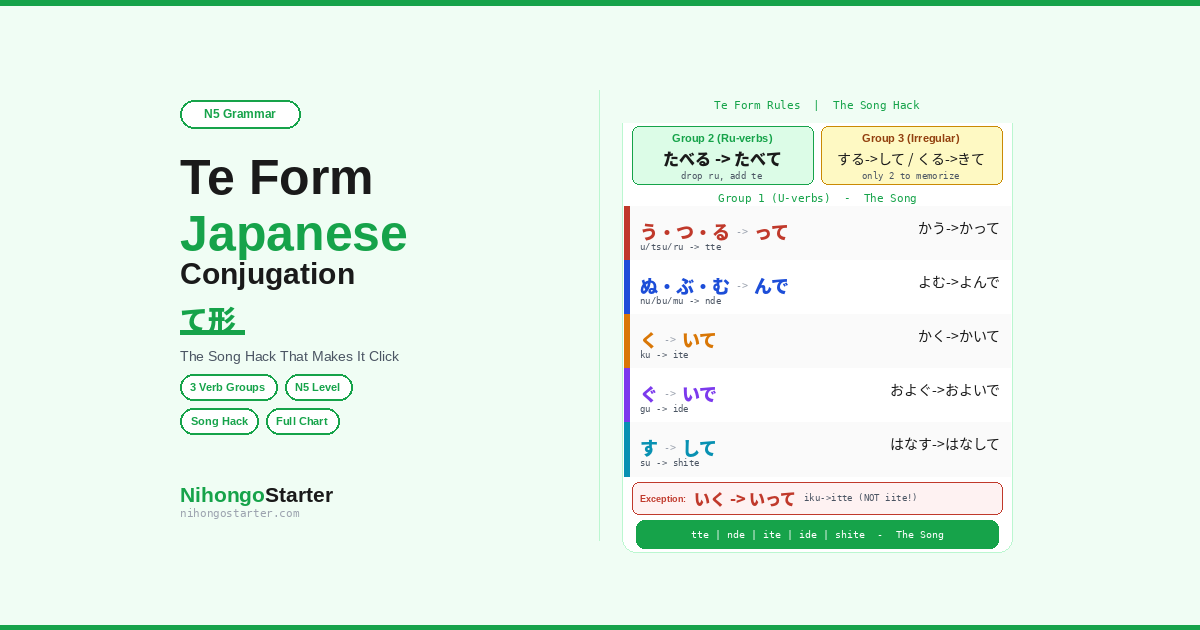
う・つ・る → って ぬ・ぶ・む → んで く → いて ぐ → いで す → して
That’s the entire Group 1 て form in five lines. Let’s break each line down with real examples:
Rule 1: う・つ・る → って (Double consonant + te)
Verbs ending in う, つ, or る (Group 1 only) → replace with って
| Verb | Meaning | Te Form |
|---|---|---|
| かう (kau) | to buy | かって (katte) |
| まつ (matsu) | to wait | まって (matte) |
| わかる (wakaru) | to understand | わかって (wakatte) |
⚠️ Critical warning: わかる ends in る — but it is a Group 1 verb, not Group 2. This is the trap that catches almost every beginner. Not all る-ending verbs are Group 2. When in doubt, check a dictionary.
Rule 2: ぬ・ぶ・む → んで (n + de)
Verbs ending in ぬ, ぶ, or む → replace with んで
Notice this produces で not て — that’s why some て forms end in で. Both are correct て form.
| Verb | Meaning | Te Form |
|---|---|---|
| よむ (yomu) | to read | よんで (yonde) |
| のむ (nomu) | to drink | のんで (nonde) |
| あそぶ (asobu) | to play | あそんで (asonde) |
| しぬ (shinu) | to die | しんで (shinde) |
Rule 3: く → いて (i + te)
Verbs ending in く → replace with いて
| Verb | Meaning | Te Form |
|---|---|---|
| かく (kaku) | to write | かいて (kaite) |
| きく (kiku) | to listen | きいて (kiite) |
| あるく (aruku) | to walk | あるいて (aruite) |
Rule 4: ぐ → いで (i + de)
Verbs ending in ぐ → replace with いで
| Verb | Meaning | Te Form |
|---|---|---|
| およぐ (oyogu) | to swim | およいで (oyoide) |
| いそぐ (isogu) | to hurry | いそいで (isoide) |
Rule 5: す → して (shi + te)
Verbs ending in す → replace with して
| Verb | Meaning | Te Form |
|---|---|---|
| はなす (hanasu) | to speak | はなして (hanashite) |
| かす (kasu) | to lend | かして (kashite) |
| さがす (sagasu) | to search | さがして (sagashite) |
The One Exception You Must Know
After all those rules — there is exactly one verb that breaks the pattern. Just one.
いく (iku — to go)
いく ends in く — so following Rule 3, it should become いいて. But it doesn’t.
いく → いって (itte)
Not いいて. いって. Nobody knows exactly why historically — it’s simply how it evolved. Every beginner gets caught by this once. Now you know in advance.
Memorize it separately: いく → いって. Treat it like a Group 3 irregular.
The Complete Te Form Reference Chart
Print this. Screenshot it. Save it somewhere you’ll see it daily for the next two weeks.
| Verb Group | Ending | Te Form | Example |
|---|---|---|---|
| Group 2 (Ru-verb) | 〜る | 〜て | たべる → たべて |
| Group 3 (Irregular) | する | して | べんきょうする → べんきょうして |
| Group 3 (Irregular) | くる | きて | くる → きて |
| Group 1 (U-verb) | 〜う | 〜って | かう → かって |
| Group 1 (U-verb) | 〜つ | 〜って | まつ → まって |
| Group 1 (U-verb) | 〜る | 〜って | わかる → わかって |
| Group 1 (U-verb) | 〜ぬ | 〜んで | しぬ → しんで |
| Group 1 (U-verb) | 〜ぶ | 〜んで | あそぶ → あそんで |
| Group 1 (U-verb) | 〜む | 〜んで | よむ → よんで |
| Group 1 (U-verb) | 〜く | 〜いて | かく → かいて |
| Group 1 (U-verb) | 〜ぐ | 〜いで | およぐ → およいで |
| Group 1 (U-verb) | 〜す | 〜して | はなす → はなして |
| Exception | いく | いって | — |
The 5 Most Important Te Form Patterns — With Real Examples
Now that you can conjugate て form — here’s how to actually use it. These five patterns cover almost everything you’ll encounter at N5 level.
Pattern 1 — 〜ています (Right Now / Ongoing Action)
[Te form] + います = I am doing / I do regularly
This is Japanese’s present progressive tense — the equivalent of English “-ing.”
いま にほんごを べんきょうしています。 Ima nihongo wo benkyou shite imasu. (I am studying Japanese right now.)
まいにち あるいています。 Mainichi aruite imasu. (I walk every day.)
Pattern 2 — 〜てください (Please Do Something)
[Te form] + ください = Please…
The most natural, polite way to make a request in Japanese. You’ll use this constantly.
ちょっと まってください。 Chotto matte kudasai. (Please wait a moment.)
ゆっくり はなしてください。 Yukkuri hanashite kudasai. (Please speak slowly.)
Pattern 3 — 〜てもいいですか (Asking Permission)
[Te form] + もいいですか = May I…? / Is it okay if I…?
しゃしんを とってもいいですか。 Shashin wo totte mo ii desu ka. (May I take a photo?)
ここに すわってもいいですか。 Koko ni suwatte mo ii desu ka. (May I sit here?)
Pattern 4 — 〜てから (After Doing)
[Te form] + から = After doing…
しゅくだいを してから、テレビを みます。 Shukudai wo shite kara, terebi wo mimasu. (After doing homework, I’ll watch TV.)
ごはんを たべてから、はを みがきます。 Gohan wo tabete kara, ha wo migakimasu. (After eating, I’ll brush my teeth.)
Pattern 5 — Connecting Two Actions
[Te form] + second verb = I did X and then Y
おきて、シャワーを あびて、がっこうに いきます。 Okite, shawaa wo abite, gakkou ni ikimasu. (I wake up, take a shower, and go to school.)
This is where て form transforms your Japanese from short choppy sentences into natural flowing speech. String as many actions as you need — each one except the last goes into て form.
The 3 Most Common Beginner Mistakes
I made all three of these during my own N5 preparation. Learn them now.
Mistake 1 — Treating All る-Ending Verbs as Group 2
The most common error in Japanese. Some verbs ending in る are Group 1 — not Group 2. They look identical but conjugate differently.
Group 2: たべる → たべて ✅ Group 1: わかる → わかって ✅ (not わかて ❌)
The safe approach: if you’re not sure which group a verb belongs to, look it up. Common Group 1 る-verbs to memorize: わかる (understand), はいる (enter), かえる (return), しる (know), きる (cut).
Mistake 2 — Forgetting the いく Exception
Every beginner does it. いく ends in く so they write いいて. The correct form is いって. Underline it in your notes. Circle it. Write it ten times. Make sure it sticks before your exam.
Mistake 3 — Memorizing Conjugations Without Using Them
Drilling the conjugation chart is useful. Writing real sentences with て form patterns is ten times more useful. The moment て form appears in a sentence you wrote yourself — it stops being an abstract rule and becomes language. Use Pattern 1 through 5 daily from the first day you learn them.
How to Practice Te Form — A 5-Day Plan
Day 1: Learn the song. Write it out five times. Say it aloud until you can recite it without looking.
Day 2: Take 10 Group 2 verbs. Conjugate each one to て form. Check your answers. All should be straightforward.
Day 3: Take 10 Group 1 verbs — two from each ending pattern. Conjugate each one. The song should guide you automatically.
Day 4: Write five sentences using 〜ています and five using 〜てください. Real sentences using vocabulary you know.
Day 5: Write a short paragraph about your morning routine — three to five sentences connected with て form. Example: おきて、はを みがいて、ごはんを たべて、がっこうに いきます。
Five days of focused practice and て form will feel natural. Consistent daily writing is what moves conjugation rules from your short-term memory into automatic instinct.
FAQ
What is the te form in Japanese?
The て form (te form) is a verb conjugation that ends in て or で, depending on the verb. It’s one of the most versatile and frequently used forms in Japanese — functioning as a connector between actions (like “and then”), forming the present progressive tense with います, making polite requests with ください, and serving as the base for many other N5 grammar patterns. Once you know how to conjugate て form, you immediately unlock five or more major grammar structures.
How do you conjugate Group 1 verbs into te form?
Group 1 (u-verb / godan) te form conjugation follows five rules based on the verb’s final sound: verbs ending in う/つ/る become って; verbs ending in ぬ/ぶ/む become んで; verbs ending in く become いて; verbs ending in ぐ become いで; verbs ending in す become して. The classic memory hack is to learn these as a five-line song: う・つ・る → って / ぬ・ぶ・む → んで / く → いて / ぐ → いで / す → して.
What is the te form of する and くる?
する (to do) becomes して in te form. くる (to come) becomes きて. These are the only two fully irregular verbs in Japanese. Any verb ending in 〜する (like べんきょうする — to study, or りょこうする — to travel) also follows this pattern and becomes 〜して in te form.
Why does いく become いって and not いいて?
いく (to go) ends in く, which normally produces the て form ending いて. But いく is an exception — its て form is いって, not いいて. This irregularity comes from historical sound changes in Japanese (音便 / onbin). There’s no logical reason to derive it from rules — it simply must be memorized separately. It’s the only exception to the く → いて rule and one of the most important irregular forms to know at N5 level.
How long does it take to master te form conjugation?
With focused daily practice, most beginners can conjugate te form accurately within one to two weeks. Recognizing te form in reading usually comes faster than producing it in writing. The key is to move from drilling conjugation rules to writing real sentences as quickly as possible — the patterns become automatic through use, not memorization. According to Tofugu’s comprehensive grammar guide, consistent exposure to te form in real Japanese sentences is the most reliable path to natural mastery.
One Song. Five Rules. Unlimited Japanese.
The て form in Japanese is genuinely one of the most important things you’ll learn at N5 level. It’s also one of the most rewarding — because the moment it clicks, your Japanese transforms from short isolated sentences into connected, natural speech.
Learn the song: う・つ・る → って / ぬ・ぶ・む → んで / く → いて / ぐ → いで / す → して
Remember the two irregulars: する → して / くる → きて
Remember the one exception: いく → いって
Then immediately start using the five patterns. Write sentences. Make requests. Describe what you’re doing right now. Connect your morning routine into one flowing sentence. The conjugation rules will become automatic faster than you expect.
Now that you have て form, your N5 grammar foundation is growing stronger with every post. Head back to our guide on Japanese sentence structure for beginners to see how て form fits into the SOV framework — and review the wa vs ga particle guide to make sure your て form sentences use the right particles throughout.
う・つ・る → って。 Sing it. Know it. Use it.