

This is the page I wish existed when I started studying Japanese in early 2025.
Every other N5 grammar list I found was either an alphabetical dump with no examples, or a single topic covered in isolation — leaving me to hunt across ten different websites to understand how everything connected.
What I needed was one page. Every grammar point. Organized by theme. With real examples I could actually picture using.
After passing my PJC Bridge N5 equivalent exam at ISL Dhaka in June 2025 — and my N4 the following month — I know exactly which grammar points matter most, which ones trip up beginners, and how they all fit together. That knowledge is what this guide is built from.
Bookmark this page. This is your complete N5 grammar reference.
Table of Contents
How to Use This Guide
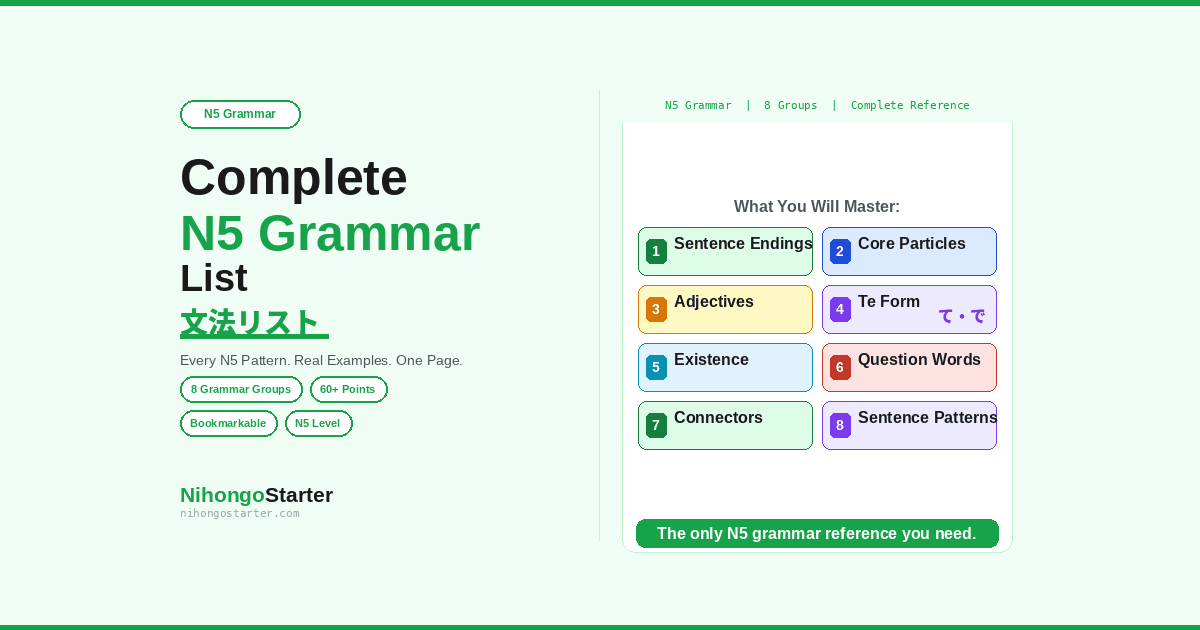
This guide organizes all N5 grammar points into eight thematic groups — not alphabetically. Learning grammar in themes means each point reinforces the others around it.
Each entry includes:
- The grammar pattern
- What it means and when to use it
- A real example sentence in Japanese
- Romaji pronunciation
- Natural English translation
For grammar points NihongoStarter has already covered in full detail, you’ll find a link to the dedicated guide. Use those for deep practice — use this page as your master reference and study checklist.
The N5 exam covers approximately 60–80 grammar points. There is no official list from the Japan Foundation — this guide is built from analysis of past exam papers, the Genki I curriculum, and the JLPT Sensei grammar reference, which is the most comprehensive independent N5 grammar database available.
Group 1 — Core Sentence Endings (です・ます System)
These are the foundation of all polite Japanese. Every N5 sentence uses one of these forms.
For the complete conjugation breakdown, see our desu and masu form guide and past tense conjugation guide.
~です (desu) — Polite Copula
Meaning: Is / am / are. Links nouns and adjectives to their subject.
Pattern: [Noun / Adjective] + です
Example:
わたしは がくせいです。 Watashi wa gakusei desu. (I am a student.)
~ます (masu) — Polite Verb Ending
Meaning: Polite present/future tense for all action verbs.
Pattern: [Verb stem] + ます
Example:
まいにち にほんごを べんきょうします。 Mainichi nihongo wo benkyou shimasu. (I study Japanese every day.)
~ました (mashita) — Polite Past
Meaning: Did [action]. The past tense form of ます.
Pattern: [Verb stem] + ました
Example:
きのう すしを たべました。 Kinou sushi wo tabemashita. (I ate sushi yesterday.)
~ません (masen) — Polite Negative Present
Meaning: Do not / will not do [action].
Pattern: [Verb stem] + ません
Example:
にくを たべません。 Niku wo tabemasen. (I don’t eat meat.)
~ませんでした (masen deshita) — Polite Negative Past
Meaning: Did not do [action].
Pattern: [Verb stem] + ませんでした
Example:
きのう がっこうに いきませんでした。 Kinou gakkou ni ikimasen deshita. (I did not go to school yesterday.)
~でした (deshita) — Polite Past Copula
Meaning: Was / were. Past form of です.
Pattern: [Noun / Adjective] + でした
Example:
こどものとき、がくせいでした。 Kodomo no toki, gakusei deshita. (When I was a child, I was a student.)
~じゃないです (ja nai desu) — Polite Negative Copula
Meaning: Is not / am not.
Pattern: [Noun / Adjective] + じゃないです
Example:
これは ほんじゃないです。 Kore wa hon ja nai desu. (This is not a book.)
Group 2 — Core Particles
Particles are the grammatical connectors of Japanese. Without them, sentences have no structure. For deep dives, see our wa vs ga guide and ni vs de guide.
は (wa) — Topic Marker
Meaning: As for [topic]… Sets what the sentence is about.
Example:
とうきょうは おおきいです。 Tōkyō wa ōkii desu. (Tokyo is big.)
が (ga) — Subject Marker
Meaning: Identifies or spotlights the specific subject. Used with question words and new information.
Example:
だれが きましたか。 Dare ga kimashita ka. (Who came?)
を (wo) — Object Marker
Meaning: Marks the direct object — the thing the action is done to.
Example:
コーヒーを のみます。 Koohii wo nomimasu. (I drink coffee.)
に (ni) — Direction / Existence / Time / Indirect Object
Meaning: Marks destination, location of existence, specific time, or who receives something.
Example:
がっこうに いきます。 Gakkou ni ikimasu. (I go to school.)
で (de) — Location of Action / Means
Meaning: Marks where an action happens, or the tool/method used.
Example:
としょかんで べんきょうします。 Toshokan de benkyou shimasu. (I study at the library.)
の (no) — Possessive / Linking Nouns
Meaning: Connects nouns — like “‘s” in English, or “of.”
Example:
これは わたしの ほんです。 Kore wa watashi no hon desu. (This is my book.)
と (to) — And / With
Meaning: Connects nouns exhaustively (A and B — complete list), or “together with.”
Example:
いぬと ねこが います。 Inu to neko ga imasu. (There is a dog and a cat.)
も (mo) — Also / Too
Meaning: “Also” or “too.” Replaces は or が.
Example:
わたしも にほんごを べんきょうしています。 Watashi mo nihongo wo benkyou shite imasu. (I am also studying Japanese.)
か (ka) — Question Marker
Meaning: Turns any statement into a question. No word order change needed.
Example:
にほんじんですか。 Nihonjin desu ka. (Are you Japanese?)
For the full か guide, see our ka particle questions guide.
から (kara) — From / Because
Meaning: “From” for origin in space or time. “Because” for giving reasons.
Example:
バングラデシュから きました。 Banguradeshu kara kimashita. (I came from Bangladesh.)
つかれたから、やすみます。 Tsukareta kara, yasumimasu. (I’m tired, so I’ll rest.)
まで (made) — Until / Up to
Meaning: Marks a limit in time or space — “until” or “as far as.”
Example:
ごじまで はたらきます。 Goji made hatarakimasu. (I work until 5 o’clock.)
へ (e) — Direction
Meaning: Marks the direction of movement. Similar to に but emphasizes the journey over the destination.
Example:
にほんへ いきます。 Nihon e ikimasu. (I am going to Japan.)
や (ya) — And (Non-Exhaustive)
Meaning: “And” for listing examples — implies the list is not complete. Compare to と.
Example:
つくえの うえに ほんや えんぴつが あります。 Tsukue no ue ni hon ya enpitsu ga arimasu. (There are books and pencils (and other things) on the desk.)
Group 3 — Adjective Patterns
Japanese has two adjective types at N5 level — い-adjectives and な-adjectives. Both appear constantly in speaking, writing, and the N5 exam.
い-Adjectives (Present and Past)
Rule: い-adjectives conjugate on their own — です adds politeness in all forms.
| Form | Rule | Example |
|---|---|---|
| Present positive | そのまま + です | たかいです (is expensive) |
| Present negative | い → くないです | たかくないです (is not expensive) |
| Past positive | い → かったです | たかかったです (was expensive) |
| Past negative | い → くなかったです | たかくなかったです (was not expensive) |
⚠️ Exception — いい (good):
いい → よかったです (was good) — NOT いかったです. This exception appears on nearly every N5 exam.
Real example:
そのアニメは とても おもしろかったです。 Sono anime wa totemo omoshirokatta desu. (That anime was very interesting.)
な-Adjectives (Present and Past)
Rule: な-adjectives behave like nouns. They take です, でした, じゃないです, じゃなかったです.
| Form | Example |
|---|---|
| Present positive | しずかです (is quiet) |
| Present negative | しずかじゃないです (is not quiet) |
| Past positive | しずかでした (was quiet) |
| Past negative | しずかじゃなかったです (was not quiet) |
Real example:
このまちは しずかで、きれいです。 Kono machi wa shizuka de, kirei desu. (This town is quiet and beautiful.)
Group 4 — Verb Groups and Te Form
Understanding verb groups is essential for て form, past tense, and almost every other conjugation at N5 level.
For the complete て form guide with the song hack, see our te form guide.
Verb Groups — Quick Reference
| Group | Type | Example | ます Form |
|---|---|---|---|
| Group 1 | U-verbs (godan) | かく (write) | かきます |
| Group 2 | Ru-verbs (ichidan) | たべる (eat) | たべます |
| Group 3 | Irregular | する (do)、くる (come) | します、きます |
~て Form — The Connector
Meaning: Connects actions, forms requests, and builds progressive tense. The most versatile form in Japanese.
Key conjugations:
| Group | Rule | Example |
|---|---|---|
| Group 2 | Drop る, add て | たべる → たべて |
| Group 1 (u/tsu/ru) | → って | かう → かって |
| Group 1 (nu/bu/mu) | → んで | のむ → のんで |
| Group 1 (ku) | → いて | かく → かいて |
| Group 1 (su) | → して | はなす → はなして |
| Irregular | — | する → して、くる → きて |
Exception: いく → いって (not いいて)
~ています (te imasu) — Progressive / Ongoing State
Meaning: Is doing / has done and is in that state.
Example:
いま にほんごを べんきょうしています。 Ima nihongo wo benkyou shite imasu. (I am studying Japanese right now.)
~てください (te kudasai) — Polite Request
Meaning: Please do [action].
Example:
ゆっくり はなしてください。 Yukkuri hanashite kudasai. (Please speak slowly.)
~てもいいですか (te mo ii desu ka) — Asking Permission
Meaning: May I [do action]? / Is it okay if I…?
Example:
ここに すわってもいいですか。 Koko ni suwatte mo ii desu ka. (May I sit here?)
~てから (te kara) — After Doing
Meaning: After doing [action], [next action].
Example:
しゅくだいを してから、ゲームを します。 Shukudai wo shite kara, geemu wo shimasu. (After doing homework, I play games.)
Group 5 — Existence and Location
These patterns answer “where is it?” and “does it exist?” — some of the most tested N5 questions.
~があります / ~がいます — There Is / Exists
Meaning:
- あります — for inanimate objects and plants
- います — for people, animals, living things
Pattern: [Place] に [thing] が あります / います
Examples:
つくえの うえに ほんが あります。 Tsukue no ue ni hon ga arimasu. (There is a book on the desk.)
こうえんに こどもが います。 Kouen ni kodomo ga imasu. (There are children in the park.)
⚠️ The あります vs います rule is one of the most tested distinctions on the N5 exam. Animate (living) things always use います. Inanimate objects always use あります. Plants technically use あります — even though they’re alive.
Location Words — Essential Set
| Japanese | Romaji | Meaning |
|---|---|---|
| うえ | ue | above / on top of |
| した | shita | below / under |
| なか | naka | inside |
| そと | soto | outside |
| まえ | mae | in front of |
| うしろ | ushiro | behind |
| となり | tonari | next to |
| ちかく | chikaku | near / close to |
| あいだ | aida | between |
Example using location words:
ねこは ソファの したに います。 Neko wa sofa no shita ni imasu. (The cat is under the sofa.)
Group 6 — Question Words and Information Questions
Every N5 question word combines with the sentence structure and か particle to form complete questions. For the full breakdown of the か particle system, see our ka particle guide.
Complete Question Word Reference Table
Format this as a WordPress Table block with three columns: Question Word | Meaning | Example Sentence
| Question Word | Meaning | Example Sentence |
|---|---|---|
| なに / なん (nani / nan) | What | これは なんですか。(What is this?) |
| どこ (doko) | Where | トイレは どこですか。(Where is the bathroom?) |
| だれ (dare) | Who | あれは だれですか。(Who is that?) |
| いつ (itsu) | When | いつ にほんに いきますか。(When will you go to Japan?) |
| どうして / なぜ (doushite / naze) | Why | どうして べんきょうしますか。(Why do you study?) |
| どう (dou) | How | にほんごは どうですか。(How is Japanese?) |
| いくら (ikura) | How much | これは いくらですか。(How much is this?) |
| いくつ (ikutsu) | How many | りんごは いくつありますか。(How many apples are there?) |
| どれ (dore) | Which one | どれが あなたのですか。(Which one is yours?) |
| どんな (donna) | What kind of | どんな おんがくが すきですか。(What kind of music do you like?) |
| なんじ (nanji) | What time | いま なんじですか。(What time is it now?) |
| なんにち (nannichi) | What day (date) | きょうは なんにちですか。(What day is today?) |
| なんようび (nan’youbi) | What day of the week | きょうは なんようびですか。(What day of the week is today?) |
Group 7 — Connecting Sentences and Giving Reasons
These patterns let you build complex, natural sentences at N5 level.
~から (kara) — Because / So
Meaning: Gives a reason. “[Reason] because/so [result].”
Pattern: [Reason sentence] + から、[result]
Example:
さむいから、コートを きます。 Samui kara, kooto wo kimasu. (Because it’s cold, I’ll wear a coat.)
Anime context: This is one of the most commonly heard sentence patterns in any slice-of-life anime. Characters explain their decisions constantly with から.
~が (ga) — But / However
Meaning: Connects two contrasting clauses. Softer than でも.
Pattern: [Clause A] が、[Clause B]
Example:
にほんごは むずかしいですが、たのしいです。 Nihongo wa muzukashii desu ga, tanoshii desu. (Japanese is difficult, but it’s fun.)
~そして (soshite) — And Then / And Also
Meaning: Connects sentences sequentially or additively.
Example:
ごはんを たべました。そして、テレビを みました。 Gohan wo tabemashita. Soshite, terebi wo mimashita. (I ate. And then, I watched TV.)
~でも (demo) — But / However
Meaning: Contrasts two ideas. Stronger and more conversational than が.
Example:
べんきょうしました。でも、テストは むずかしかったです。 Benkyou shimashita. Demo, tesuto wa muzukashikatta desu. (I studied. But the test was difficult.)
~から~まで (kara~made) — From~Until
Meaning: Marks the start and end point in time or space.
Example:
くじから ごじまで はたらきます。 Kuji kara goji made hatarakimasu. (I work from 9 to 5.)
Group 8 — Essential N5 Sentence Patterns
These fixed patterns appear throughout the N5 exam and in everyday Japanese conversation.
~たい (tai) — Want to Do
Meaning: Expresses desire to do an action.
Pattern: [Verb stem] + たい
Example:
にほんに いきたいです。 Nihon ni ikitai desu. (I want to go to Japan.)
Anime context: This pattern is everywhere in anime — characters expressing their dreams and goals. 「強くなりたい」(I want to become stronger) is essentially the theme of half of all shōnen anime.
~ないでください (naide kudasai) — Please Don’t Do
Meaning: Polite negative request — “please don’t.”
Pattern: [Negative verb stem] + ないでください
Example:
ここで しゃしんを とらないでください。 Koko de shashin wo toranaide kudasai. (Please don’t take photos here.)
~ことができます (koto ga dekimasu) — Can Do / Able to Do
Meaning: Expresses ability — “can” or “is able to.”
Pattern: [Verb dictionary form] + ことができます
Example:
にほんごを はなすことが できます。 Nihongo wo hanasu koto ga dekimasu. (I can speak Japanese.)
~なければなりません (nakereba narimasen) — Must Do / Have to Do
Meaning: Expresses obligation — “must” or “have to.”
Pattern: [Negative verb stem] + なければなりません
⚠️ Level note: This pattern borders on N4 territory in some strict curricula. It frequently appears in N5 reading materials and is worth knowing — but don’t panic if it feels harder than the others. Many test-takers first encounter it properly at N4.
Example:
くすりを のまなければ なりません。 Kusuri wo nomanakere ba narimasen. (I must take my medicine.)
~てもいいです (te mo ii desu) — It Is Okay to Do
Meaning: Gives permission — “you may” or “it’s okay to.”
Pattern: [Te form] + もいいです
Example:
ここで たべてもいいです。 Koko de tabete mo ii desu. (It’s okay to eat here.)
~てはいけません (te wa ikemasen) — Must Not Do
Meaning: Prohibits an action — “you must not” or “you cannot.”
Pattern: [Te form] + はいけません
Example:
ここで たばこを すってはいけません。 Koko de tabako wo sutte wa ikemasen. (You must not smoke here.)
~ましょう (mashou) — Let’s Do / Shall We
Meaning: Suggests doing something together — “let’s.”
Pattern: [Verb stem] + ましょう
Example:
いっしょに たべましょう! Issho ni tabemashou! (Let’s eat together!)
~ましょうか (mashou ka) — Shall I / Shall We?
Meaning: Offers to do something or suggests an action.
Example:
てつだいましょうか。 Tetsudaimashou ka. (Shall I help you?)
~ながら (nagara) — While Doing
Meaning: Two actions happening simultaneously — “while doing A, I do B.”
Pattern: [Verb stem] + ながら + [main action]
Example:
おんがくを きながら、べんきょうします。 Ongaku wo kikinagara, benkyou shimasu. (I study while listening to music.)
~たり~たりします (tari~tari shimasu) — Do Things Like A and B
Meaning: Lists representative actions — “I do things like A and B.” Implies there are other activities too.
Pattern: [Verb past] + り + [Verb past] + り + します
Example:
しゅうまつは えいがを みたり、ほんを よんだり します。 Shuumatsu wa eiga wo mitari, hon wo yondari shimasu. (On weekends, I do things like watch movies and read books.)
~のです / ~んです (no desu / n desu) — Explanatory / Emphasis
Meaning: Provides explanation or seeks explanation. Implies there’s context behind the statement.
⚠️ Level note: This pattern is classified as N4 in some strict curricula, but appears regularly in N5 reading passages. Learn it for recognition — active use is more of an N4 skill.
Example:
つかれたんです。 Tsukareta n desu. (The thing is, I’m tired. / I’m tired, you see.)
これ / それ / あれ / どれ — Demonstrative Pronouns
Meaning: This / That / That over there / Which. Distance from speaker determines which one.
Format this as a WordPress Table block — four columns: Word | Distance | Romaji | Example
| Word | Distance | Romaji | Example |
|---|---|---|---|
| これ | Near speaker | kore | これは なんですか。(What is this?) |
| それ | Near listener | sore | それを ください。(Please give me that.) |
| あれ | Far from both | are | あれは ふじさんです。(That is Mt. Fuji.) |
| どれ | Question | dore | どれが いいですか。(Which one is good?) |
この / その / あの / どの — Demonstrative Adjectives
Meaning: Same distance system as above — but used directly before nouns, not alone.
| Word | Romaji | Example |
|---|---|---|
| この | kono | このほんは おもしろいです。(This book is interesting.) |
| その | sono | そのかばんは たかいです。(That bag is expensive.) |
| あの | ano | あのひとは だれですか。(Who is that person?) |
| どの | dono | どのクラスに いきますか。(Which class are you going to?) |
The N5 Grammar Exam — What to Expect
The JLPT N5 Language Knowledge section is 25 minutes long and tests:
- Grammar structure — choosing the correct particle or grammar form to complete a sentence
- Sentence ordering — rearranging scrambled words into a grammatically correct sentence
- Text grammar — reading a short passage and selecting correct grammar forms in context
The passing score is 80 out of 180 total points, with a minimum threshold of 19 points in each scoring section. Grammar is tested alongside vocabulary and kanji in the Language Knowledge section — which is why strong grammar knowledge directly improves your vocabulary and reading scores too.
Based on my own N5 preparation in 2025, the grammar points that appeared most frequently in practice tests were:
- Particle choice — は vs が, に vs で, を vs に
- て form patterns — ています, てください, てもいいですか
- Existence patterns — あります vs います
- Adjective conjugation — especially よかったです (いい past tense)
- Sentence connectors — から (because), が (but), ながら (while)
Your N5 Grammar Study Plan
Work through the grammar groups in this order for the most logical progression:
- Week 1: Group 1 (sentence endings) + Group 2 (particles) — these are the skeleton of every sentence
- Week 2: Group 3 (adjectives) + Group 5 (existence) — high-frequency, tested constantly
- Week 3: Group 4 (verb groups + て form) — the most important single conjugation in N5
- Week 4: Group 6 (question words) + Group 7 (connectors) — builds sentence complexity
- Week 5: Group 8 (sentence patterns) — the “advanced” N5 patterns
- Week 6: Full review + practice tests — mock exam conditions, time yourself
For a complete timeline and daily study schedule, see our guide on how long it takes to pass JLPT N5.
FAQ
How many grammar points are on the JLPT N5?
There is no official grammar list published by the Japan Foundation or JLEC for any JLPT level. Based on analysis of past exam papers and established study resources, the N5 covers approximately 60–80 grammar points. This guide covers the core patterns that appear most consistently across practice tests and past exams. According to JLPT Sensei, their independently compiled N5 grammar list contains over 80 lessons — making it the most comprehensive free reference available.
What is the most important grammar point for JLPT N5?
Particle usage is the single most important grammar area for N5. は, が, を, に, で, の, と, も, か — these nine particles appear in virtually every sentence on the exam. Getting particles right means getting sentence meaning right. After particles, て form patterns (ています, てください, てもいいですか) are the highest-frequency grammar structures tested in both the grammar section and the listening section.
Can I pass JLPT N5 just by memorizing grammar patterns?
No — and this is a common mistake. The N5 grammar section tests whether you can use grammar in context, not just recognize patterns in isolation. The sentence ordering questions in particular require understanding how grammar elements connect logically — not just knowing each pattern individually. The most effective preparation combines grammar pattern study with extensive reading and listening practice using real Japanese content.
Is Genki I enough for JLPT N5 grammar?
Genki I covers most — but not all — of the grammar points tested on the N5. It is an excellent primary textbook and covers the core particles, ます/です system, て form, and most essential patterns. However, some N5 patterns like ~なければなりません, ~たり~たり, and ~のです appear in the exam but are not always emphasized in Genki I. Supplementing Genki with JLPT Sensei’s grammar list ensures you cover everything.
How long does it take to learn all N5 grammar points?
Most consistent learners can study all N5 grammar patterns in 4–8 weeks with daily practice of 45–90 minutes. The bigger challenge is not memorizing patterns but developing the ability to use them naturally under exam conditions. For a complete timeline based on real study data, see our guide on how long to learn JLPT N5.
Bookmark This. Take It One Group at a Time.
Don’t try to memorize this entire page today. That’s not how language learning works — and it’s not how I studied for my N5 exam either.
Bookmark this page right now. Then come back to it one group per week, following the study plan above.
The learners who actually pass N5 are the ones who practice these patterns out loud — in real sentences, with real words they know — not the ones who stare at a list and assume they’ve learned it. Pick up Group 1 this week. Write five sentences using です and ます. Say them aloud. Then move on.
Every guide linked throughout this page goes deep on a single grammar area. This page ties them all together — it’s your map. The guides are where you do the actual work.
にほんごは むずかしいですが、あなたは できます。
(Japanese is difficult, but you can do it.)