
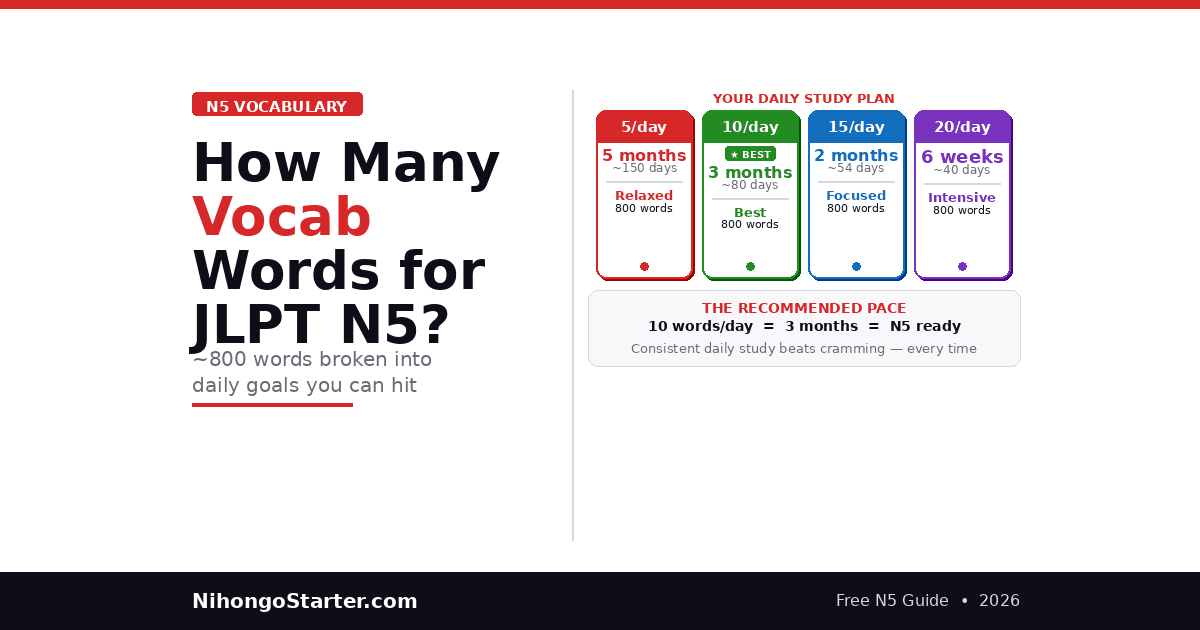

The number is around 800. And before that number scares you — let me put it in perspective immediately.
800 words divided by 90 days is fewer than 9 words per day. Round it up to 10 words per day and you cover the entire N5 vocabulary list in 80 days — less than three months. That is one short study session every morning, or one 20-minute review every evening. Not a lifestyle overhaul. A manageable daily habit.
I know this because I lived it. In early 2025 I started Japanese from absolute zero. By June 2025 — roughly five months later — I sat the PJC Bridge N5 equivalent exam at ISL Dhaka and passed with a C+ (60/100). By July 2025 I passed the N4 equivalent with a B+ (74/100). Vocabulary was a core part of both results, and the approach that made it work was not intensive cramming — it was consistent, daily, category-based study with a realistic word count target I could actually hit.
This guide tells you exactly how many vocabulary words the JLPT N5 requires, breaks them into a daily study plan you can start today, and gives you the category framework that makes 800 words feel completely manageable rather than overwhelming.
Table of Contents
How Many Vocabulary Words Does JLPT N5 Actually Require?
The honest answer: approximately 800 words, depending on the source.
The Japan Foundation, which administers the JLPT, does not publish an official fixed vocabulary list for any level. The N5 is designed to test whether a learner can understand basic everyday Japanese — which means the vocabulary tested is drawn from a broad pool of common words rather than a single memorizable list.
That said, the most widely accepted estimate — used by established study resources and confirmed by analysis of official JLPT sample questions — is approximately 800 words for N5. You will see numbers ranging from 700 to 900 depending on which source you consult. The variation exists because different resources count slightly differently — some include word variations, some count only base forms, some include words that appear in listening but not reading.
For your study purposes, 800 is the right working number. It is large enough to prepare you for any vocabulary question that appears on a real N5 exam, and small enough to be genuinely achievable with a consistent daily study habit.
According to the official JLPT level summary on jlpt.jp, N5 tests the ability to understand some basic Japanese used in everyday situations — meaning the vocabulary is specifically the kind of common, practical language used in daily life. This is actually good news: you are not memorizing obscure academic terms. You are learning words you can use immediately.
The Daily Study Plan — 4 Paces for 4 Types of Learner
Here is the complete breakdown of how long it takes to cover 800 N5 vocabulary words at four different daily study paces. All of these are realistic — choose the one that fits your actual schedule and stick to it consistently.
| Daily Goal | Days to Complete | Approximate Timeline |
|---|---|---|
| 5 words / day | 160 days | ~5 months |
| 10 words / day | 80 days | ~3 months |
| 15 words / day | 54 days | ~2 months |
| 20 words / day | 40 days | ~6 weeks |
The 5 Words Per Day Pace — For Busy Schedules
Five words per day is the minimum effective pace. At this speed, you cover all 800 N5 vocabulary words in about five months — which is a perfectly reasonable timeline if you are studying Japanese alongside full-time work, school, or family commitments.
The advantage of this pace is sustainability. Five new words per day is a 10–15 minute daily commitment. It is small enough that you will almost never miss a day because life gets in the way. And consistency over five months builds vocabulary that genuinely sticks — because you have had time to encounter each word in multiple contexts before the exam.
The risk at this pace is that it only works if your exam date is at least five to six months away. If you have less time, you need a higher gear.
The 10 Words Per Day Pace — The Recommended Sweet Spot
Ten words per day is the pace I recommend for most N5 learners — and it is the one I used during my own preparation.
At 10 words per day, you cover all 800 N5 vocabulary words in 80 days — just under three months. That leaves meaningful buffer time for review, practice tests, grammar study, and the kanji work that runs in parallel with vocabulary. It is fast enough to reach N5 readiness in a reasonable time frame, and manageable enough to sustain without burnout.
A daily 10-word session takes about 20 to 30 minutes including review of previous days. At this pace, you are always reviewing recently learned words alongside new ones — which is exactly the kind of spaced repetition that builds long-term retention.
The 15 Words Per Day Pace — For Focused Preparation
Fifteen words per day covers the full list in just under two months — a solid pace for someone with a specific exam date in two to three months who wants a structured, intensive preparation.
At this pace, daily study sessions run 30 to 45 minutes for new words plus review. The key risk is review debt — if you skip review sessions, new words start pushing old ones out of working memory. Fifteen per day requires a reliable review system (spaced repetition flashcards work best at this pace) to keep retention high across the full 800-word range.
The 20 Words Per Day Pace — Last-Resort Intensive
Twenty words per day covers all 800 N5 vocabulary words in 40 days — about six weeks. This pace is what I would recommend only if your exam is six to eight weeks away and you are starting from scratch.
Let me be honest about this pace: it works, but it requires treating Japanese vocabulary study as a near-daily priority commitment of 45 to 60 minutes. At 20 words per day, the forgetting curve becomes your biggest enemy — new words arrive faster than old ones consolidate. You absolutely need a spaced repetition system at this pace, and you need to review aggressively.
I have met learners who used this pace successfully. I have also met learners who burned out at week three and retained very little. The 10 words per day pace produces more reliable results for most people.
The 7 Vocabulary Categories — How 800 Words Break Down
One of the most important things I learned during my N5 preparation is that 800 words is not a flat, undifferentiated list. It breaks down into logical categories — and studying by category is dramatically more effective than studying in random or frequency order.
Here is how the N5 vocabulary roughly distributes across categories:
| Category | Approximate Word Count | Examples |
|---|---|---|
| Everyday verbs | ~150 words | 食べる, 飲む, 行く, 来る, 見る |
| Common nouns | ~200 words | 学校, 電車, 時間, 人, 食べ物 |
| Adjectives (i and na) | ~100 words | 大きい, 小さい, 好き, 元気 |
| Numbers and time | ~80 words | 一, 二, 何時, 今日, 毎日 |
| Greetings and expressions | ~50 words | こんにちは, ありがとう, すみません |
| Family and people | ~60 words | 父, 母, 友達, 先生, 学生 |
| Places and directions | ~80 words | 右, 左, 駅, 学校, うち |
| Colors, shapes, nature | ~80 words | 赤, 青, 山, 川, 花 |
This breakdown reveals something immediately useful: nearly a quarter of the N5 vocabulary list consists of common nouns that you will encounter in every real Japanese conversation. Another fifth are everyday verbs — the action words that form the backbone of every sentence you read or hear.
Studying by category means that when you learn 食べる (to eat), you learn it alongside 飲む (to drink), 作る (to make), and 買う (to buy) — related action words that reinforce each other through association. Your brain builds a mental cluster of “eating and drinking vocabulary” rather than four isolated, disconnected entries on a flat list.
The N5 Vocabulary Categories — Detailed Study Guide
Everyday Verbs (~150 words)
Verbs are the engine of Japanese sentences. Every N5 grammar pattern you study — て-form, ます-form, past tense, negation — attaches to verbs. Learning verbs early means your grammar practice immediately has real vocabulary to work with.
The most important N5 verbs to prioritize in your first month:
| Verb | Reading | Meaning |
|---|---|---|
| 食べる | taberu | to eat |
| 飲む | nomu | to drink |
| 行く | iku | to go |
| 来る | kuru | to come |
| 見る | miru | to see / watch |
| 聞く | kiku | to listen / ask |
| 話す | hanasu | to speak |
| 読む | yomu | to read |
| 書く | kaku | to write |
| 買う | kau | to buy |
| 帰る | kaeru | to return home |
| 起きる | okiru | to wake up |
| 寝る | neru | to sleep |
| 働く | hataraku | to work |
| 勉強する | benkyou suru | to study |
These 15 verbs alone cover a significant portion of the action vocabulary tested in N5 listening and reading comprehension. Master these first — everything else builds around them.
Common Nouns (~200 words)
Nouns form the largest single category in the N5 vocabulary list. The good news: most of them are concrete, everyday objects and concepts that are easy to visualize and connect to real experience.
High-priority N5 nouns by subcategory:
Food and drink: ご飯 (gohan — rice/meal), 水 (mizu — water), お茶 (ocha — tea), パン (pan — bread), 肉 (niku — meat), 魚 (sakana — fish)
Daily life: 家 (ie — house), 部屋 (heya — room), 電話 (denwa — phone), 時計 (tokei — clock/watch), 鞄 (kaban — bag), 服 (fuku — clothes)
Transport and places: 電車 (densha — train), バス (basu — bus), 駅 (eki — station), 学校 (gakkou — school), 病院 (byouin — hospital), 銀行 (ginkou — bank)
Nature and weather: 天気 (tenki — weather), 雨 (ame — rain), 風 (kaze — wind), 雪 (yuki — snow)
I-Adjectives and Na-Adjectives (~100 words)
Adjectives in Japanese come in two grammatical types — i-adjectives (ending in い) and na-adjectives (requiring な before a noun). At N5, you need roughly 50 of each.
The most important N5 adjectives are covered in full in the i and na adjectives guide on NihongoStarter — including the grammatical rules that govern how each type connects to nouns and verbs, with the complete N5 adjective list organized for study.
Greetings and Set Expressions (~50 words)
This is the smallest category but arguably the most immediately useful. N5 greetings and set expressions appear in the listening section of every JLPT exam — and they are the vocabulary you can start using in real Japanese conversations from day one.
The full breakdown of essential N5 greetings and expressions is in the basic Japanese greetings N5 guide on NihongoStarter — going well beyond こんにちは to cover morning, evening, leaving, returning, thanking, apologizing, and the expressions that make everyday Japanese interaction flow naturally.
How to Actually Study 10 Words Per Day — The System That Works
Knowing the target is 10 words per day is one thing. Having a daily system that actually produces retention — not just temporary recognition — is another entirely.
Here is the exact three-part daily system I used during my own N5 preparation in 2025.
Part 1 — Morning: Learn 10 new words (15 minutes) Open your vocabulary list for the day. For each new word: read the Japanese, say the reading out loud, read the meaning, and immediately make one short example sentence using that word — even a simple one like “今日、水を飲む” (Today I drink water). Creating even one sentence forces your brain to process the word as usable language rather than just a memorization item.
Part 2 — Evening: Review the last 3 days (10 minutes) Go back through the previous three days’ vocabulary and test yourself — cover the meaning column and read each word, or cover the Japanese and recall it from the English meaning. Any word you hesitate on for more than two seconds goes back into active review. This simple three-day rolling review prevents the most common vocabulary study failure: words that feel learned but are forgotten within a week.
Part 3 — Weekly: Full category review (20 minutes on day 7) At the end of each week, go through every word from that week in random order. Mark any gaps. The weekly review session is what turns short-term familiarity into genuine long-term retention.
This three-part system requires about 25 minutes per day on weekdays and 20 minutes on the weekend review day. It is sustainable over three months — which is exactly what N5 vocabulary preparation requires.
For vocabulary flashcard management, Jisho.org is the most reliable free Japanese dictionary for verifying readings, checking example sentences, and understanding the nuances between similar words. Many N5 learners also use Anki with pre-built N5 vocabulary decks — the spaced repetition algorithm handles the review scheduling automatically, which makes the system even more efficient.
The Biggest Vocabulary Study Mistakes N5 Beginners Make
Three patterns come up consistently among N5 learners who struggle with vocabulary — and all three are completely avoidable once you know to watch for them.
Mistake 1 — Studying vocabulary completely separately from grammar. Vocabulary and grammar are not two separate subjects. They are the same subject approached from different angles. When you learn 食べる (to eat), immediately practice it in the ます-form (食べます), the て-form (食べて), and the past tense (食べました). The vocabulary word becomes a grammar practice tool. The grammar pattern becomes a vocabulary memory anchor. Both improve simultaneously.
Mistake 2 — Learning words in alphabetical or frequency order instead of by category. Alphabetical order produces no associative memory. High-frequency order front-loads abstract function words (particles, conjunctions, time words) that are hard to memorize without context. Category order — all food words together, all transport words together, all verbs together — builds associative clusters that your brain navigates efficiently. It is the difference between storing items randomly in a warehouse versus organizing them on labeled shelves.
Mistake 3 — Treating recognition and recall as the same thing. You might recognize a word when you see it in a reading comprehension question but completely fail to recall it when you hear it in the listening section. Recognition (seeing → understanding) and recall (hearing → understanding) are different memory skills that require different practice. Always practice both: read the word and give the meaning, then cover the word and give the Japanese from the meaning or an audio cue.
FAQ
How many vocabulary words do I need for JLPT N5?
Approximately 800 words. This is the most widely accepted estimate based on official JLPT sample materials and established N5 study resources. The official JLPT level summary on jlpt.jp defines N5 as the ability to understand basic everyday Japanese — meaning the vocabulary tested consists of common, practical words used in daily life situations.
Is 800 words a lot for JLPT N5?
No — in context, it is quite manageable. English speakers have a passive vocabulary of 15,000 to 20,000 words. A functional everyday conversation vocabulary in any language is typically 1,000 to 2,000 words. The N5 standard of 800 words is specifically designed to be achievable by a motivated beginner in three to six months of consistent study. The key word is consistent — 10 words per day every day is far more effective than 50 words one day per week.
Should I use a vocabulary list or just study from a textbook?
Both work, but for different purposes. A structured vocabulary list — organized by category with readings and meanings clearly laid out — is the most efficient tool for systematic coverage of all 800 N5 words. A textbook provides vocabulary in context, which builds deeper understanding of how words are used. The most effective approach combines both: use a category list for systematic daily study, and use a textbook or reading material to see the words in real sentences.
How do I remember the difference between similar-sounding N5 words?
Context sentences are the most effective solution. 聞く (kiku — to hear/ask) and 見る (miru — to see) are aurally distinct but conceptually easy to mix up in a flat list. Create one concrete sentence for each word that anchors it to a specific real situation — “音楽を聞く” (I listen to music) and “映画を見る” (I watch a movie). The situation becomes the memory hook that separates similar words in your recall.
What is the fastest way to learn 800 words for JLPT N5?
The fastest sustainable method — not the fastest possible method — is 15 words per day with strict spaced repetition review, covering the list in approximately two months. Going faster than 15 words per day significantly increases the risk of review debt, where new words displace old ones before they consolidate into long-term memory. Intensity without review is just temporary familiarity. The 10 words per day pace at three months produces more reliable exam-ready retention for most learners.
800 Words. 80 Days. 10 Per Day.
That is the equation. Clean, simple, achievable.
800 vocabulary words sounds like a mountain until you divide it by 80 days and realize it is 10 words per morning — a habit smaller than your daily coffee. Three months of consistent 10-word study sessions will cover every vocabulary word you need for JLPT N5, with buffer time for review, grammar study, and practice tests.
The learners who struggle with N5 vocabulary are almost never the ones who studied too slowly. They are the ones who studied irregularly — five days of intense cramming followed by a week of nothing. Consistent beats intensive. Every single time.
Start today. Pick your pace from the four options in this guide. Open your first category. Learn your first 10 words. Come back tomorrow and do it again.
The next step is knowing which words to prioritize first. The basic Japanese greetings N5 guide on NihongoStarter covers the 50 essential expressions and greetings that every N5 learner should learn in week one — the words that appear in every conversation and every listening section, and that you can start using in real Japanese from day one.