

In English, asking a question requires rearranging the entire sentence.
“You are a student.” → “Are you a student?”
The verb jumps to the front. The word order flips. And if you add “do” or “does” — the rules get even more complicated.
Japanese does none of that.
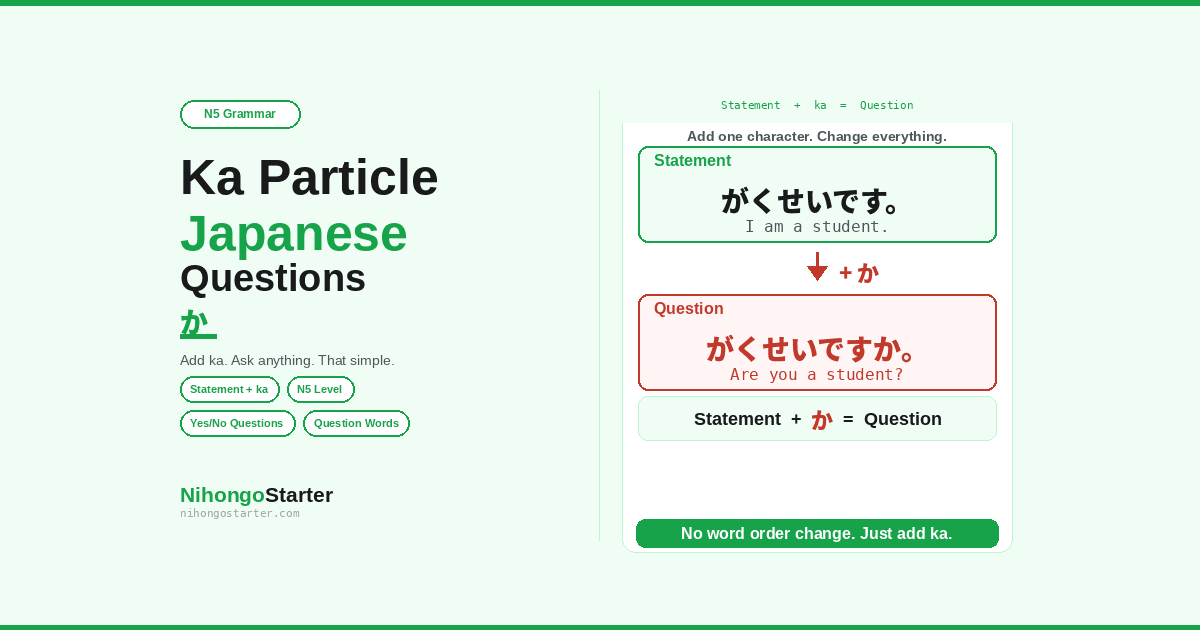
To turn any Japanese statement into a question, you add one character to the end: か (ka). The word order stays exactly the same. Nothing moves. Nothing changes. Just か — and the sentence becomes a question.
When I was preparing for my PJC Bridge N5 exam at ISL Dhaka in June 2025, the か particle was the first grammar point that made me genuinely laugh. After weeks of struggling with particles and verb groups, here was something that took about ninety seconds to understand and worked perfectly every single time.
This guide shows you the full か system — yes/no questions, question word questions, choice questions, and real examples you can use immediately.
Table of Contents
The Core Rule — One Character Does Everything
The entire rule fits in one line:
[Statement] + か = Question
That’s it. No verb inversion. No auxiliary verbs. No special grammar structures.
Take any sentence you already know. Add か to the end. You now have a question.
| Statement | Question | English |
|---|---|---|
| がくせいです。 | がくせいですか。 | Are you a student? |
| たべます。 | たべますか。 | Will you eat? |
| にほんじんです。 | にほんじんですか。 | Are you Japanese? |
| むずかしいです。 | むずかしいですか。 | Is it difficult? |
| いきました。 | いきましたか。 | Did you go? |
Every sentence follows the same pattern. The statement is identical — か is the only addition.
How English and Japanese Compare — Side by Side
This comparison is the fastest way to feel just how elegant the か system is.
| English Question | What English Does | Japanese Question | What Japanese Does |
|---|---|---|---|
| Are you a student? | Inverts verb | がくせいですか。 | Adds か |
| Did you eat? | Adds “did,” changes verb | たべましたか。 | Adds か |
| Will you come? | Adds “will” | きますか。 | Adds か |
| Is it delicious? | Inverts “is” | おいしいですか。 | Adds か |
| Was it fun? | Inverts “was” | たのしかったですか。 | Adds か |
Every English question uses a different grammatical trick. Japanese uses the same trick every single time.
The か particle is genuinely one of the most elegant features of Japanese grammar for beginners. Once it clicks — you can turn every sentence you’ve ever learned into a question instantly.
Yes/No Questions — The Most Common Use
Yes/no questions are the simplest application of か. Statement plus か — done.
Answering yes/no questions in Japanese:
- はい (hai) — yes
- いいえ (iie) — no
- はい、そうです (hai, sou desu) — yes, that’s right
- いいえ、ちがいます (iie, chigaimasu) — no, that’s wrong
Real Conversation Examples
Q: にほんごを べんきょうしていますか。 Nihongo wo benkyou shite imasu ka. Are you studying Japanese?
A: はい、べんきょうしています。 Hai, benkyou shite imasu. Yes, I am studying.
Q: コーヒーを のみますか。 Koohii wo nomimasu ka. Will you drink coffee?
A: いいえ、のみません。みずを のみます。 Iie, nomimasen. Mizu wo nomimasu. No, I won’t. I’ll drink water.
Q: きのう がっこうに いきましたか。 Kinou gakkou ni ikimashita ka. Did you go to school yesterday?
A: はい、いきました。 Hai, ikimashita. Yes, I went.
Question Words + か — Unlocking Every Type of Question
Yes/no questions are just one half of the か system. The other half — and the part that dramatically expands what you can ask — is combining か with question words.
Every question word in Japanese works with the same sentence structure. The question word goes where the unknown information would be — the sentence ends with か.
The N5 question word list:
| Question Word | Hiragana | Romaji | Meaning |
|---|---|---|---|
| 何 | なに / なん | nani / nan | what |
| どこ | どこ | doko | where |
| 誰 | だれ | dare | who |
| いつ | いつ | itsu | when |
| どうして / なぜ | どうして / なぜ | doushite / naze | why |
| どう / いかが | どう / いかが | dou / ikaga | how |
| いくら | いくら | ikura | how much |
| いくつ | いくつ | ikutsu | how many |
| どんな | どんな | donna | what kind of |
| どれ | どれ | dore | which one |
Question Word Sentences in Action
なにを たべますか。 Nani wo tabemasu ka. What will you eat?
どこに いきますか。 Doko ni ikimasu ka. Where are you going?
だれが きましたか。 Dare ga kimashita ka. Who came?
いつ にほんに いきますか。 Itsu Nihon ni ikimasu ka. When are you going to Japan?
これは いくらですか。 Kore wa ikura desu ka. How much is this?
なんじですか。 Nanji desu ka. What time is it?
Notice the pattern: the question word slides into the sentence where the unknown information belongs. The verb stays at the end. か closes the question. The structure is consistent every time.
Turning Your Existing Sentences Into Questions
Here’s the insight that made this grammar point click for me during N5 preparation: you already know dozens of Japanese sentences. Every single one of them is now also a question — just add か.
Every sentence from the jikoshoukai guide, the sentence structure guide, the past tense guide — all of them can become questions right now.
From the self-introduction guide:
- わたしは がくせいです。→ がくせいですか。(Are you a student?)
- にほんごを べんきょうしています。→ にほんごを べんきょうしていますか。(Are you studying Japanese?)
From the past tense guide:
- えいがを みました。→ えいがを みましたか。(Did you watch a movie?)
- ごはんを たべませんでした。→ ごはんを たべませんでしたか。(Didn’t you eat?)
From the numbers guide:
- ひゃくえんです。→ ひゃくえんですか。(Is it 100 yen?)
Every statement you’ve ever learned — question in one step.
か for Choices — A or B
か has one more important use at N5 level: expressing choices between two options.
Formula: [Option A] か [Option B]
This is different from the question か — it sits between choices, not at the end of a sentence.
| Japanese | Romaji | English |
|---|---|---|
| コーヒーか おちゃ | koohii ka ocha | coffee or tea |
| ねこか いぬ | neko ka inu | a cat or a dog |
| にほんか かんこく | Nihon ka Kankoku | Japan or Korea |
In a full sentence:
コーヒーか おちゃを のみますか。 Koohii ka ocha wo nomimasu ka. Will you drink coffee or tea?
にほんか かんこくに いきたいですか。 Nihon ka Kankoku ni ikitai desu ka. Do you want to go to Japan or Korea?
Intonation — How か Sounds in Real Speech
Written Japanese uses か as the question marker — often without a question mark (?). The question mark appears in casual modern writing, but traditionaly, か carries all the weight.
In spoken Japanese, か with です/ます forms uses flat or slightly rising intonation — more neutral than the strong rising intonation English speakers default to. Raising your voice dramatically at the end sounds unnatural to Japanese ears.
In casual speech among friends, Japanese speakers sometimes drop か entirely and use rising intonation alone:
- Formal: コーヒーを のみますか。 (flat to slight rise)
- Casual: コーヒー、のむ? (rising intonation — no か)
At N5 level — always use the full です/ますか form. It’s universally polite, always correct, and exactly what the JLPT exam expects.
The 3 Most Common Beginner Mistakes
Mistake 1 — Changing Word Order for Questions
English speakers instinctively want to move the verb forward when asking questions.
❌ ですか がくせい あなたは。(Moving words around) ✅ あなたは がくせいですか。(Statement + か — nothing moves)
The word order never changes. か does all the work.
Mistake 2 — Answering はい/いいえ to Negative Questions
In English, answering a negative question is straightforward: “Don’t you eat meat?” → “No, I don’t.”
In Japanese, はい and いいえ confirm or deny the reality — not the question’s polarity.
にくを たべませんか。 (Don’t you eat meat?)
- はい、たべません。 — Yes (you are correct), I don’t eat meat.
- いいえ、たべます。 — No (you are wrong), I do eat meat.
This trips up English speakers constantly. はい confirms the truth of what follows — not agreement with the question’s structure.
Mistake 3 — Using か With Plain Form in Formal Situations
At N5 level, か always follows です or ます in polite speech.
❌ たべるか。(Plain form — sounds blunt or rude in formal situations) ✅ たべますか。(Polite form — always appropriate)
Save the plain form questions for when you’re comfortable with casual Japanese register — well beyond N5 level.
FAQ
What does the ka particle do in Japanese?
The か (ka) particle is Japanese’s question marker. Adding か to the end of any polite-form statement turns it into a question without changing the word order. For example: がくせいです (I am a student) becomes がくせいですか (Are you a student?) by adding only か. This is the fundamental difference from English, which requires verb inversion or auxiliary verbs to form questions. か is one of the simplest and most immediately useful grammar points in the entire N5 curriculum.
How do you use ka to ask questions in Japanese?
To form a question using か, take any complete Japanese statement ending in です or ます and add か at the end. The entire sentence structure stays identical — nothing moves. たべます (I eat / will eat) becomes たべますか (Will you eat?). いきました (I went) becomes いきましたか (Did you go?). For question-word questions, place the question word (なに, どこ, だれ, いつ) where the unknown information belongs in the sentence, then end with か as normal.
What are the question words in Japanese for N5?
The essential N5 question words are: なに/なん (what), どこ (where), だれ (who), いつ (when), どうして/なぜ (why), どう (how), いくら (how much), いくつ (how many), どんな (what kind of), and どれ (which one). Each one combines with the standard Japanese sentence structure — question word in the position of the unknown information, か at the end. According to The Japan Foundation’s N5 curriculum, these ten question words cover virtually all question-forming needs at the N5 level.
Do you need a question mark when using ka in Japanese?
Technically no — か itself signals a question, making a question mark (?) grammatically redundant in Japanese. In traditional and formal writing, sentences end with a period (。) even when they’re questions containing か. In modern casual writing, digital communication, and manga, question marks appear commonly because they visually reinforce the questioning tone. On the JLPT N5 exam, you will see both conventions. At NihongoStarter, we include ? in conversation examples for clarity, but both are correct.
How do you answer yes/no questions in Japanese?
Yes/no questions in Japanese are answered with はい (hai — yes) or いいえ (iie — no). The key difference from English: はい and いいえ confirm or deny the truth of the statement that follows them — not the grammatical polarity of the question. When answering a negative question like にくを たべませんか (Don’t you eat meat?), はい、たべません means “Yes, you are correct, I don’t eat meat” — and いいえ、たべます means “No, you are wrong, I do eat meat.” This reversal from English intuition is one of the most important N5 conversation points to master early.
One Character. Every Question.
The か particle is proof that Japanese grammar rewards beginners.
While English makes you learn different question structures for every tense and verb type, Japanese gives you one tool that works everywhere — instantly, consistently, without exception.
Take any sentence you know. Add か. Ask the question.
Every statement in every guide on NihongoStarter is now also a question. The sentences from our self-introduction guide, our past tense guide, our sentence structure guide — add か to any of them and you’re asking questions in Japanese right now.
That’s the power of one character.