
You’re staring at a Japanese sentence and something feels off. Some characters look soft and rounded. Others look sharp and angular. Same language — but two completely different visual styles staring back at you.
That’s hiragana and katakana. And the confusion you’re feeling right now? Every single Japanese learner has been exactly there.
I remember it clearly — early 2025, sitting in Dhaka with my first Japanese study material, wondering why on earth one language needed two completely different-looking scripts that made the same sounds. It felt unnecessary. Almost cruel. But once someone explained the logic behind it, everything clicked instantly. That’s exactly what this guide is going to do for you.
Here’s a clean, honest breakdown of what each script is, why it exists, and exactly when Japanese uses one over the other. With real examples you can read right now.
Table of Contents
First — What They Actually Have in Common
Before diving into the differences, let’s deal with the thing that confuses beginners most.
Hiragana and katakana represent the exact same sounds. Every single one. Both scripts have 46 basic characters. Both cover the complete range of Japanese syllables — from あ/ア (a) to ん/ン (n).
Think of it like this: the word “cat” written in regular text and the word “cat” written in italics — same word, same pronunciation, completely different visual style. Hiragana and katakana work the same way. Different look, same sound underneath.
They’re both part of a category called kana — the phonetic scripts of Japanese. Neither carries meaning on its own the way kanji does. They just represent sound.
So why have two? Because each one has a completely different job.
The Core Difference — One Simple Rule
Here it is. The rule that explains everything:
Hiragana = Japanese words. Katakana = foreign words.
That’s the foundation. Everything else builds from there.
Hiragana (ひらがな) handles native Japanese — words that originated in Japan, grammatical particles, verb endings, anything that is fundamentally Japanese in origin.
Katakana (カタカナ) handles foreign imports — words borrowed from English, French, Portuguese, German, or any other language outside Japan.
When a Japanese person sees katakana, their brain instantly registers: “This word came from somewhere else.” It’s a visual signal built right into the script. That’s not an accident — it’s by design.
How They Look Different — Rounded vs. Angular
The visual difference is the easiest way to tell them apart — and it’s a direct reflection of their history.
Hiragana looks curved, flowing, and soft — like handwritten cursive. Characters like か, め, and の have loops, flowing strokes, and organic shapes. Hiragana developed from the cursive form of Chinese characters (kanji), which explains the rounded elegance of the script. Historically, it was even called onna-de — “women’s hand” — because Japanese court women developed and used it first.
Katakana looks sharp, angular, and blocky — like printed text. Characters like ク, メ, and ノ have straight lines, hard angles, and a more mechanical appearance. Katakana developed from components of Chinese characters rather than the full cursive form — stripped down, efficient, direct.
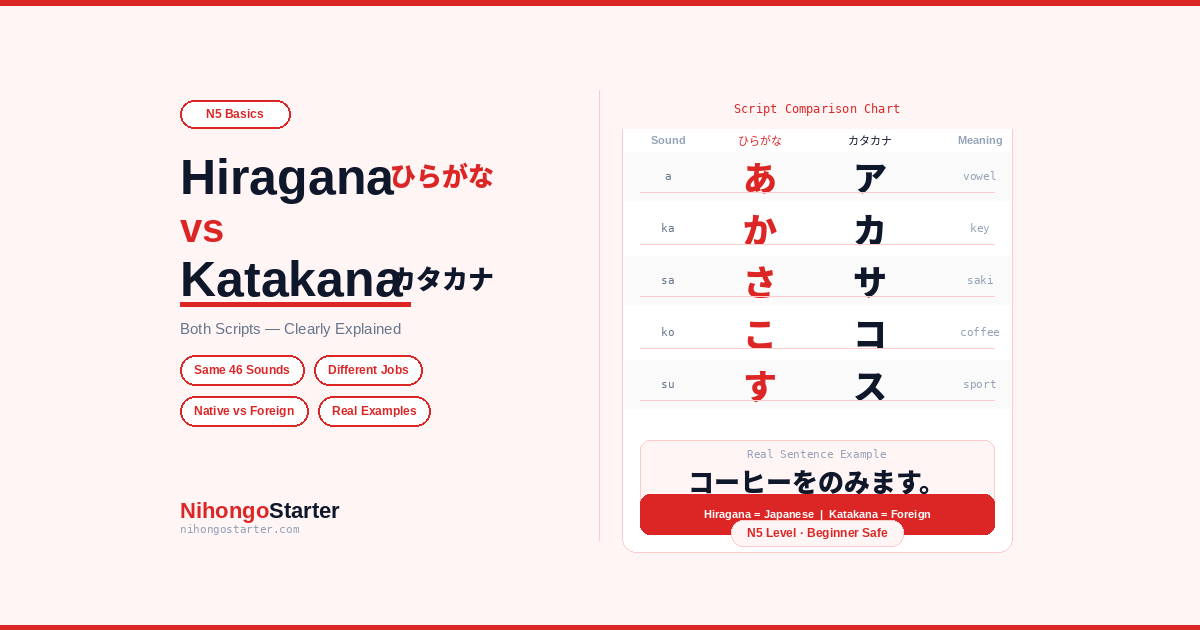
Here’s a quick side-by-side so you can see the contrast immediately:
| Sound | Hiragana | Katakana |
|---|---|---|
| a | あ | ア |
| i | い | イ |
| u | う | ウ |
| e | え | エ |
| o | お | オ |
| ka | か | カ |
| ki | き | キ |
| ko | こ | コ |
| sa | さ | サ |
| su | す | ス |
Notice how the hiragana characters feel like they flow — and the katakana versions feel more precise and structural. Both say the exact same sounds. Completely different visual personality.
When to Use Hiragana — The 4 Main Jobs
Hiragana is the workhorse of Japanese. It shows up constantly, in every type of text, every single day. Here’s exactly what it handles:
1. Native Japanese Words
Words that originated in Japan are written in hiragana — unless they have a kanji form, in which case the kanji handles the root and hiragana handles the endings.
Examples of hiragana-written native words:
- きれい (kirei) — beautiful
- むずかしい (muzukashii) — difficult
- たのしい (tanoshii) — fun/enjoyable
2. Grammatical Particles
Every Japanese sentence uses particles — small words that tell you the relationship between other words. All of them are written in hiragana.
Common particles you’ll see everywhere:
- は (wa) — topic marker
- が (ga) — subject marker
- を (wo) — object marker
- に (ni) — direction/location marker
- の (no) — possession marker
3. Verb and Adjective Endings
The root of a verb or adjective is often kanji — but the endings that change with tense and conjugation are always written in hiragana.
Example: 食べる (taberu — to eat)
- 食 = kanji root (meaning “eat”)
- べる = hiragana ending (makes it a verb form)
4. Furigana
Small hiragana written above or beside kanji characters to show pronunciation. You’ll see this in children’s books, beginner textbooks, and manga — incredibly helpful when you’re just starting out.
When to Use Katakana — The 5 Main Jobs
Katakana has a narrower but very important role. Once you know what it signals, reading Japanese gets significantly easier.
1. Foreign Loanwords (Gairaigo)
This is katakana’s primary purpose. Any word borrowed from another language — predominantly English — gets written in katakana. These borrowed words are called gairaigo (外来語), meaning “words from outside.”
Real examples you’ll encounter immediately:
- コーヒー (kōhī) — coffee
- テレビ (terebi) — television
- スマホ (sumaho) — smartphone
- パソコン (pasokon) — personal computer
- レストラン (resutoran) — restaurant
- アイスクリーム (aisu kurīmu) — ice cream
Here’s what makes this so useful for English speakers: you already know thousands of katakana words. You just can’t read them yet. Once you learn the katakana characters, entire menus, signs, and product labels suddenly become readable — because so much of modern Japanese vocabulary is borrowed English.
2. Foreign Names and Place Names
Names from outside Japan are written in katakana. Your own name, if you’re not Japanese, would be written in katakana.
Examples:
- マイク (Maiku) — Mike
- サラ (Sara) — Sarah
- ニューヨーク (Nyū Yōku) — New York
- アメリカ (Amerika) — America
3. Onomatopoeia and Sound Effects
Japanese is famous for its rich vocabulary of sound words. Many of them — especially in manga — are written in katakana for visual impact.
- ワンワン (wanwan) — dog barking
- ドキドキ (dokidoki) — heartbeat sound
- ザーザー (zāzā) — heavy rain
4. Scientific and Technical Terms
Plant names, animal species, and scientific terminology often appear in katakana in formal writing.
5. Emphasis
Just like English uses italics or bold to stress a word, Japanese writers sometimes switch a normally hiragana word into katakana — purely to make it stand out visually.
A Real Japanese Sentence — All Three Scripts Together
This is the part most beginner guides skip entirely. Real Japanese sentences mix hiragana, katakana, and kanji all at once. Let’s break one down so you can see exactly how each script functions in context.
わたしは まいあさ コーヒーを のみます。
Watashi wa maiasa kōhī wo nomimasu.
(I drink coffee every morning.)
Breaking it down:
- わたし — hiragana (native Japanese word: “I/me”)
- は — hiragana (particle: topic marker)
- まいあさ — hiragana (native Japanese: “every morning”)
- コーヒー — katakana (foreign loanword from English: “coffee”)
- を — hiragana (particle: object marker)
- のみます — hiragana (verb ending: “drink”)
See it? One foreign word, written in katakana, surrounded by hiragana. That visual contrast is exactly how Japanese reading works — and once you understand it, mixed Japanese text starts making sense immediately.
The Confusing Pairs — Characters That Look Almost Identical
Nobody warns beginners about this part. Several hiragana and katakana characters look dangerously similar. These are the ones to watch:
| Hiragana | Katakana | Sound | How to Tell Apart |
|---|---|---|---|
| へ | ヘ | he | Nearly identical — context is your clue |
| に | ニ | ni | に has a curve; ニ is two straight lines |
| り | リ | ri | り has a connecting curve; リ is two separate strokes |
| の | ノ | no | の has a loop; ノ is a single diagonal stroke |
| う | ウ | u | う has a rounded top; ウ is angular |
The good news? Context makes these much easier. In a sentence full of curved hiragana, a sharp katakana character stands out immediately — and vice versa.
FAQ
Are hiragana and katakana the same sounds?
Yes — completely. Every sound represented by a hiragana character has an exact katakana equivalent. あ and ア both say “a.” か and カ both say “ka.” The difference is never the pronunciation — it’s always about which type of word you’re writing. Once you know all 46 hiragana sounds, you already know the phonetics of katakana too.
Why does Japanese need two separate scripts for the same sounds?
The dual-script system works as a built-in visual signal for readers. When you see katakana in a sentence, you instantly know that word came from outside Japan — without any additional context needed. It also helps separate word boundaries in Japanese, which is written without spaces. The visual contrast between rounded hiragana and angular katakana makes text easier to scan and understand at a glance.
Can I skip katakana and just learn hiragana?
Technically possible as a starting point — but not recommended for long. Katakana is everywhere in modern Japanese: restaurant menus, product labels, street signs, advertisements, apps, and virtually all modern vocabulary borrowed from English. Skipping katakana means missing a massive portion of real-world Japanese from day one. Most learners find katakana quicker to pick up than hiragana because the words are familiar English words in disguise.
Do Japanese people use hiragana and katakana at the same time?
Every day, in every sentence. Most adult Japanese text mixes hiragana, katakana, and kanji naturally within the same sentence. Hiragana handles grammar and native words, katakana flags foreign words, and kanji carries meaning-dense vocabulary. The three scripts work together as a system — not separately.
Is it harder to learn hiragana or katakana?
Most learners find hiragana slightly easier because of its rounder, more distinct shapes. Katakana characters can look more similar to each other, which trips some people up early on. That said, katakana often feels more motivating — once you crack the script, you can suddenly read hundreds of familiar English words in Japanese. Both scripts are completely learnable within a few weeks of consistent daily practice.
Ready to Learn Your First Script?
The difference between hiragana and katakana isn’t complicated — it just needs to be explained clearly.
Hiragana is the home script of Japanese. It carries native words, grammar, and the structural flow of every sentence. Katakana is the international script — the one Japanese uses to welcome words from the rest of the world. Same sounds, different jobs, both essential.
When I started studying in early 2025, understanding this one distinction made everything else click into place. It turned three confusing writing systems into a logical, readable structure — and it’ll do the same for you.
Start with hiragana. Build your reading speed with our hiragana reading practice guide. Then move to katakana — and watch an enormous amount of modern Japanese vocabulary suddenly become recognizable.
Two scripts. One language. And now you understand exactly how they work together.