

If you’ve spent any time studying kanji, you’ve almost certainly hit this wall.
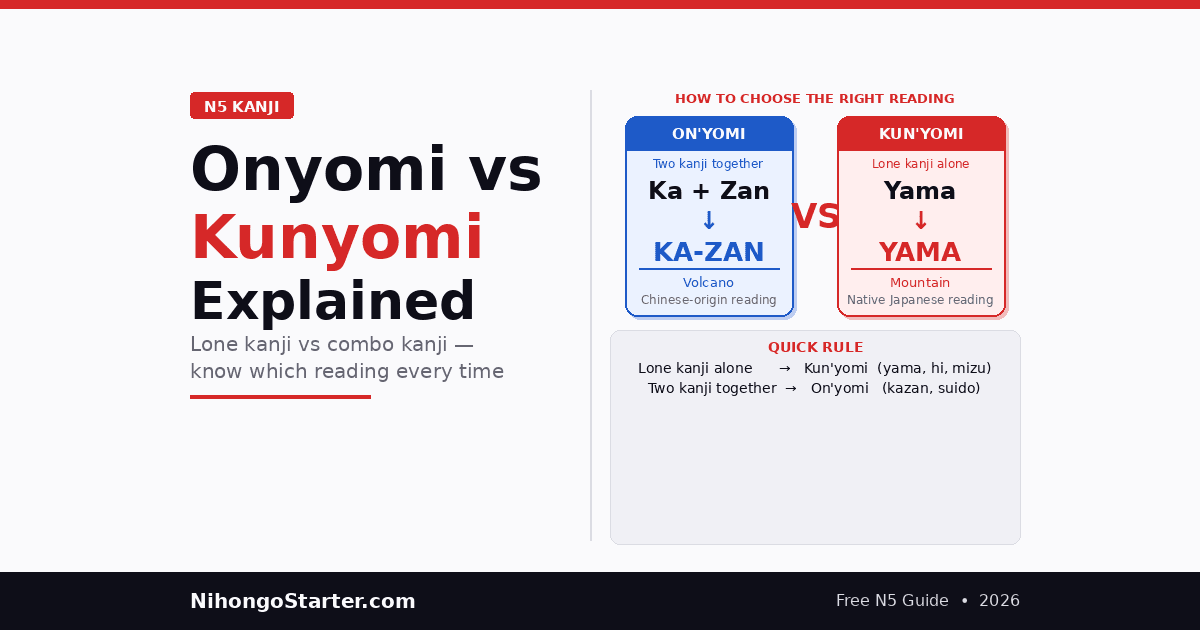
You learn that 山 means mountain. You learn it reads “yama.” You feel confident. Then you see 火山 (volcano) and someone tells you it reads “kazan” — not “hi-yama.” The onyomi vs kunyomi confusion stops almost every N5 beginner in their tracks. Same kanji, completely different sound, and no one explains why.
There is a rule. One clear, logical rule that handles the vast majority of reading situations you will ever encounter at N5 level. I remember the exact moment this clicked for me during my N5 studies in early 2025 — it was one of those rare moments where something confusing becomes so obvious you almost feel silly for being confused by it. This guide gives you that rule, walks through real N5 kanji examples until the pattern is automatic, and honestly explains where the rule breaks down so you’re never caught off guard.
Table of Contents
What Onyomi vs Kunyomi Actually Means
Every kanji in Japanese carries at least two different readings. These readings fall into two categories — onyomi and kunyomi — and understanding the difference is the key to unlocking how kanji actually work in real Japanese text.
Onyomi (音読み) literally means “sound reading.” These are the Chinese-derived pronunciations that arrived in Japan along with the kanji characters themselves, starting around the 5th century. When Chinese writing was introduced to Japan, the Japanese adopted not just the characters but approximations of their Chinese pronunciations. Over centuries those sounds evolved into what we now call onyomi. They tend to be shorter, more clipped, and in Japanese dictionaries they are listed in katakana.
Kunyomi (訓読み) literally means “meaning reading.” These are the native Japanese pronunciations — words that already existed in the Japanese language long before kanji arrived from China. When the Japanese encountered a Chinese character meaning “mountain,” they mapped it to their existing word for mountain: “yama.” That native word became the kunyomi of 山. Kunyomi tend to sound more natural and flowing in everyday speech, and in Japanese dictionaries they are listed in hiragana.
Standard online dictionaries like Jisho.org format kanji entries exactly this way — onyomi in katakana first, kunyomi in hiragana below it. Once you know what that formatting means, every dictionary entry immediately becomes more useful.
The confusion most beginners experience comes from not knowing which reading applies in a given sentence. That is exactly what the rule of thumb solves.
The 1 Simple Onyomi vs Kunyomi Rule That Works Every Time
Here it is — the single most useful principle for choosing between onyomi and kunyomi:
Lone kanji → use kunyomi. Kanji paired with other kanji → use onyomi.
Write that down. Stick it somewhere visible while you study. This one rule handles roughly 80% of the reading situations you will encounter at N5 level and beyond.
Lone Kanji Examples (Kunyomi)
When a kanji stands by itself — alone or attached to hiragana — it almost always uses its kunyomi reading.
| Kanji | Kunyomi Reading | Meaning | Example Sentence |
|---|---|---|---|
| 山 | yama | mountain | 山がある (there is a mountain) |
| 火 | hi | fire | 火が出た (fire broke out) |
| 水 | mizu | water | 水を飲む (drink water) |
| 木 | ki | tree | 木の下 (under the tree) |
| 月 | tsuki | moon | 月が綺麗 (the moon is beautiful) |
| 人 | hito | person | 人がいる (there is a person) |
| 目 | me | eye | 目が痛い (my eye hurts) |
| 手 | te | hand | 手を洗う (wash your hands) |
| 日 | hi | sun / day | 日が暮れる (the sun sets) |
| 金 | kana | metal | 金のなる木 (money tree, idiom) |
Notice how each kanji connects to hiragana or stands alone. That lone kanji pattern signals kunyomi almost every time.
Compound Kanji Examples (Onyomi)
When two or more kanji appear together with no hiragana between them, the compound almost always uses onyomi for every component.
| Compound | Onyomi Reading | Meaning |
|---|---|---|
| 火山 | ka-zan | volcano |
| 山林 | san-rin | mountain forest |
| 水道 | sui-dou | water supply |
| 木曜日 | moku-you-bi | Thursday |
| 人口 | jin-kou | population |
| 日本 | ni-hon | Japan |
| 月曜日 | getsu-you-bi | Monday |
| 目的 | moku-teki | purpose |
| 手術 | shu-jutsu | surgery |
| 金曜日 | kin-you-bi | Friday |
See the pattern? 山 alone reads “yama” (kunyomi). The moment it joins another kanji — 火山, 山林 — it shifts to “san” (onyomi). Same character, predictable rule.
Why This Onyomi vs Kunyomi Rule Exists — The Logic Behind It
The lone vs compound rule is not arbitrary. It reflects the actual history of how Japanese and Chinese vocabulary developed together in Japan.
Kunyomi readings represent native Japanese vocabulary — words like “yama,” “mizu,” and “hi” that Japanese people used in everyday speech for centuries before kanji arrived. These words appear naturally in ordinary conversation: describing the mountain you can see, the water you’re drinking, the fire in front of you.
Onyomi readings represent the vocabulary of scholarship and formal language — concepts that came to Japan through Chinese texts and academic writing. Compound kanji words built from onyomi tend to express more abstract or technical ideas: volcano, population, surgery, water infrastructure. These are words Japanese scholars adopted from Chinese along with their Chinese-derived pronunciations.
This is why, even today, onyomi compound words often feel more formal than their kunyomi equivalents. 水 (mizu — water, kunyomi) is the water you drink every day. 水道 (suidou — water supply, onyomi compound) is the engineering system that delivers it. That formal-versus-everyday pattern runs throughout the entire language.
Understanding this history makes the rule feel inevitable rather than arbitrary — and things that feel inevitable are far easier to remember permanently.
The N5 Kanji That Need Both Readings
The rule of thumb handles most situations, but at N5 level a core set of kanji appear frequently in both lone and compound contexts. Knowing both readings by name — not just by feel — matters for vocabulary recognition and reading comprehension on the actual exam. The official JLPT N5 content reference from jlpt.jp confirms vocabulary and reading are both tested directly.
Here are the most important N5 kanji with both readings clearly laid out:
| Kanji | Meaning | Onyomi | Kunyomi | Key N5 Vocabulary |
|---|---|---|---|---|
| 山 | mountain | san / zan | yama | 火山 (kazan), 富士山 (Fujisan), 山 (yama) |
| 川 | river | sen | kawa | 川 (kawa), 河川 (kasen) |
| 日 | sun / day | nichi / jitsu | hi / ka | 日本 (Nihon), 日曜日 (nichiyoubi), 今日 (kyou)* |
| 月 | moon / month | getsu / gatsu | tsuki | 月曜日 (getsuyoubi), 一月 (ichigatsu), 月 (tsuki) |
| 火 | fire | ka | hi | 火曜日 (kayoubi), 火山 (kazan), 火 (hi) |
| 水 | water | sui | mizu | 水曜日 (suiyoubi), 水道 (suidou), 水 (mizu) |
| 木 | tree | moku / boku | ki | 木曜日 (mokuyoubi), 木 (ki) |
| 金 | gold / money | kin | kane | 金曜日 (kin’youbi), お金 (okane) |
| 土 | earth | do / to | tsuchi | 土曜日 (doyoubi), 土 (tsuchi) |
| 人 | person | jin / nin | hito | 人口 (jinkou), 外国人 (gaikokujin), 人 (hito) |
| 大 | big | dai / tai | oo | 大学 (daigaku), 大きい (ookii) |
| 小 | small | shou | chii / ko | 小学校 (shougakkou), 小さい (chiisai) |
| 上 | above | jou / shou | ue | 上手 (jouzu), 上 (ue) |
| 下 | below | ka / ge | shita | 地下 (chika), 下 (shita) |
| 手 | hand | shu | te | 手術 (shujutsu), 上手 (jouzu), 手 (te) |
*Today’s date note below under exceptions.
If you have not yet worked through the kanji themselves, the complete N5 kanji list on NihongoStarter has all 103 characters grouped by category — the readings in this table map directly onto that list.
Where the Onyomi vs Kunyomi Rule Breaks Down — Honest Exceptions
I promised to be honest, so here it is: the lone vs compound rule is a rule of thumb, not an absolute law. A small number of extremely common words break it — and at N5 level, you’ll encounter all of them constantly.
今日 (kyou — today) Two kanji together, which should mean onyomi. But “kyou” is a special reading that doesn’t match either kanji’s individual onyomi. This category of exception is called jukujikun (熟字訓) — a compound with a single native Japanese reading that can’t be predicted from the rule. You simply learn it as a complete vocabulary word.
大人 (otona — adult) Again two kanji, but entirely kunyomi-based. Another jukujikun. Very common in everyday Japanese.
明日 (ashita — tomorrow) Same category. Special compound reading, learned as a unit.
名前 (namae — name) Both kanji use kunyomi in this compound — 名 reads “na” and 前 reads “mae.” Less common than pure onyomi compounds, but not rare.
The honest bottom line: the rule handles roughly 80% of N5 kanji reading situations correctly. The remaining 20% involves either jukujikun special readings — learned as complete vocabulary words — or mixed-reading compounds that come naturally through vocabulary study over time. The rule dramatically reduces the number of situations where you are genuinely guessing.
How to Practice Onyomi and Kunyomi Without Confusing Yourself
The most common mistake learners make when studying readings is trying to memorize both onyomi and kunyomi for every kanji before feeling confident using either one.
Don’t do this. It leads directly to paralysis.
Here’s the approach that worked during my own N5 preparation in 2025. For each new kanji, learn it inside two real vocabulary words simultaneously — one that uses the onyomi (typically a compound) and one that uses the kunyomi (typically the standalone reading or a word with hiragana attached). Don’t think of them as “the onyomi” and “the kunyomi.” Think of them as two different words that happen to share the same character.
For 山: learn 山 (yama — the mountain outside your window) and 火山 (kazan — the volcano you studied in geography). Two words. Two contexts. The reading difference becomes natural through association rather than through memorizing abstract labels.
This approach connects directly to your N5 vocabulary study. Every vocabulary word you learn gives you a practical, contextualized example of a kanji reading. You’re building reading intuition from real words — exactly how native Japanese speakers develop the same intuition growing up.
Once you’re comfortable with your N5 kanji and their readings, the N5 vocabulary guides on NihongoStarter are built around exactly this principle — kanji and vocabulary taught together so neither exists as an isolated, context-free list.
FAQ
What is the difference between onyomi and kunyomi?
Onyomi (音読み) are the Chinese-derived readings of a kanji, used primarily in compound words made of two or more kanji. Kunyomi (訓読み) are the native Japanese readings, used primarily when a kanji stands alone or attaches to hiragana endings. The simplest rule: lone kanji uses kunyomi, compound kanji uses onyomi. You can verify any kanji’s readings instantly on Jisho.org — onyomi appear in katakana, kunyomi in hiragana.
Do all kanji have both onyomi and kunyomi readings?
Most do, but not all. Some kanji — typically those borrowed for concepts with no existing native Japanese equivalent — have only onyomi. Some have only kunyomi. At N5 level, the kanji you encounter almost all have at least one of each, and the most common characters like 日, 月, and 山 have multiple readings in both categories.
Is onyomi or kunyomi more important for JLPT N5?
Both are tested, but in different ways. Kunyomi readings appear more frequently in basic vocabulary and everyday sentence patterns. Onyomi is essential for compound vocabulary words, which make up a significant portion of the N5 word list. You need both — which is why learning them through real vocabulary rather than as isolated abstract labels is so effective.
Why do Japanese dictionaries show onyomi in katakana and kunyomi in hiragana?
This is a standard Japanese lexicographic convention that makes the two reading types visually distinct at a glance. Katakana for onyomi signals the Chinese-origin nature of those readings. Hiragana for kunyomi signals the native Japanese origin. When you look up any kanji on Jisho.org and see readings in mixed katakana and hiragana, that formatting is doing exactly this work — immediately telling you which category each reading belongs to.
What is a jukujikun reading?
Jukujikun (熟字訓) are special compound readings where a group of kanji together carries a single native Japanese reading that cannot be predicted from the individual characters. Common N5 examples include 今日 (kyou — today), 大人 (otona — adult), and 明日 (ashita — tomorrow). These are memorized as complete vocabulary words rather than decoded from the lone vs compound rule. At N5 level there are only a handful of common jukujikun — but they appear constantly, so learning them by name is worth it.
The Moment the Rule Becomes Automatic
There is a specific point in every Japanese learner’s journey where onyomi and kunyomi stop being confusing labels and start being natural, automatic responses to what they see on the page.
That moment comes from exposure to real vocabulary — not from memorizing abstract reading charts. The more N5 words you study, the more your brain builds the pattern automatically. You stop consciously applying the lone vs compound rule and simply know which reading fits, the same way a native Japanese speaker does without ever thinking about it.
But you have to walk through the rule first. The lone kanji vs combo kanji principle is what gets you over the wall — and once you’re over it, the readings start feeling as natural as the characters themselves.
The natural next step is seeing these readings applied directly to a practical vocabulary set. The days of the week in Japanese guide on NihongoStarter is a perfect next read — all seven days use the onyomi of the natural element kanji you just studied, and seeing that pattern in action makes the rule click permanently.