
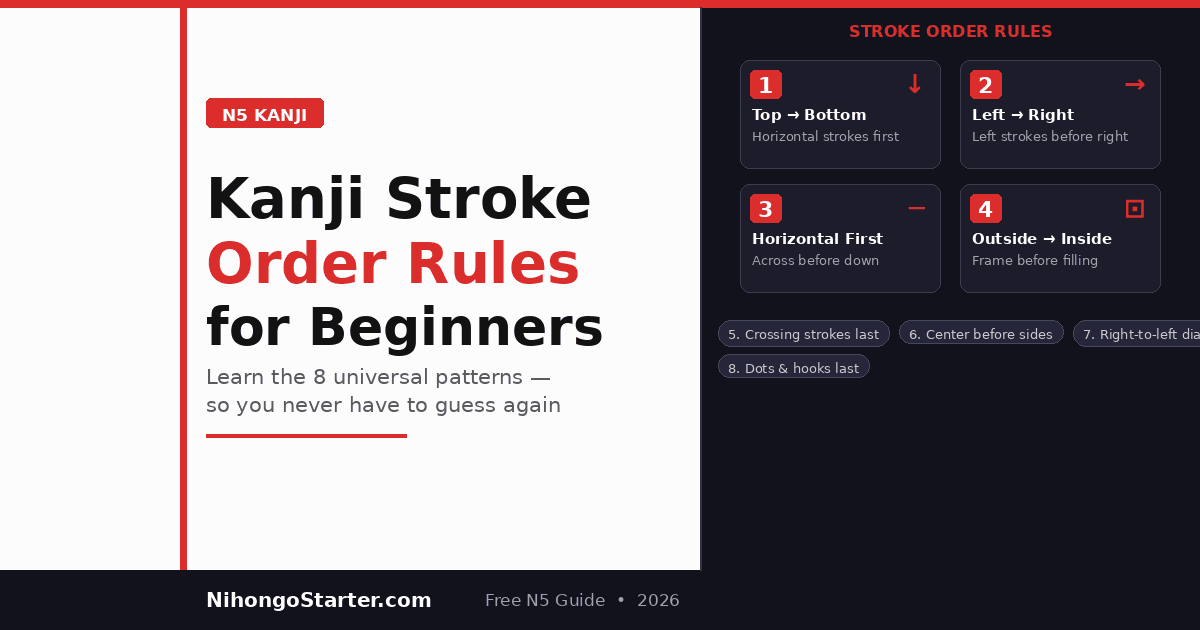

Most beginners treat stroke order as a mystery. Every time they pick up a pen to write a new kanji, they guess — starting wherever the character looks like it should start, drawing lines in whatever direction feels natural, and hoping for the best.
Here’s what I discovered after weeks of doing exactly that: stroke order in Japanese is not a mystery at all. It is a system. A logical, consistent system built on eight universal patterns that apply to virtually every kanji you will ever write — from the simplest N5 characters all the way through advanced kanji you won’t encounter for years.
When I was preparing for my PJC Bridge N5 equivalent exam at ISL Dhaka in June 2025, I spent the first few weeks writing kanji in completely random order. My characters looked wrong, my writing was inconsistent, and I kept forgetting which direction certain strokes went. The moment I sat down and actually learned the eight rules — not individual stroke orders for individual characters, but the underlying system — everything clicked into place. I stopped guessing. I started writing confidently. And my kanji recognition actually improved because I finally understood the structure of each character from the inside out.
This guide teaches you all eight patterns, shows you exactly how they apply to real N5 kanji, and gives you a framework you can use for every new character you encounter — including ones you’ve never seen before.
Table of Contents
Why Stroke Order Actually Matters for N5 Learners
Before getting into the rules themselves, it’s worth being honest about something most beginner guides get wrong on this topic.
Stroke order does not matter for the JLPT N5 exam. The test is multiple choice — you read and recognize kanji, you don’t write them. So if your only goal is passing the N5 exam, you can technically skip stroke order entirely.
But here’s why learning it anyway is one of the smartest investments you can make at this stage.
First, stroke order improves recognition. When you write a kanji with the correct stroke sequence, you’re tracing the visual logic the character was built with. Your hand learns the shape in the same order your eye is meant to read it. This creates a stronger, more reliable memory trace than purely visual study — and that stronger memory pays off directly in the reading sections of any Japanese exam.
Second, stroke order makes your handwriting readable. Written Japanese — in notes, cards, letters, or any situation where you write by hand — relies on consistent stroke order because Japanese people read handwritten characters by following the flow of the strokes. Characters written in random order often look strange or illegible even when the individual lines are correct.
Third, and most practically for N5 learners: understanding stroke order means you can learn new kanji faster. Once you know the eight patterns, you can look at any unfamiliar character and immediately understand how to write it. You don’t need to look up stroke order charts every single time. The rules tell you.
The 8 Universal Kanji Stroke Order Rules
These eight rules govern the stroke order of virtually every kanji in existence. They are not arbitrary conventions — they evolved from thousands of years of brush calligraphy, where writing in a consistent direction produced smoother, more fluid characters. The same logic applies to pen and pencil writing today.
Learn these eight rules and you have the master key to stroke order for life.
Rule 1 — Top to Bottom
When strokes are stacked vertically, always write from the top stroke down to the bottom stroke.
This is the most fundamental rule and the one that feels most natural to most beginners. Think of the kanji 三 (three) — three horizontal lines. You write the top line first, then the middle line, then the bottom line. Always top to bottom, never bottom to top.
This applies to any kanji with stacked elements. In 音 (sound), you write the top portion before the bottom portion. In 草 (grass), the upper components come before the lower ones. The rule is consistent without exception.
N5 examples: 三, 王, 音, 草, 言
Rule 2 — Left to Right
When strokes are arranged horizontally side by side, always write from the left stroke to the right stroke.
This feels natural because it mirrors the direction of English writing — left to right across the page. In 川 (river), you write the left vertical stroke first, then the middle stroke, then the right stroke. Never right to left.
The same principle applies to complex kanji with left and right components. 明 (bright) is built from 日 on the left and 月 on the right — you write the entire left component before starting the right component.
N5 examples: 川, 明, 男, 林, 州
Rule 3 — Horizontal Before Vertical (When They Cross)
When a horizontal stroke and a vertical stroke cross each other, write the horizontal stroke first.
This rule catches many beginners off guard because it contradicts what feels instinctive. When you look at 十 (ten), your eye might want to draw the vertical line first — it looks like the spine of the character. But the rule is clear: horizontal first, then vertical through it.
The same pattern governs 木 (tree), 土 (earth), 王 (king), and dozens of other N5 kanji. Draw across, then draw down through the horizontal stroke.
There is one important exception to note: when the vertical stroke is the center of the character and horizontal strokes hang off both sides of it, the vertical comes first. The kanji 中 (middle/inside) works this way — vertical center stroke first, then the horizontal stroke crossing through it. Recognizing this exception becomes instinctive with practice.
N5 examples: 十, 木, 土, 王, 大, 本
Rule 4 — Outside (Frame) Before Inside
When a kanji has a frame or enclosure, write the outer frame first — then fill in the inside content.
Look at 日 (sun/day). The outer box comes first: left side, top, right side. Then you add the horizontal stroke inside. You are building the container before adding the contents.
This applies to any kanji with a box or frame structure: 目 (eye), 田 (rice field), 口 (mouth), 国 (country). Frame first, contents second.
The practical reason this rule exists comes from traditional brush calligraphy — writing the frame first establishes the size and proportion of the character before you commit to the interior strokes. The same benefit applies when writing with a pen.
N5 examples: 日, 月, 目, 田, 口, 国, 四
Rule 5 — Close the Frame Last
When a frame has a bottom stroke that closes it, always write that closing stroke last — after all interior content is complete.
This is a specific extension of Rule 4 that trips up beginners constantly. In 国 (country), you write the outer sides first, then all the interior content, and only then do you close the bottom of the frame. The frame is sealed last, not first.
Think of it like writing a letter, putting it inside an envelope, and then sealing the envelope. You don’t seal the envelope before writing the letter.
This rule applies to any closed frame kanji — those where four sides completely enclose interior content. Open frames (like the three-sided enclosure in 区 or 医) follow a slightly different pattern, but for standard N5 closed-frame kanji, closing stroke always comes last.
N5 examples: 国, 図, 固, 因
Rule 6 — Center Before Outside (Symmetrical Characters)
When a kanji has a clear center element with symmetrical strokes on both sides, write the center element first, then the left side, then the right side.
This rule applies most clearly to kanji like 小 (small) and 水 (water). In 小, you write the center vertical stroke first, then the left hooked stroke, then the right hooked stroke. In 水, the center stroke comes first, then the left side strokes, then the right side strokes.
The logic here mirrors a real-world principle — you establish the center axis of a symmetrical structure before building outward from it. Architects draw the center line before designing the wings of a building. Kanji stroke order applies the same logic.
N5 examples: 小, 水, 山, 火, 来
Rule 7 — Right-to-Left Diagonal Before Left-to-Right Diagonal
When a kanji contains two crossing diagonal strokes, write the right-to-left diagonal (the stroke that goes from upper right toward lower left) first, before the left-to-right diagonal.
This rule feels the most counterintuitive to English writers because it goes against the natural left-to-right bias. But in the kanji 文 (writing/sentence), 父 (father), and 交 (interaction/crossing), the right-leaning diagonal is written before the left-leaning one.
The practical reason: in brush calligraphy, the right-to-left diagonal is written with a specific brush angle that naturally prepares the hand position for the left-to-right diagonal that follows. Writing them in the reverse order would require an awkward mid-stroke repositioning of the brush.
N5 examples: 文, 父, 交, 女, 又
Rule 8 — Dots and Small Strokes Last
Small dots, minor finishing strokes, and decorative hooks are always written last — after the main body of the kanji is complete.
In 犬 (dog), the small dot on the upper right is the final stroke, added after the rest of the character is complete. In 玉 (jewel/ball), the interior dot is written last. In 式 (ceremony/style), the finishing hook comes after the main components.
Think of these final strokes as the punctuation of a kanji — the period at the end of a sentence, added once the main content is written. They finalize and complete the character.
This rule prevents a very common beginner mistake: writing what looks like the most prominent or interesting part of a character first, then realizing the surrounding strokes don’t flow naturally around it.
N5 examples: 犬, 玉, 式, 戸, 成
How the 8 Rules Work Together — A Real Example
The rules rarely operate in isolation. Most kanji require applying two, three, or even four rules simultaneously in the correct priority order.
Let me walk through 語 (language/word) — a common N5 kanji — using all applicable rules.
語 has a left component (言 — speech/words) and a right component (吾 — I/me). Apply Rule 2: left before right. Write 言 completely before starting 吾.
Within 言, apply Rule 1: top to bottom. The short horizontal stroke at the very top comes first, then the mouth shape (口) below it, built with Rule 4 (frame before inside) applied to the box.
Within 吾, apply Rule 3: the horizontal stroke in 五 crosses the vertical, so horizontal first. Then the mouth shape at the bottom, again with frame before inside.
Result: a complex kanji with eleven total strokes, written in a logical, consistent sequence you can derive entirely from the eight rules — without ever looking at a stroke order chart.
This is the power of learning the system rather than memorizing individual stroke sequences. Once the eight rules are automatic, every kanji becomes a puzzle you can solve rather than a sequence you have to memorize separately.
The Most Common Stroke Order Mistakes N5 Beginners Make
After going through this learning process myself and reading extensively about where beginners consistently go wrong, three mistakes come up again and again.
Mistake 1 — Writing vertical strokes before horizontal strokes because vertical “looks like the main stroke.” This is the most frequent error, especially in kanji like 十, 木, and 土. The horizontal stroke always comes first when they cross. Drill this rule specifically — it contradicts instinct for most people.
Mistake 2 — Closing the frame too early. Beginners see the outer box in 国 or 図 and naturally want to complete it before moving inside. The bottom of the frame — the closing stroke — comes last, after everything inside is written. This one single mistake makes handwriting look immediately wrong to native Japanese readers.
Mistake 3 — Treating every kanji as unique rather than rule-governed. This is the root cause of most stroke order confusion. When learners approach each new kanji as an entirely new memorization task, stroke order becomes overwhelming. When they apply the eight rules as a checklist, even unfamiliar kanji become manageable on first encounter.
A Simple Way to Practice These Rules Daily
You don’t need to set aside separate stroke order study sessions. The most effective practice is integrating stroke order into your regular kanji study from the very first character.
When you learn a new N5 kanji — whether from the complete N5 kanji list grouped by category on NihongoStarter or from your vocabulary study — go through this quick three-step process:
First, look at the kanji and identify which of the eight rules apply. Second, write the character once slowly, consciously applying each rule in sequence. Third, write it five more times at normal speed without thinking — letting the correct sequence become automatic.
Six intentional repetitions using the rule-based system will build more reliable muscle memory than fifty mindless repetitions on autopilot. I can say this from direct personal experience — the switch from volume-based practice to rule-based practice cut my stroke order errors by more than half within a week.
FAQ
Do I really need to learn stroke order for JLPT N5?
Strictly speaking, no — the JLPT N5 does not test writing. But learning stroke order significantly improves kanji recognition and memory retention, which directly helps your reading comprehension and vocabulary performance on the actual exam. It also makes your handwriting legible if you ever need to write Japanese by hand, which becomes increasingly important as you progress beyond N5.
What happens if I write a kanji in the wrong stroke order?
In casual handwriting, minor stroke order deviations often go unnoticed. In formal writing, calligraphy, or situations where a native Japanese speaker examines your handwriting closely, incorrect stroke order is noticeable — characters written out of order have a different visual flow that looks unnatural. For exam purposes at N5, the bigger risk is that wrong stroke order leads to vague or inconsistent kanji forms that damage your recognition ability over time.
Are there any kanji that break all these rules?
A small number of kanji have stroke orders that seem to violate one or more of the standard rules — these are historical exceptions where the traditional calligraphic sequence was preserved even though it doesn’t follow the general patterns. At N5 level, these exceptions are extremely rare. The eight rules cover the vast majority of N5 kanji without exception.
Is there a difference between Japanese stroke order and Chinese stroke order?
The core principles are very similar — both systems evolved from the same brush calligraphy tradition. There are occasional differences in specific kanji, particularly for characters that were simplified differently in Japan (shinjitai) and China (simplified Chinese). For N5 learners, using Japanese stroke order references — not Chinese ones — is important for absolute accuracy.
How long does it take to internalize the eight rules?
Most learners feel comfortable applying the rules automatically within two to three weeks of consistent practice. The first week involves consciously checking each rule before writing. By the second week, the top-to-bottom and left-to-right rules become automatic. By the third week, most learners are applying all eight rules without conscious effort on familiar N5 kanji.
The Stroke Order System Is Your Shortcut
Every kanji you will ever encounter follows the same eight rules. That means the work you put into understanding these patterns today pays compounding returns for every kanji you learn tomorrow — at N5, at N4, and beyond.
Stop guessing which stroke comes first. Start applying the rules. Your handwriting will look better within days, your recognition will strengthen within weeks, and you’ll never need to look up stroke order for a basic kanji again.
The next step is understanding how to read kanji — specifically the two pronunciation systems every N5 character carries. The onyomi vs kunyomi guide on NihongoStarter explains the difference in plain English and gives you the simple rule of thumb that makes choosing the right reading almost automatic.