
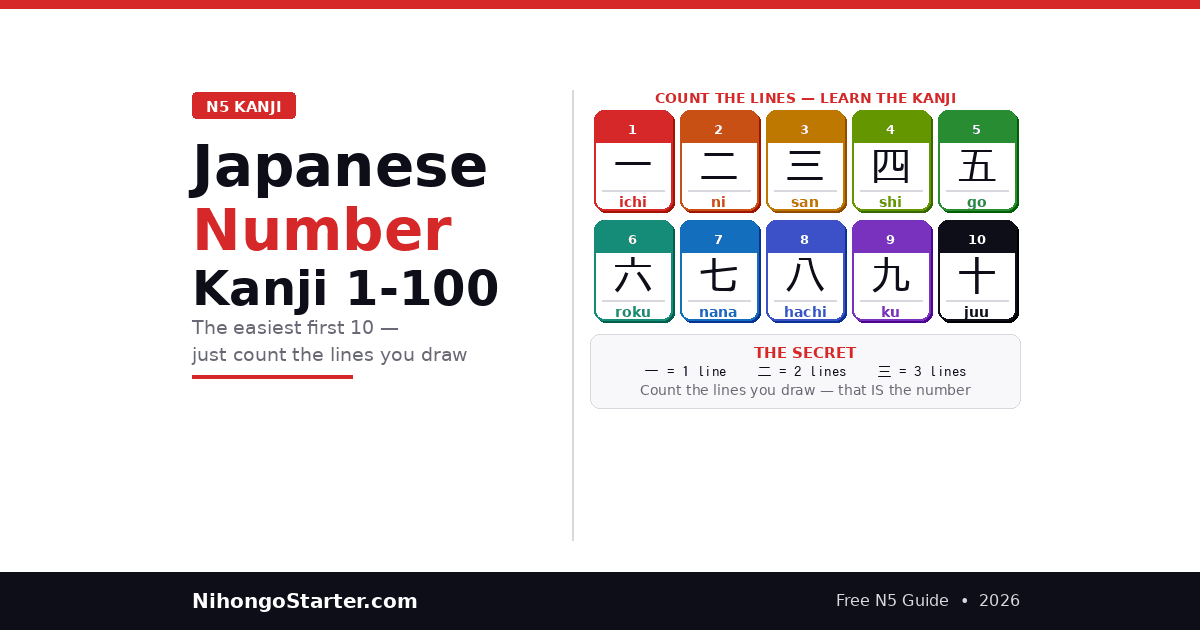

Of all the kanji you need to learn for JLPT N5, the number kanji have the single best secret hiding in plain sight.
一 is one horizontal line. 二 is two horizontal lines. 三 is three horizontal lines. You are not memorizing abstract shapes — you are literally drawing the number. Count the strokes. That is the number. Nothing in Japanese kanji gets more logical than this, and nothing builds beginner confidence faster than realizing the first three number kanji are things you already know how to draw.
I remember the moment I first understood this during my N5 preparation in early 2025. I had been dreading the kanji section for weeks. Then I looked at 一, 二, 三 properly for the first time and laughed. Three of the kanji I needed were just lines. That realization changed how I approached every kanji that followed — if the number system was this logical, maybe the rest of Japanese kanji had logic hiding in them too. It did. And it does.
This guide teaches you all Japanese number kanji from 1 through 100, starting with the first 10 characters that follow a clear visual pattern — and then showing you the elegant mathematical logic that makes 11 through 100 almost effortless once you have the foundation.
Table of Contents
Why Japanese Number Kanji Are the Best Starting Point for N5
Before getting into the characters themselves, it is worth understanding why number kanji deserve to be the very first kanji any beginner learns — even before the more commonly recommended starting points.
First, the visual logic. As you are about to see, 一, 二, and 三 are pictographically transparent. You draw one line for one, two lines for two, three lines for three. This is not a coincidence or a happy accident — these characters were designed with exactly that visual simplicity, and they have maintained it for thousands of years across Chinese and Japanese writing systems.
Second, the mathematical logic. Once you know 一 through 十 (one through ten), you can read and write every number from 11 to 99 without learning any new kanji at all. 十一 is eleven (ten-one). 二十 is twenty (two-ten). 九十九 is ninety-nine (nine-ten-nine). The system is additive and completely transparent. Compare this to English, where “eleven,” “twelve,” and “thirteen” follow no logical pattern whatsoever.
Third, frequency. Number kanji appear constantly in everyday Japanese — in dates, times, prices, addresses, train stations, floor numbers, and exam questions. Every hour you invest in number kanji pays back immediately in reading ability across dozens of real-world contexts.
According to the official JLPT N5 level summary on jlpt.jp, N5 tests the ability to read and understand basic everyday Japanese — and numbers appear in virtually every category of everyday reading. These are not optional kanji. They are the foundation everything else is built on.
Japanese Number Kanji 1-10: The Complete Foundation
Here are the first ten number kanji with their readings, stroke counts, and the visual logic behind each one.
| Kanji | Number | Onyomi | Kunyomi | Strokes | Visual Logic |
|---|---|---|---|---|---|
| 一 | 1 | ichi | hitotsu | 1 | One horizontal line |
| 二 | 2 | ni | futatsu | 2 | Two horizontal lines |
| 三 | 3 | san | mittsu | 3 | Three horizontal lines |
| 四 | 4 | shi / yo | yottsu | 5 | Box with two inner lines |
| 五 | 5 | go | itsutsu | 4 | Stylized “5” shape |
| 六 | 6 | roku | muttsu | 4 | Roof with two legs |
| 七 | 7 | nana / shichi | nanatsu | 2 | Hook and cross |
| 八 | 8 | hachi | yattsu | 2 | Two spreading strokes |
| 九 | 9 | ku / kyuu | kokonotsu | 2 | Arm with hook |
| 十 | 10 | juu | too | 2 | Cross — ten directions |
一 (ichi) — One
One stroke. One horizontal line drawn left to right. That is the entire character. 一 is the simplest kanji in the Japanese writing system and simultaneously one of the most important — it appears in compound kanji, in words like 一番 (ichiban — number one, the best), 一月 (ichigatsu — January), and 一日 (tsuitachi — the first of the month).
Reading note: In compound words, 一 almost always reads “ichi” (onyomi). As a standalone word meaning “one thing,” it reads “hitotsu” (kunyomi). You will see both constantly at N5 level.
二 (ni) — Two
Two horizontal lines, the upper one slightly shorter than the lower one. Draw the top line first, then the bottom line — top to bottom, following the universal stroke order rule you learned in the kanji stroke order guide on NihongoStarter. 二 appears in 二月 (nigatsu — February), 二人 (futari — two people), and is one of the most frequently written kanji in everyday Japanese.
Reading note: In compounds, 二 reads “ni.” Standing alone as “two things,” it reads “futatsu.”
三 (san) — Three
Three horizontal lines — top, middle, bottom, in that order. The middle line is typically the shortest of the three, and the bottom line is the longest. This gives 三 a slight trapezoidal balance that makes it visually distinct from a random stack of three lines.
三 appears in 三月 (sangatsu — March), 三人 (sannin — three people), and 三つ (mittsu — three things). It is also the “san” in the famous greeting 「こんにちは」— though that comes from a different word entirely.
四 (shi / yo) — Four
Here is where the pure visual logic of 一 二 三 ends. 四 is a box with two horizontal strokes inside it — five strokes total, not four. The visual simplicity breaks down at four, which is why 四 requires actual memorization rather than just counting lines.
One helpful observation: 四 looks somewhat like a box with two shelves inside it — a storage unit holding four items. It is also worth noting that four (四, shi) sounds like the Japanese word for death (死, shi), which is why four is considered unlucky in Japan and sometimes avoided in building floor numbers, hospital room numbers, and gift giving.
Reading note: 四 has two common readings — “shi” and “yo.” You will encounter both: 四月 (shigatsu — April) uses “shi,” while 四つ (yottsu — four things) and 四人 (yonin — four people) use “yo/yon.”
五 (go) — Five
五 is one of those kanji that rewards a second look. It has a stylized shape that vaguely resembles the Roman numeral V crossed with a horizontal bar at top and bottom. Five strokes, though only four are needed. The key visual feature is the bent horizontal stroke in the middle — it gives 五 a distinctive zigzag quality that makes it recognizable once you’ve written it a few times.
五 appears in 五月 (gogatsu — May), 五人 (gonin — five people), and お五つ (gotsutsu — five things, less common). It is also the reading in 五十音 (gojuuon — the 50-sound Japanese phonetic chart).
六 (roku) — Six
六 has a distinctive shape: two strokes at the top form a small roof or hat, and two strokes at the bottom spread outward like legs. Four strokes total. The “roof with legs” image is a surprisingly effective mnemonic — imagine a small house with six people under it, two legs per person.
六 appears in 六月 (rokugatsu — June), 六人 (rokunin — six people), and 六つ (muttsu — six things).
七 (nana / shichi) — Seven
七 is a two-stroke kanji that looks somewhat like the number 7 itself — a horizontal stroke at the top with a curved vertical stroke cutting through it and hooking at the bottom. If you look at it slightly sideways, the resemblance to the Arabic numeral 7 is striking.
七 has two equally common readings: “nana” and “shichi.” Both appear frequently at N5 level. 七月 (shichigatsu — July) uses “shichi,” while 七つ (nanatsu — seven things) uses “nana.” Like four, seven has some cultural significance — 七五三 (Shichi-Go-San) is a traditional Japanese children’s festival.
八 (hachi) — Eight
Two strokes spreading outward from a center point — like two arms opening wide, or the shape of someone bowing with arms spread. This spreading shape is easy to remember because it looks like someone spreading their arms to show how wide something is — “this wide,” showing eight.
八 appears in 八月 (hachigatsu — August), 八人 (hachinin — eight people), and the famous Tokyo district 渋谷 (Shibuya — though the eight connection there is indirect). It is also one of the luckiest numbers in Japanese culture because its spreading shape represents growing prosperity.
九 (ku / kyuu) — Nine
Two strokes: a curved arm stroke followed by a hooking stroke. 九 looks somewhat like a backwards “q” or a stylized arm with a bent elbow. It has two common onyomi readings — “ku” and “kyuu” — both of which appear regularly in N5 vocabulary.
九月 (kugatsu — September) uses “ku.” 九時 (kuji — nine o’clock) also uses “ku.” But 九十 (kyuujuu — ninety) uses “kyuu.” Both readings need to be learned for N5 level.
Like four, nine (九, ku) sounds like the Japanese word for suffering (苦, ku), making it another sometimes-avoided number in certain contexts.
十 (juu) — Ten
Two strokes forming a cross — a horizontal line and a vertical line crossing through the center. 十 looks exactly like a plus sign, which makes intuitive sense: ten is the completion of the first counting cycle, the number where everything “adds up.” In Chinese philosophical tradition, 十 represents completeness — all ten directions (north, south, east, west, and the six diagonal points).
十 is one of the most important kanji in the entire number system because it is the building block for every number from 11 to 99. Once 十 is fully automatic, the mathematical logic of the whole system unlocks immediately.
The Mathematical Logic: How to Read Numbers 11-99
This is the part of Japanese number kanji that makes most beginners stop and say “wait, that’s actually brilliant.”
In Japanese, numbers from 11 to 99 are not new words. They are combinations of the ten kanji you already know, arranged in a pattern that is completely transparent once you see it.
| Number | Kanji | Logic | Reading |
|---|---|---|---|
| 11 | 十一 | Ten + One | juu-ichi |
| 12 | 十二 | Ten + Two | juu-ni |
| 20 | 二十 | Two-Ten | ni-juu |
| 21 | 二十一 | Two-Ten + One | ni-juu-ichi |
| 35 | 三十五 | Three-Ten + Five | san-juu-go |
| 47 | 四十七 | Four-Ten + Seven | yon-juu-nana |
| 58 | 五十八 | Five-Ten + Eight | go-juu-hachi |
| 69 | 六十九 | Six-Ten + Nine | roku-juu-ku |
| 77 | 七十七 | Seven-Ten + Seven | nana-juu-nana |
| 99 | 九十九 | Nine-Ten + Nine | kyuu-juu-ku |
The pattern is: [tens digit] + 十 + [units digit]. Twenty is “two-ten.” Thirty-five is “three-ten-five.” Ninety-nine is “nine-ten-nine.” There are no irregular words, no special names for multiples of ten, no exceptions anywhere in the 1-99 range.
Compare this to English. Eleven and twelve are completely opaque — there is no logical connection between those words and the numbers they represent. Thirteen through nineteen reverse the digit order (three-ten instead of ten-three). Twenty, thirty, forty — “-ty” is a suffix that means ten, but it is buried and irregular. Japanese has none of these problems. The number system is pure mathematical logic written in kanji.
Number Kanji Beyond 100
For completeness at N5 level, you need three additional number kanji for the larger units.
| Kanji | Reading | Meaning | Example |
|---|---|---|---|
| 百 | hyaku | hundred | 百円 (hyaku-en — 100 yen) |
| 千 | sen | thousand | 千円 (sen-en — 1,000 yen) |
| 万 | man | ten thousand | 一万円 (ichi-man-en — 10,000 yen) |
These three kanji unlock reading Japanese prices, large numbers, and many compound vocabulary words at N5 level. 百 (hyaku) and 千 (sen) follow the same additive logic as 十 — 二百 is two-hundred (200), 三千 is three-thousand (3,000).
One important cultural note: Japanese uses 万 (ten thousand) as a basic unit rather than 千 (thousand) as English does. So 50,000 in Japanese is 五万 (go-man — five ten-thousands) rather than “fifty thousand.” This takes adjustment for English speakers but becomes natural quickly with practice.
How to Practice Japanese Number Kanji Until They Are Automatic
You already know that the number kanji are logical. But logic alone does not create automatic recognition — that requires a specific kind of practice.
Here is the exact three-step approach I used during my N5 preparation in 2025 that got 一 through 十 fully automatic within five days.
Day 1 — Write each kanji once, slowly, while saying the reading out loud. Do not drill. Do not repeat. Just write each of the ten kanji once with full attention, saying “ichi, ni, san…” as you write. The goal is a single high-quality impression of each character.
Days 2-4 — Read numbers in real Japanese. Find any Japanese content with numbers — a Japanese recipe, a price list, a calendar, a simple news article from NHK Web Easy. Every time you encounter a number kanji in real context, read it out loud. This builds recognition through meaning rather than repetition.
Day 5 — Write numbers 1-99 from memory using the mathematical logic. Do not write them in order. Pick random numbers — 37, 82, 14, 56 — and write the kanji form from scratch. If you can write any number from 1-99 correctly using 一 through 十 and the additive pattern, the foundation is complete.
If you want to verify your readings as you practice, Jisho.org shows the exact onyomi and kunyomi readings for every number kanji with example sentences — it is the most reliable free resource for confirming Japanese readings.
Connection to Other N5 Vocabulary
Number kanji do not exist in isolation. They appear directly inside dozens of the most important N5 vocabulary words you are already studying — which means every hour you spend on number kanji simultaneously strengthens your vocabulary recognition.
Here are the most important N5 vocabulary words that use number kanji directly:
| Vocabulary | Kanji | Reading | Meaning |
|---|---|---|---|
| January-December | 一月〜十二月 | ichigatsu〜juunigatsu | months of the year |
| One o’clock | 一時 | ichiji | time telling |
| One minute | 一分 | ippun | time telling |
| 100 yen | 百円 | hyaku-en | currency |
| 1,000 yen | 千円 | sen-en | currency |
| Alone / one person | 一人 | hitori | counter |
| Two people | 二人 | futari | counter |
| First floor | 一階 | ikkai | building floors |
| One week | 一週間 | isshuukan | time period |
| January 1st | 一月一日 | ichigatsu tsuitachi | dates |
Once the number kanji are automatic, all of these vocabulary words become immediately readable rather than requiring separate memorization. The complete N5 vocabulary guides on NihongoStarter are built around exactly this kind of kanji-vocabulary connection — so your kanji study and vocabulary study reinforce each other at every step.
FAQ
How many number kanji do I need for JLPT N5?
For JLPT N5, you need 一 through 十 (1-10) plus 百 (100), 千 (1,000), and 万 (10,000). That is 13 kanji total. With those 13 characters and the additive mathematical logic, you can read any number that appears in N5 reading and listening sections. The official JLPT N5 content reference on jlpt.jp confirms that number vocabulary is core N5 content tested in multiple sections.
What is the difference between onyomi and kunyomi for number kanji?
Each number kanji has both onyomi (Chinese-derived) and kunyomi (native Japanese) readings. Onyomi readings — ichi, ni, san, shi, go, roku, nana/shichi, hachi, ku/kyuu, juu — are used in compound words, clock times, months, and most formal counting contexts. Kunyomi readings — hitotsu, futatsu, mittsu, yottsu, itsutsu, muttsu, nanatsu, yattsu, kokonotsu, too — are used when counting things in native Japanese style (hitotsu, futatsu, mittsu…). At N5, you need both sets. The onyomi vs kunyomi guide on NihongoStarter explains the full rule in detail.
Why does four have two readings — shi and yo?
Both readings are correct and both appear in everyday Japanese. “Shi” (onyomi) is used in formal contexts like 四月 (shigatsu — April). “Yo/yon” (a kunyomi-derived form) is used in most counting contexts like 四人 (yonin — four people) and 四十 (yonjuu — forty) — partly because “shi” sounds like the word for death and is avoided in some counting situations. Both readings need to be learned for N5.
Is the Japanese number system easier than the English one?
For numbers 1-9999, yes — significantly. Japanese numbers follow a completely regular additive pattern with no irregular words or special names. Once you know 一 through 十 and the three large-unit kanji (百, 千, 万), you can construct and read any number in that range without additional memorization. English has irregular forms (eleven, twelve, thirteen), inverted digit order in the teens, and irregular suffixes (-ty, -teen) that have no equivalent complexity in Japanese.
Do number kanji appear on real Japanese signs and products?
Yes — constantly. Japanese prices on menus and shop displays frequently use kanji numerals, particularly for traditional or formal contexts. Train station names often include number kanji (like 三軒茶屋 — Sangen-jaya). Floor numbers in buildings use number kanji. Dates in formal Japanese writing use number kanji. Learning to recognize them immediately unlocks a significant amount of real-world Japanese reading that would otherwise remain inaccessible.
The Numbers That Unlock Everything Else
一, 二, 三. Three lines. Three kanji. The simplest characters in the Japanese writing system — and the beginning of a number system that is more logical, more consistent, and more mathematically transparent than the English counting system most of us learned as children.
The first three took me about ninety seconds to learn permanently. The next seven took a few days of real-context reading. The full 1-99 range using the additive logic clicked in less than a week. By the time I sat my PJC Bridge N5 exam at ISL Dhaka in June 2025, every number question was answered with confidence — not because I had drilled them endlessly, but because the system itself is just that logical once you see it clearly.
The next step in your N5 kanji journey is the complete N5 kanji list — all 103 characters organized by category, with readings and example vocabulary for each. The JLPT N5 kanji list guide on NihongoStarter brings everything together into one complete reference you can bookmark and return to throughout your entire N5 preparation.