

Most N5 guides teach the days of the week as a flat memorization list. Seven Japanese words, seven readings, repeat until they stick. It works — eventually — but it takes far longer than it should, and the readings blur together almost immediately.
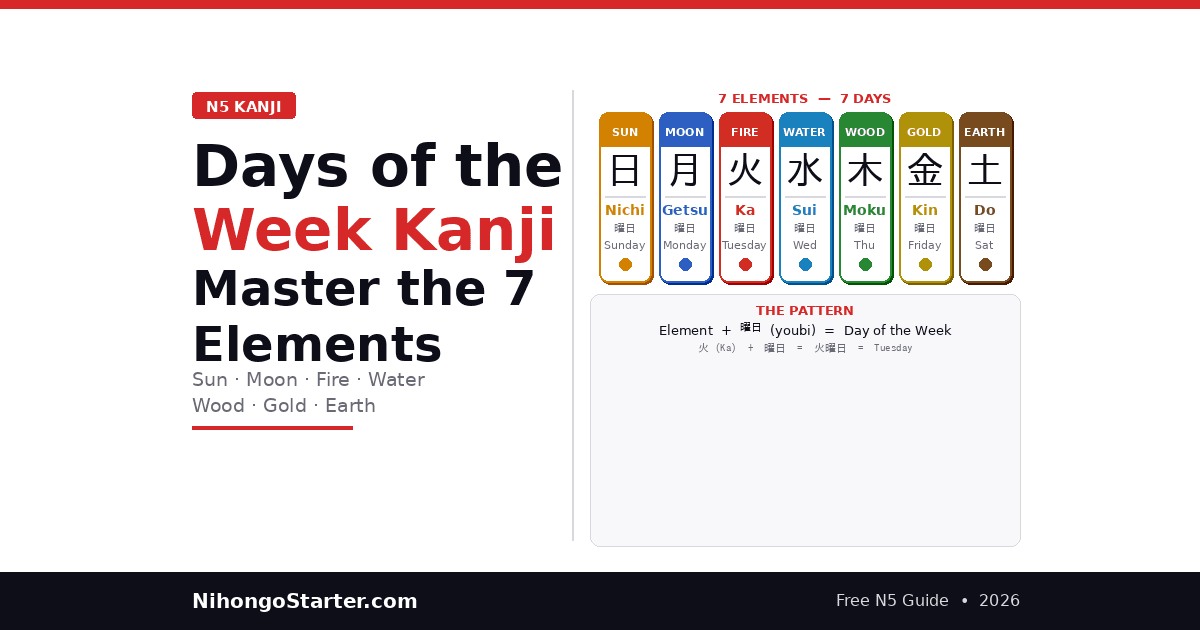
Here is the thing nobody tells you upfront: every single day of the week in Japanese is named after a natural element. Sun. Moon. Fire. Water. Wood. Gold. Earth. Seven elements, seven days, one pattern. The moment that structure clicks, the days of the week kanji go from a confusing list to a logical system you can decode — and recall — without effort.
I remember drilling 月曜日, 火曜日, 水曜日 in early 2025 during my N5 preparation and feeling like the readings were slipping through my fingers every time I stepped away from my flashcards. Then I stopped trying to memorize the words and started learning the elements behind them. Within a week, every day was locked in permanently. By the time I sat my PJC Bridge N5 equivalent exam at ISL Dhaka in June 2025, the days of the week kanji were among the easiest questions on the paper.
This guide teaches you all 7 days of the week kanji through their elements — with readings, mnemonics, and the one structural pattern that makes every single day unforgettable.
Table of Contents
The 1 Pattern Behind All Days of the Week Kanji
Before looking at each day individually, understand the structure that governs all seven.
Every day of the week in Japanese follows this exact formula:
Element Kanji + 曜日 (youbi) = Day of the Week
曜日 (youbi) simply means “day of the week.” It is the same suffix attached to all seven days without exception. This means once you know the seven element kanji — 日, 月, 火, 水, 木, 金, 土 — and the suffix 曜日, you can read and write every single day of the week in Japanese.
You are not memorizing seven unrelated words. You are learning seven element kanji plus one two-character suffix. That is eight things total — and most N5 learners already know at least four of the element kanji from their basic vocabulary study.
All 7 Days of the Week Kanji — With Elements, Readings, and Mnemonics
Here is every day broken down by its element, kanji, reading, and a memory story that makes it stick.
Sunday — 日曜日 (Nichiyoubi) — The Sun
| Kanji | Element | Onyomi | Full Word | Meaning |
|---|---|---|---|---|
| 日 | Sun (太陽) | Nichi | 日曜日 | Sunday |
Sunday is named after the sun — 日 (nichi/hi). This kanji is one of the first you ever learn in Japanese because it also means “day,” “sun,” and appears in 日本 (Japan — literally “origin of the sun”). It is a pictograph: the original form was a circle with a dot in the center representing the sun.
Memory story: The sun rises every Sunday morning. 日 is literally a picture of the sun. Nichiyoubi — Nichi-you-bi — the sun’s special day.
How it appears: 日曜日は休みです。(Nichiyoubi wa yasumi desu — Sunday is a day off.)
Monday — 月曜日 (Getsuyoubi) — The Moon
| Kanji | Element | Onyomi | Full Word | Meaning |
|---|---|---|---|---|
| 月 | Moon (月) | Getsu | 月曜日 | Monday |
Monday is named after the moon — 月 (getsu/tsuki). Like Sunday’s 日, this kanji has a pictographic origin: the crescent moon shape. 月 also means “month” in Japanese, which makes sense — the original calendar was lunar-based, so moon and month share the same character.
Memory story: Monday starts the work week — and the moon rules the night before it all begins. 月 looks like a crescent moon seen through a window frame. Getsuyoubi — Getsu-you-bi — the moon’s day.
How it appears: 月曜日から仕事があります。(Getsuyoubi kara shigoto ga arimasu — I have work from Monday.)
Tuesday — 火曜日 (Kayoubi) — Fire
| Kanji | Element | Onyomi | Full Word | Meaning |
|---|---|---|---|---|
| 火 | Fire (火) | Ka | 火曜日 | Tuesday |
Tuesday is named after fire — 火 (ka/hi). This is a kanji you likely already know from 火山 (kazan — volcano). The character itself resembles a flame: a central vertical stroke with two strokes spreading outward at the bottom like fire spreading across the ground.
Memory story: Tuesday is the day the week’s fire really starts burning — energy picks up after slow Monday. 火 looks like a flame. Kayoubi — Ka-you-bi — fire’s day. And if you already know 火山 (volcano), remember: fire under a mountain makes a volcano. Fire on its own makes Tuesday.
How it appears: 火曜日に映画を見ます。(Kayoubi ni eiga wo mimasu — I watch a movie on Tuesday.)
Wednesday — 水曜日 (Suiyoubi) — Water
| Kanji | Element | Onyomi | Full Word | Meaning |
|---|---|---|---|---|
| 水 | Water (水) | Sui | 水曜日 | Wednesday |
Wednesday is named after water — 水 (sui/mizu). The kanji 水 is a pictograph of a river: a central vertical stroke representing the main current, with two smaller strokes on each side representing the flow of water around it. You will also recognize it from 水道 (suidou — water supply) and just 水 alone meaning “water” in everyday speech.
Memory story: Wednesday is the middle of the week — like water, it flows through the center of everything. 水 looks like a flowing river. Suiyoubi — Sui-you-bi — water’s day. And Wednesday in English is named after the Norse god Woden — not water — so forget that connection entirely and just see the flowing kanji instead.
How it appears: 水曜日は忙しいです。(Suiyoubi wa isogashii desu — Wednesday is busy.)
Thursday — 木曜日 (Mokuyoubi) — Wood / Tree
| Kanji | Element | Onyomi | Full Word | Meaning |
|---|---|---|---|---|
| 木 | Wood / Tree (木) | Moku | 木曜日 | Thursday |
Thursday is named after wood and trees — 木 (moku/ki). This is one of the most recognizable kanji for beginners: it looks exactly like a tree, with a horizontal branch stroke crossing a vertical trunk, and two root strokes at the bottom. You already know 木 from vocabulary like 木の下 (ki no shita — under the tree) or compound words like 木造 (mokuzou — wooden construction).
Memory story: Thursday — the week is nearly done, like a tree that’s nearly fully grown. 木 is literally a drawing of a tree. Mokuyoubi — Moku-you-bi — the tree’s day. Stand under a 木 and wait for Friday.
How it appears: 木曜日に友達に会います。(Mokuyoubi ni tomodachi ni aimasu — I meet a friend on Thursday.)
Friday — 金曜日 (Kin’youbi) — Gold / Metal
| Kanji | Element | Onyomi | Full Word | Meaning |
|---|---|---|---|---|
| 金 | Gold / Metal (金) | Kin | 金曜日 | Friday |
Friday is named after gold and metal — 金 (kin/kane). This is a particularly satisfying connection: in Japanese, 金 means both gold and money (お金 — okane). Friday is payday in many cultures — and in Japanese, Friday is literally the golden day. The kanji 金 also appears in 金メダル (kin medaru — gold medal) and 金曜日 is consistently the most anticipated day of the week.
Memory story: Friday is the golden day — the week is done, the gold (pay) comes in, and the weekend begins. お金 and 金曜日 share the same first kanji for a reason. Kin’youbi — Kin-you-bi — gold’s day.
How it appears: 金曜日が大好きです!(Kin’youbi ga daisuki desu — I love Friday!)
Saturday — 土曜日 (Doyoubi) — Earth / Soil
| Kanji | Element | Onyomi | Full Word | Meaning |
|---|---|---|---|---|
| 土 | Earth / Soil (土) | Do | 土曜日 | Saturday |
Saturday is named after earth and soil — 土 (do/tsuchi). The kanji 土 is a simple pictograph: a cross shape representing a plant growing from the ground, or a mound of soil. It is also the earth element in the five-element system (五行 — gogyou) that the Japanese calendar days are partly based on. 土 is easy to confuse with 士 (samurai/warrior) — the difference is that 土 has the longer stroke at the bottom, like soil anchoring everything to the ground.
Memory story: Saturday is earth day — you’re finally grounded after the busy week, back to solid earth. Dig in the garden, rest on solid ground. 土 looks like a cross planted in the earth. Doyoubi — Do-you-bi — earth’s day.
How it appears: 土曜日は家でゆっくりします。(Doyoubi wa ie de yukkuri shimasu — I relax at home on Saturday.)
The Complete Days of the Week Kanji Reference Table
Here is every day in a single reference table — elements, kanji, readings, and full words — organized for easy review and study.
| Day | Kanji | Element | Onyomi | Kunyomi | Full Word | Romaji |
|---|---|---|---|---|---|---|
| Sunday | 日 | Sun | Nichi | Hi | 日曜日 | Nichiyoubi |
| Monday | 月 | Moon | Getsu | Tsuki | 月曜日 | Getsuyoubi |
| Tuesday | 火 | Fire | Ka | Hi | 火曜日 | Kayoubi |
| Wednesday | 水 | Water | Sui | Mizu | 水曜日 | Suiyoubi |
| Thursday | 木 | Wood | Moku | Ki | 木曜日 | Mokuyoubi |
| Friday | 金 | Gold | Kin | Kane | 金曜日 | Kin’youbi |
| Saturday | 土 | Earth | Do | Tsuchi | 土曜日 | Doyoubi |
Notice that every full word uses the onyomi reading of the element kanji — Ka, Sui, Moku, Kin, Do — not the kunyomi. This is the lone kanji vs compound kanji rule from the onyomi vs kunyomi guide on NihongoStarter working in action: 火 in a compound reads “ka” (onyomi), not “hi” (kunyomi).
Why the Days of the Week Use These 7 Elements
This is the “why” explanation that almost every beginner guide skips — and it’s genuinely fascinating.
The seven-element system behind the Japanese days of the week does not come from ancient Japanese culture. It came to Japan from China via India, originally through Buddhist astrological texts. The seven elements — sun (日), moon (月), fire (火), water (水), wood (木), metal/gold (金), earth (土) — correspond to the seven classical celestial bodies visible to the naked eye: the Sun, the Moon, Mars, Mercury, Jupiter, Venus, and Saturn respectively.
This is the same system that underlies the Western seven-day week. In English: Sunday (Sun), Monday (Moon), Tuesday (Tyr/Mars), Wednesday (Woden/Mercury), Thursday (Thor/Jupiter), Friday (Frigg/Venus), Saturday (Saturn). Different cultures, same celestial framework, same seven-day structure.
That connection is worth knowing because it makes the mapping between English and Japanese days feel logical rather than arbitrary. Sunday and 日曜日 are both named after the sun. Monday and 月曜日 are both named after the moon. Tuesday and 火曜日 are both named after the planet Mars — which in the Eastern system corresponds to fire. The parallel runs through all seven days.
According to the Japan Foundation’s Japanese language resources, understanding cultural and historical context behind language structures significantly improves retention — and this is a perfect example of that principle in practice.
How to Memorize the Days of the Week Kanji Fast
You have the elements. You have the readings. Now here is the practice system that locks them in permanently.
Step 1 — Learn the 7 element kanji first. If you’ve already worked through the complete N5 kanji list on NihongoStarter, you know most of these: 日, 月, 火, 水, 木, 金, 土 all appear in the core N5 kanji list. If they’re not yet solid in your memory, spend one day on just these seven before moving to the days of the week.
Step 2 — Learn 曜日 (youbi) as the fixed suffix. Write it out five times. Say it out loud. 曜日 — youbi — day of the week. This suffix never changes. Every single day of the week ends in 曜日. Once youbi is automatic, you only need to recall which element goes first.
Step 3 — Practice the element → day connection. Go through each element and say the day name out loud: Sun → 日 → Nichi → Nichiyoubi. Fire → 火 → Ka → Kayoubi. Do this in order, then in random order, until the element-to-day connection is instant in both directions.
Step 4 — Use the days in real sentences immediately. Write one sentence per day using that day of the week. What do you actually do on Mondays? What happens at school or work on Wednesdays? Attaching each day to a real personal event in your life is the fastest way to make the vocabulary genuinely yours rather than exam knowledge that fades after the test.
Step 5 — Check a Japanese calendar. Standard Japanese calendars display days of the week using the kanji — 日月火水木金土 — across the top of each week column. Looking at one of these for just five minutes after studying is worth more than another thirty minutes of flashcard drilling. You can find Japanese calendar formats easily on any Japanese website like NHK Web Easy, which uses simple Japanese and displays dates in kanji format.
Common Mistakes Beginners Make With Days of the Week Kanji
Two mistakes come up so consistently with this topic that they are worth naming directly before you encounter them yourself.
Mistake 1 — Confusing 日曜日 and 月曜日. Sunday and Monday are the two most commonly confused days in Japanese for beginners. The reason is that 日 (sun) and 月 (moon) are both extremely common kanji that look somewhat similar at a glance — particularly when reading quickly. The fix: anchor Sunday firmly as 日 = sun = the circle in the sky, and Monday as 月 = moon = the crescent. Practice those two specifically until the distinction is automatic before drilling all seven together.
Mistake 2 — Using kunyomi instead of onyomi in the day names. 火曜日 reads “Kayoubi” — not “Hi-youbi.” 水曜日 reads “Suiyoubi” — not “Mizu-youbi.” Every day of the week uses the onyomi reading of the element kanji, because 曜日 is a compound. Beginners who haven’t yet internalized the onyomi vs kunyomi rule sometimes default to the more familiar kunyomi reading and produce incorrect pronunciations. If this rule isn’t yet clear, the onyomi vs kunyomi guide on NihongoStarter explains exactly why compounds use onyomi and lone kanji use kunyomi.
FAQ
What are the days of the week kanji in order?
In order from Sunday to Saturday: 日 (Sun), 月 (Moon), 火 (Fire), 水 (Water), 木 (Wood), 金 (Gold), 土 (Earth). Each becomes a full day name by adding 曜日 (youbi): 日曜日, 月曜日, 火曜日, 水曜日, 木曜日, 金曜日, 土曜日. You can look up any of these kanji on Jisho.org to see their full reading entries with both onyomi and kunyomi clearly listed.
Do the days of the week kanji appear on the JLPT N5 exam?
Yes. The days of the week are core N5 vocabulary and appear in listening, reading comprehension, and vocabulary sections. According to the official JLPT level summary on jlpt.jp, N5 tests basic everyday vocabulary — and the days of the week are among the most fundamental. Knowing how to read and hear all seven days correctly is essential for N5 readiness.
Why does Japanese use elements for days of the week instead of planet names?
Japanese does use planet names — the element kanji and the planet names are the same system. 火 (fire) corresponds to Mars (火星 — Kasei, literally “fire star”). 水 (water) corresponds to Mercury (水星 — Suisei, “water star”). 木 (wood) corresponds to Jupiter (木星 — Mokusei, “wood star”). 金 (gold/metal) corresponds to Venus (金星 — Kinsei, “gold star”). 土 (earth) corresponds to Saturn (土星 — Dosei, “earth star”). The connection is perfect — Japanese planet names use the exact same kanji as the days of the week.
How do you write the days of the week in hiragana?
Sunday: にちようび (nichiyoubi). Monday: げつようび (getsuyoubi). Tuesday: かようび (kayoubi). Wednesday: すいようび (suiyoubi). Thursday: もくようび (mokuyoubi). Friday: きんようび (kin’youbi). Saturday: どようび (doyoubi). In everyday Japanese text, the kanji versions are used in formal writing and calendars, while hiragana versions appear in beginner materials and informal messages.
What is the kanji for “day of the week” in Japanese?
曜日 (youbi) means “day of the week.” It is the suffix added to each element kanji to form the complete day name. 曜 alone (you) refers to the day of the week in a general sense — you’ll sometimes see it abbreviated on calendars as just the element kanji without 曜日, particularly in small calendar grids where space is limited.
Seven Elements, Seven Days, Zero Guessing
The days of the week kanji are one of the most satisfying things to master in N5 Japanese — not because they’re easy, but because the moment the element framework clicks, all seven days lock in simultaneously rather than one by one.
Sun becomes Sunday. Moon becomes Monday. Fire, water, wood, gold, earth — each one drops into place as a day rather than a random Japanese word. You stop memorizing a list and start reading a system.
I still remember the first time I looked at a Japanese calendar after learning this framework and could read every column header instantly — 日, 月, 火, 水, 木, 金, 土 — left to right, like reading the natural world. That moment made the weeks of vocabulary study feel immediately worth it.
The next step in your N5 kanji journey is learning the number kanji — 一 through 十 — which appear inside the days of the week vocabulary (the month and date system), compound words you’ll encounter constantly, and the N5 reading comprehension section. The Japanese number kanji guide on NihongoStarter covers all of them with the same element-logic approach used here.