
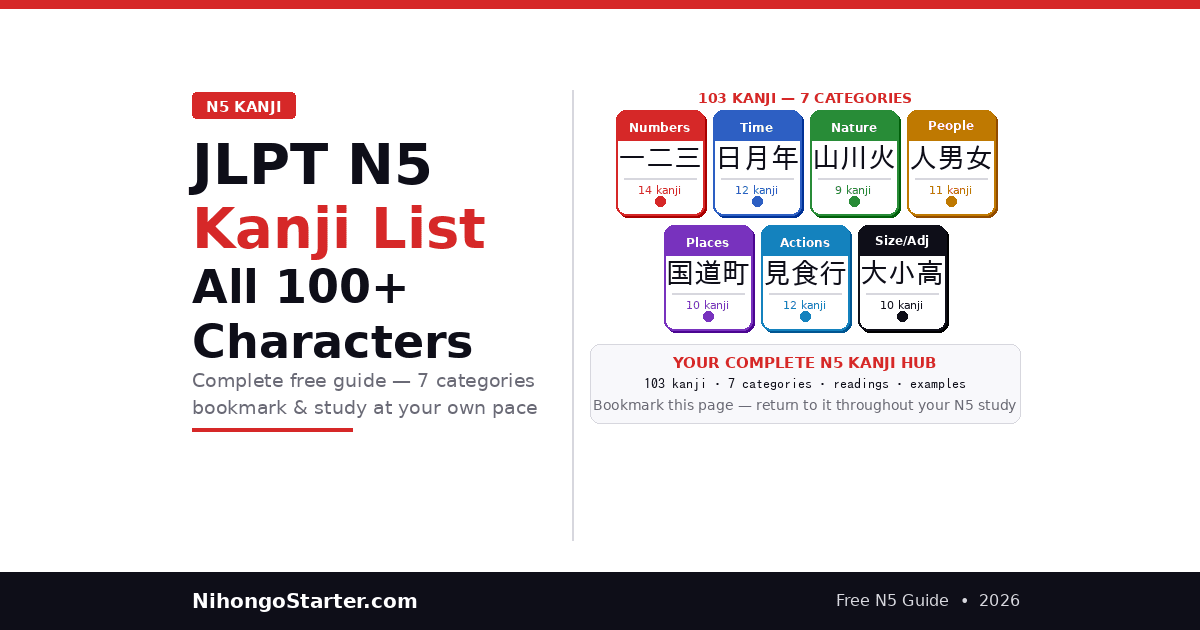

This is the page you bookmark, return to, and use throughout your entire N5 preparation.
Every N5 kanji you need is here — organized into seven logical categories, each with its onyomi reading, kunyomi reading, core meaning, and a real vocabulary example so the character never sits in isolation. Not a flat list of 103 symbols. A structured, usable reference that connects every kanji to the vocabulary, grammar, and reading comprehension you are studying at the same time.
I built this guide because when I was preparing for my PJC Bridge N5 equivalent exam at ISL Dhaka in June 2025, the resources I found online were either incomplete, randomly ordered, or so densely formatted they were unusable during actual study sessions. I passed that exam with a C+ — and then went on to pass the N4 equivalent a month later with a B+. The organized, category-based approach to kanji study was one of the key things that made both results possible. This is the reference I wish I had when I started.
The jlpt n5 kanji list here follows the official JLPT N5 content framework from jlpt.jp — approximately 103 characters covering basic everyday Japanese reading at the N5 standard.
Table of Contents
How to Use This JLPT N5 Kanji List
Before diving into the characters, here is the most effective way to use this guide depending on where you are in your N5 preparation.
If you are just starting kanji: Read through one category per study session. Do not try to learn all 103 in one sitting. One category per day — seven days, full coverage. Then return and review.
If you are mid-preparation: Use this as a gap-check. Go through each category and mark any character you cannot immediately recognize. Focus your remaining study time on those gaps rather than re-studying kanji you already know.
If you are close to your exam: Use this as a rapid-fire recognition drill. Cover the meaning column and read each kanji from left to right. If you hesitate for more than two seconds on any character, that character goes on your final review list.
For vocabulary connection: Every kanji here appears in the N5 vocabulary list. As you study each character, find it in your vocabulary materials and see it in a real word. The N5 vocabulary guides on NihongoStarter are organized to complement this kanji list directly.
One note on the count: different study sources cite slightly different numbers — you will see 100, 103, or 110 depending on the reference. The Japan Foundation does not publish a fixed official kanji list. The 103 characters in this guide are compiled from official JLPT sample questions, the standard N5 vocabulary list, and established community research. If you know all 103 characters here, you are fully covered for the N5 exam.
Category 1 — Number Kanji (14 Characters)
Number kanji are the best starting point for any N5 learner — the first three are literally drawings of the numbers they represent, and the mathematical logic of the system makes 1-99 readable with just ten characters.
| Kanji | Onyomi | Kunyomi | Meaning | Example Word |
|---|---|---|---|---|
| 一 | ichi | hitotsu | one | 一月 (ichigatsu — January) |
| 二 | ni | futatsu | two | 二人 (futari — two people) |
| 三 | san | mittsu | three | 三月 (sangatsu — March) |
| 四 | shi / yo | yottsu | four | 四月 (shigatsu — April) |
| 五 | go | itsutsu | five | 五月 (gogatsu — May) |
| 六 | roku | muttsu | six | 六月 (rokugatsu — June) |
| 七 | nana / shichi | nanatsu | seven | 七月 (shichigatsu — July) |
| 八 | hachi | yattsu | eight | 八月 (hachigatsu — August) |
| 九 | ku / kyuu | kokonotsu | nine | 九月 (kugatsu — September) |
| 十 | juu | too | ten | 十月 (juugatsu — October) |
| 百 | hyaku | — | hundred | 百円 (hyaku-en — 100 yen) |
| 千 | sen | — | thousand | 千円 (sen-en — 1,000 yen) |
| 万 | man | — | ten thousand | 一万円 (ichi-man-en — 10,000 yen) |
| 円 | en | maru | yen / circle | 百円 (hyaku-en — 100 yen) |
The complete breakdown of number kanji — including the mathematical logic for reading 11-99 — is in the Japanese number kanji 1-100 guide on NihongoStarter.
Category 2 — Time Kanji (12 Characters)
Time kanji are among the highest-frequency N5 characters. They appear in clock times, dates, days of the week, and expressions used in almost every Japanese conversation.
| Kanji | Onyomi | Kunyomi | Meaning | Example Word |
|---|---|---|---|---|
| 日 | nichi / jitsu | hi / ka | sun / day | 日曜日 (nichiyoubi — Sunday) |
| 月 | getsu / gatsu | tsuki | moon / month | 月曜日 (getsuyoubi — Monday) |
| 年 | nen / toshi | — | year | 今年 (kotoshi — this year) |
| 時 | ji | toki | time / hour | 何時 (nanji — what time) |
| 分 | fun / bun | wa | minute / part | 三分 (sanpun — three minutes) |
| 半 | han | — | half | 三時半 (sanji han — 3:30) |
| 今 | kon / kin | ima | now | 今日 (kyou — today) |
| 毎 | mai | — | every | 毎日 (mainichi — every day) |
| 週 | shuu | — | week | 今週 (konshuu — this week) |
| 午 | go | — | noon | 午前 (gozen — AM) |
| 前 | zen | mae | before / front | 午前 (gozen — morning/AM) |
| 後 | go / kou | nochi / ato | after / behind | 午後 (gogo — PM / afternoon) |
The days of the week kanji — 日, 月, 火, 水, 木, 金, 土 — are covered in full detail in the days of the week kanji guide on NihongoStarter.
Category 3 — Nature Kanji (9 Characters)
Nature kanji are often pictographic — many of them look like what they represent, making them some of the most visually memorable characters in the N5 set.
| Kanji | Onyomi | Kunyomi | Meaning | Example Word |
|---|---|---|---|---|
| 山 | san / zan | yama | mountain | 火山 (kazan — volcano) |
| 川 | sen | kawa | river | 川 (kawa — river) |
| 火 | ka | hi | fire | 火曜日 (kayoubi — Tuesday) |
| 水 | sui | mizu | water | 水道 (suidou — water supply) |
| 木 | moku / boku | ki | tree / wood | 木曜日 (mokuyoubi — Thursday) |
| 金 | kin | kane | gold / metal | 金曜日 (kin’youbi — Friday) |
| 土 | do / to | tsuchi | earth / soil | 土曜日 (doyoubi — Saturday) |
| 花 | ka | hana | flower | 花 (hana — flower) |
| 空 | kuu | sora | sky / empty | 空 (sora — sky) |
Category 4 — People Kanji (11 Characters)
People kanji are foundational for N5 grammar and vocabulary — they appear in sentence subjects, family vocabulary, and social context words that come up constantly in the listening and reading sections.
| Kanji | Onyomi | Kunyomi | Meaning | Example Word |
|---|---|---|---|---|
| 人 | jin / nin | hito | person | 人口 (jinkou — population) |
| 男 | dan | otoko | man / male | 男の人 (otoko no hito — male person) |
| 女 | jo | onna | woman / female | 女の人 (onna no hito — female person) |
| 子 | shi | ko | child | 子供 (kodomo — child) |
| 父 | fu | chichi | father | お父さん (otousan — father) |
| 母 | bo | haha | mother | お母さん (okaasan — mother) |
| 友 | yuu | tomo | friend | 友達 (tomodachi — friend) |
| 先 | sen | saki | previous / ahead | 先生 (sensei — teacher) |
| 生 | sei / shou | i / u | life / born | 学生 (gakusei — student) |
| 学 | gaku | mana | study / learn | 大学 (daigaku — university) |
| 名 | mei / myou | na | name | 名前 (namae — name) |
Category 5 — Places and Directions Kanji (10 Characters)
Direction and place kanji are tested directly in N5 listening and reading — understanding where things are and where people are going is core everyday Japanese.
| Kanji | Onyomi | Kunyomi | Meaning | Example Word |
|---|---|---|---|---|
| 国 | koku / kuni | — | country | 外国 (gaikoku — foreign country) |
| 東 | tou | higashi | east | 東京 (Tokyo — Eastern Capital) |
| 西 | sei / zai | nishi | west | 関西 (Kansai — western region) |
| 南 | nan | minami | south | 南口 (minamiguchi — south exit) |
| 北 | hoku | kita | north | 北海道 (Hokkaido) |
| 上 | jou / shou | ue / kami | above / up | 上手 (jouzu — skilled) |
| 下 | ka / ge | shita / kuda | below / down | 地下 (chika — underground) |
| 中 | chuu | naka | middle / inside | 中学校 (chuugakkou — middle school) |
| 外 | gai / ge | soto | outside | 外国人 (gaikokujin — foreigner) |
| 右 | u / yuu | migi | right | 右 (migi — right side) |
| 左 | sa | hidari | left | 左 (hidari — left side) |
Category 6 — Action Kanji (12 Characters)
Action kanji are the verbs and verb-roots of N5 vocabulary. Recognizing these characters in kanji form — alongside their hiragana verb endings — is essential for reading basic Japanese sentences.
| Kanji | Onyomi | Kunyomi | Meaning | Example Word |
|---|---|---|---|---|
| 見 | ken | mi | see / look | 見る (miru — to see) |
| 聞 | bun / mon | ki | hear / listen / ask | 聞く (kiku — to listen) |
| 話 | wa | hanashi | talk / story | 話す (hanasu — to speak) |
| 読 | doku | yo | read | 読む (yomu — to read) |
| 書 | sho | ka | write | 書く (kaku — to write) |
| 食 | shoku | ta | eat / food | 食べる (taberu — to eat) |
| 飲 | in | no | drink | 飲む (nomu — to drink) |
| 行 | kou / gyou | i / yuki | go | 行く (iku — to go) |
| 来 | rai | ku / ki | come | 来る (kuru — to come) |
| 帰 | ki | kae | return home | 帰る (kaeru — to return) |
| 出 | shutsu / sui | de / da | exit / come out | 出る (deru — to exit) |
| 入 | nyuu | hai / i | enter | 入る (hairu — to enter) |
Category 7 — Size, Quality, and Adjective Kanji (10 Characters)
These kanji form the core of N5 adjective vocabulary — they appear in both い-adjective and な-adjective forms and are used constantly in everyday descriptions.
| Kanji | Onyomi | Kunyomi | Meaning | Example Word |
|---|---|---|---|---|
| 大 | dai / tai | oo | big / large | 大きい (ookii — big) |
| 小 | shou | chii / ko | small | 小さい (chiisai — small) |
| 高 | kou | taka | high / expensive | 高い (takai — expensive/tall) |
| 安 | an | yasu | cheap / safe | 安い (yasui — cheap) |
| 新 | shin | atara | new | 新しい (atarashii — new) |
| 古 | ko | furu | old | 古い (furui — old) |
| 長 | chou | naga | long | 長い (nagai — long) |
| 白 | haku | shiro | white | 白い (shiroi — white) |
| 黒 | koku | kuro | black | 黒い (kuroi — black) |
| 赤 | seki | aka | red | 赤い (akai — red) |
Additional High-Frequency N5 Kanji (Remaining Characters)
These characters appear regularly in N5 vocabulary and reading but do not fit neatly into a single thematic category. Learn these alongside the seven main categories.
| Kanji | Onyomi | Kunyomi | Meaning | Example Word |
|---|---|---|---|---|
| 休 | kyuu | yasu | rest / break | 休む (yasumu — to rest) |
| 立 | ritsu | ta | stand | 立つ (tatsu — to stand) |
| 買 | bai | ka | buy | 買う (kau — to buy) |
| 道 | dou | michi | road / way | 道 (michi — road) |
| 田 | da / ta | ta | rice field | 田んぼ (tanbo — rice paddy) |
| 町 | chou | machi | town | 町 (machi — town) |
| 校 | kou | — | school | 学校 (gakkou — school) |
| 語 | go | kata | language / word | 日本語 (nihongo — Japanese) |
| 電 | den | — | electricity | 電車 (densha — train) |
| 車 | sha | kuruma | vehicle / car | 電車 (densha — train) |
| 駅 | eki | — | station | 駅 (eki — station) |
| 何 | ka | nani / nan | what | 何 (nani — what) |
How the N5 Kanji Connect to Grammar and Vocabulary
This is the insight most standalone kanji lists completely ignore — and it is the most important thing to understand about studying kanji at N5 level.
Every kanji in this list appears directly inside vocabulary words you are studying for N5. And those vocabulary words appear directly inside grammar patterns you are drilling for N5. The three streams are not separate subjects. They are one interconnected system.
When you learn 食 (eat), you learn 食べる (taberu — to eat). When you learn 食べる, you use it with the て-form grammar pattern: 食べて. When you read 食べてください, you now understand the complete sentence “Please eat.” Kanji → vocabulary → grammar → full sentences. The path is linear and direct.
This connection is why the how to memorize Japanese kanji fast guide on NihongoStarter recommends learning every kanji inside real vocabulary words rather than in isolation. And it is why the N5 vocabulary guides on this site are built around the same kanji categories used in this list — so your kanji study and vocabulary study reinforce each other at every step.
For verifying any reading or finding additional example sentences for any kanji in this list, Jisho.org is the most reliable free Japanese dictionary available — it shows every reading, stroke order, and vocabulary example clearly formatted.
Kanji Study Order — Recommended Sequence
Based on my own N5 preparation experience and what I have observed from the beginner Japanese learning community, here is the sequence I recommend for working through this list:
Week 1: Category 1 (Numbers) + Category 3 (Nature). The number kanji have visual logic that builds confidence immediately. The nature kanji are largely pictographic and memorable. Starting with these two categories gives you 23 kanji with the highest visual logic — the easiest possible entry point.
Week 2: Category 2 (Time) + Category 5 (Places). Time kanji appear constantly in everyday Japanese and overlap heavily with the days of the week you are already learning. Direction kanji unlock reading Japanese addresses and signage immediately.
Week 3: Category 4 (People) + Category 7 (Size/Adjectives). People kanji connect directly to family vocabulary and social expressions. Adjective kanji appear in almost every descriptive sentence in N5 reading comprehension.
Week 4: Category 6 (Actions) + Additional Characters. Action kanji are verb roots — learning them deepens your grammar recognition dramatically. The remaining characters fill in the gaps.
Week 5 onward: Review, gap-check, and integration. Use this page as your drill sheet.
FAQ
How many kanji are on the JLPT N5 list?
Approximately 103 kanji, depending on the source. The Japan Foundation does not publish a fixed official N5 kanji count — the exam tests kanji in the context of vocabulary and reading comprehension rather than as isolated characters. The number 103 is the most widely cited figure compiled from official JLPT sample materials and the standard N5 vocabulary list. If you know all the characters in this guide, you are fully prepared for N5 kanji content.
Are these kanji enough to pass the JLPT N5?
The kanji in this list cover all N5 kanji content. However, passing N5 also requires vocabulary (approximately 800 words), grammar (around 80 patterns), listening comprehension, and reading comprehension. Kanji knowledge supports all four sections — particularly vocabulary recognition and reading comprehension — but it is one component of complete N5 preparation rather than the whole picture.
In what order should I learn the N5 kanji?
By category, not by frequency or stroke count. Thematic grouping builds associative memory — when you learn mountain (山), fire (火), and water (水) together, each one reinforces the others. Learning in random or alphabetical order creates isolated memories that fade quickly. The seven-category sequence recommended in this guide is built around that principle.
Do I need to write all N5 kanji from memory?
No. The JLPT N5 tests reading recognition — identifying kanji in vocabulary and reading comprehension questions. Writing from memory is not tested. However, practicing writing is still valuable for building visual memory of each character’s structure, which makes recognition faster and more reliable. Focus on recognition first; writing practice is a bonus that strengthens recognition over time.
What is the best free resource for N5 kanji practice?
Jisho.org for reading verification, stroke order, and example sentences. NHK Web Easy for seeing N5 kanji in real, simplified Japanese news articles. And this guide — return to it regularly as a gap-check and recognition drill throughout your entire N5 preparation.
Your Complete N5 Kanji Reference
103 characters. Seven categories. Every reading. Every meaning. Every core vocabulary example.
This is the hub page — the one you return to when you want to check a reading, verify a meaning, find a vocabulary connection, or assess where your gaps are before an exam. Bookmark it now. Use it throughout your N5 preparation. Return to it after your exam as the foundation for N4.
The next step beyond this list is understanding the two reading systems behind every kanji here. If you have not yet worked through the onyomi and kunyomi guide, the onyomi vs kunyomi explained guide on NihongoStarter gives you the one rule of thumb that makes choosing the right reading almost automatic — and it applies directly to every single character in the list above.